
Gorgonia
The Righteous Gorgonia, Sister of Gregory the Theologian
Righteous · b. c. 325 — d. c. 372
Commemorated 23 February — Repose of the righteous Gorgonia
Gorgonia (c. 325 – c. 372) was the elder sister of Gregory the Theologian and the daughter of the holy parents Gregory the Elder, bishop of Nazianzus, and Nonna. A married laywoman, mother, and mistress of a household, she was honoured by the Church not for martyrdom or monastic withdrawal but as a model of Christian womanhood in the world — chaste, charitable, prayerful, and steadfast — and her memory is kept almost wholly through the funeral oration her brother preached over her, one of the most affecting portraits of a Christian woman to survive from the ancient Church. Gregory tells how she brought her husband and her whole house to baptism, how she was healed of a grievous injury and a mortal sickness by prayer at the holy altar, and how she foresaw her own falling-asleep and died in peace with a verse of the Psalms on her lips. She is commemorated on February 23.

A household of saints
Gorgonia was born about the year 325 into the Cappadocian family that the Church numbers almost entire among the saints. Her father, Gregory the Elder (commemorated January 1), a convert from the sect of the Hypsistarii, was baptised and afterwards made bishop of Nazianzus, which see he governed for some forty-five years; her mother, Nonna (commemorated August 5), was a Christian of deep and fervent piety who had drawn her husband to the faith. Gorgonia was the eldest of their three children: her brothers were Gregory the Theologian, the great orator, poet, and Archbishop of Constantinople, and Caesarius (commemorated March 9), the celebrated court physician. Gregory, who preached the funeral orations for father, mother, brother, and sister alike, has left in his Oration 8 the funeral oration on Gorgonia — the single source from which nearly everything known of her descends, and a deliberate portrait, held up for imitation, of holiness lived out in marriage and the ordinary duties of a woman's life.
The Christian wife
Gorgonia married and settled, the tradition holds, at Iconium; her husband Gregory does not name, following the reticence of the funeral oration, but records that she won him and her whole household to the faith, so that — as Paul had said of such marriages — the unbelieving husband was sanctified by the believing wife, and she "gained her own household" for God. Gregory praises her as the pattern of the married Christian woman: modest and grave in bearing, adorned not with gold or elaborate dress or the artifice of the age but, in the words of the Apostle Peter that Gregory presses into her portrait, with "the hidden man of the heart" and the "meek and quiet spirit"; a diligent mistress of her house and yet given wholly to prayer, vigil, psalmody, and the reading of Scripture; unwearied in charity to the poor, in hospitality, and in care for the suffering, so that she "lent to God" through the hands of the needy and laid up her treasure in heaven. In her, Gregory says, the two callings the world thinks opposed — the married life and the life given to God — were reconciled, and she proved that neither wedlock nor the management of a household need stand between a soul and holiness.
The two healings
Gregory dwells on two deliverances that marked her as a woman of faith and prayer.
The first was from a grievous accident: her mule-team bolted, the carriage was overturned, and she was dragged and terribly crushed — bones broken, her body mangled and her life despaired of. Out of modesty she would not expose herself to the hands of physicians, and she was healed, Gregory says, by prayer and by the mercy of God rather than by any human art, and rose again whole, to the wonder of all.
The second was from a mortal sickness, a strange burning fever that no treatment could touch. When medicine failed, Gorgonia turned to what Gregory calls "the common physician." Rising in the night, she went to the holy altar, and there, kneeling and pressing her head against it, she cried out with tears and vowed that she would not loose her hold until she was made well; and — mixing her tears with the reserved antitypes of the holy Mysteries she had kept, and anointing herself with them — she rose up healed. Gregory calls the deed a "pious and beautiful boldness," a holy theft that carried off its cure from the altar of God; it is one of the earliest and most vivid witnesses in Christian literature to lay devotion to the reserved Eucharist and to healing sought at the holy Table.
Repose
Gorgonia was granted, Gregory says, the death she had prayed for. She foresaw her own falling-asleep, set her house in order, gathered and blessed her husband and children and all her kin, and gave herself to prayer; and as her end drew near she fell to reciting the Psalms, and breathed out her soul upon the words of the Psalmist — "I will lay me down in peace, and take my rest" (Psalm 4:8) — so that her death, like her life, was an act of faith. She died, before her aged parents and before her brothers, about the year 372. Gregory buried her and preached her oration, mourning yet giving thanks, and holding her up to the Church not as one to be pitied but as one to be imitated: proof that sanctity is open to the woman in the world as fully as to the ascetic in the desert.
Feast and commemoration
Gorgonia is commemorated on February 23 (church date; Old Calendar civil March 8), the same day as the great hieromartyr Polycarp of Smyrna, whose feast leads the day; the Menaion and synaxarion list her among the day's saints, and the Greek and Slavic calendars keep her memory together with her brother's testimony. Her brother Gregory the Theologian is kept on January 25 and among the Three Hierarchs on January 30; her parents Gregory the Elder (January 1) and Nonna (August 5), and her brother Caesarius (March 9), are each commemorated on their own days, so that the whole household of Nazianzus is scattered as saints through the calendar.
Iconography
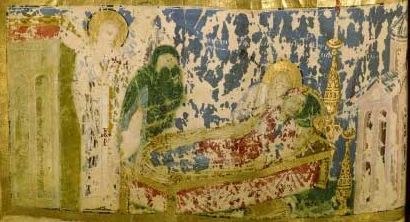
Gorgonia is depicted as a matron of the fourth century: a married laywoman in the long tunic and the maphorion (head-veil) of a Christian woman, without the attributes of a martyr or the habit of a nun, sometimes holding a cross as a confessor of the faith, and often shown in the company of her sainted family — her brother the Theologian, her parents Gregory and Nonna. The stored image is the 9th-century miniature of her death from the illustrated homilies of her brother Gregory (BnF gr. 510, fol. 43v) — among the oldest images attached to any entry in this corpus. The reproduction is small; a larger scan is listed among the upgrade-wanted icons.
Disputed questions
- The date of her baptism. Gregory's oration raises a much-discussed question: whether Gorgonia was baptised only late in life, as was common in that age of deferred baptism, and whether the "healing at the altar" preceded her baptism. Gregory speaks of her sealing herself and her whole household, and the natural reading is that she and her house were baptised together; the passage is read variously, and the tradition simply honours her as one made wholly Christ's.
- Her husband and dwelling. Gregory names neither her husband nor, with certainty, her city; the identification of her home with Iconium rests on the oration's incidental notices and later tradition. Her children and grandchildren are mentioned but not named.
- The year of her repose. No year is transmitted precisely; she died before her parents (Nonna reposed c. 374) and is conventionally placed about 372. The reference gives the date with "c."