
Nonna
The Holy and Righteous Nonna, Deaconess, mother of Gregory the Theologian
Righteous · Deaconess · b. c. 274, in Cappadocia — d. August 5, 374, at Nazianzus
Commemorated 5 August — Her repose at prayer in the church at Nazianzus
Nonna was the mother of Gregory the Theologian, and the head — under God, and by her own praying — of the most extraordinary household of saints in Christian history: she converted her pagan husband, who became bishop of Nazianzus; she bore three children, and all three are numbered among the saints; and she served the church of Nazianzus as a deaconess into extreme old age. Her son, who was the finest writer of his century, spent a great part of his verse on her, so that she is one of the very few laywomen of the fourth century whose character is known to us in detail and from the inside. She died at about a hundred years old, at prayer, in the church, before the holy table, on August 5 in the year 374, a few months after her husband.
.jpg)
Family and marriage
Nonna was a Cappadocian, born of Christian parents named Philtatios and Gorgonia, who raised her in the faith; she was thus a Christian of the third generation, at a time when that was still rare. Through her sister she was the aunt of Amphilochius of Iconium, the friend of Basil the Great and a Father of the Church in his own right — the family was already a nursery of bishops.
She married Gregory the Elder, a landowner of substance in the district of Arianzus near Nazianzus in Cappadocia. He was not a Christian. He belonged to the sect of the Hypsistarians — the "worshippers of the Most High" — a curious syncretism, described by his own son, which honoured a single supreme God and kept certain Jewish observances, the sabbath and the food laws, while rejecting circumcision, and at the same time venerated fire and lamps after the manner of the Persians. It was a religion of half-lights: neither pagan nor Jewish nor Christian, and, in Gregory the Theologian's phrase, made up of the two worst elements of each.
The conversion of her husband
Nonna would not accept it. Her son records that she made her husband's conversion the whole business of her life, and that she pursued it by every means at once: by argument and by silence, by reproach and by flattery, by fasting, by nights of prayer and tears, and above all by the sheer unanswerable spectacle of a Christian life lived beside him. She used, he says, every kind of persuasion, and would not be worn down.
The change, when it came, came in a dream. Gregory the Elder saw himself singing the words of a psalm he had never learned — I was glad when they said unto me, we will go into the house of the Lord (Ps. 121:1 LXX) — and woke with the verse and the gladness still on him. He went to the church. He was catechised and baptised; the tradition places his baptism in 325, at the hands of Leontius of Caesarea, who was then on his way to the council at Nicaea. He was afterwards ordained presbyter and then consecrated bishop of Nazianzus, a see he governed for some forty-five years until his death early in 374, at nearly a hundred years of age. Nonna, for her part, was made a deaconess of the church — the office of the older Christian women, charged with the care of the women of the congregation, the preparation of catechumens and the works of mercy.
It is a plain sequence, and it is worth stating baldly: the bishop of Nazianzus, the father of the Theologian, one of the fathers present in spirit at the Nicene settlement, was a Hypsistarian pagan whom his wife prayed into the Church.
Mother of saints
Nonna had asked God for a son and vowed him before his birth, as Hannah vowed Samuel; Gregory the Theologian records the vow himself, and records too that she carried him to the altar as a child and put the Scriptures into his hands. Her three children are all saints of the Church:
- Gorgonia (feast February 23), the eldest, a married laywoman of extraordinary charity and self-discipline, who reposed about 372 and whose funeral oration by her brother is one of the finest things he wrote;
- Gregory the Theologian (born c. 329; feasts January 25 and, among the Three Hierarchs, January 30), archbishop of Constantinople, president of the Second Ecumenical Council, and the only man besides the Evangelist John whom the Church has named "the Theologian";
- Caesarius (feast March 9), the physician of the imperial court at Constantinople, who kept his faith under Julian the Apostate and died in 368 or 369.
Nonna outlived them all but Gregory. She buried her daughter, then her son Caesarius, then her husband; and the son who remained wrote afterwards that grief never made her cry out against God, and that she never let a sound of mourning escape her before the Eucharist was offered.
Her manner of life
Gregory's portrait of his mother is exact and, for a fourth-century woman, unusually personal. She was, he says, of a piety that had no calculation in it: she gave away her substance so freely that her husband had to restrain her, and she would gladly, in her son's hyperbole, have sold herself and her children into slavery to feed the poor. She never spoke in the church, and never turned her back on the holy table. She never spat on the pavement of a church, never took the hand of a pagan woman in greeting, never ate at a pagan feast, never looked on at the public games. She kept the fasts, watched the nights in psalmody, and reverenced the priesthood in her husband as though she had had no part in making it. Her son, who knew what rhetoric was, insists that he is not exaggerating.
She was also, and this is the note that runs through all of it, relentless. The same persistence that won her husband's baptism she applied to everything: to the poor, to her children's souls, to her own body, and at last to her own death, which she is said to have asked for and been granted.
Her repose
Gregory the Elder died early in 374. Nonna survived him by only a few months. On the fifth of August of that year, being about a hundred years old, she came to the church as she always did, took her place at the holy table, and while she was praying there she gave up her spirit — dying, as her son puts it, in the very posture of her life. She was buried beside her husband at Nazianzus.
Gregory wrote a great many funeral epigrams upon her — a whole cluster of them survives in the eighth book of the Greek Anthology — and returns to her again in Oration 18, the funeral oration on his father, which is in practice as much about the mother as about the bishop. She is, in consequence, one of the best-attested laywomen of the patristic age: what the Church knows of her, it knows from a first-rate witness who lived in the house.
Feast and commemoration
August 5 (church date; Old Calendar civil August 18), the forefeast of the Transfiguration and within the Dormition fast — the anniversary of her repose at prayer in 374. The day's service belongs to the forefeast and to the martyr Eusignius, and Nonna is commemorated with a simple synaxarion notice; the Greek calendars list her as Ἁγία Νόννα, the Slavonic as праведная Нонна.
The household of Nazianzus is scattered across the year, so that the family is honoured piece by piece: Gregory the Elder on January 1, Gregory the Theologian on January 25 and January 30, Gorgonia on February 23, Caesarius on March 9, and Nonna here on August 5. She is invoked especially by wives of unbelieving husbands and by mothers praying for their children, on the plain grounds of what she accomplished.
Hymns
Apolytikion — Tone 8 (common of a righteous woman)
In thee, O mother, was the divine image preserved with exactness; for taking up thy cross, thou didst follow Christ, and by thy deeds thou didst teach us to despise the flesh, which passeth away, and to care for the soul, which is immortal. Wherefore doth thy spirit rejoice with the angels, O righteous Nonna.
Kontakion — Tone 2
By thy tears thou didst water the hard ground of thy husband's heart until it brought forth a bishop; thou didst offer thy children to God and receive them back as saints; and standing before the holy table thou didst render up thy spirit in prayer, O righteous Nonna: beseech Christ God to save our souls.
Original translation from the Greek
Iconography
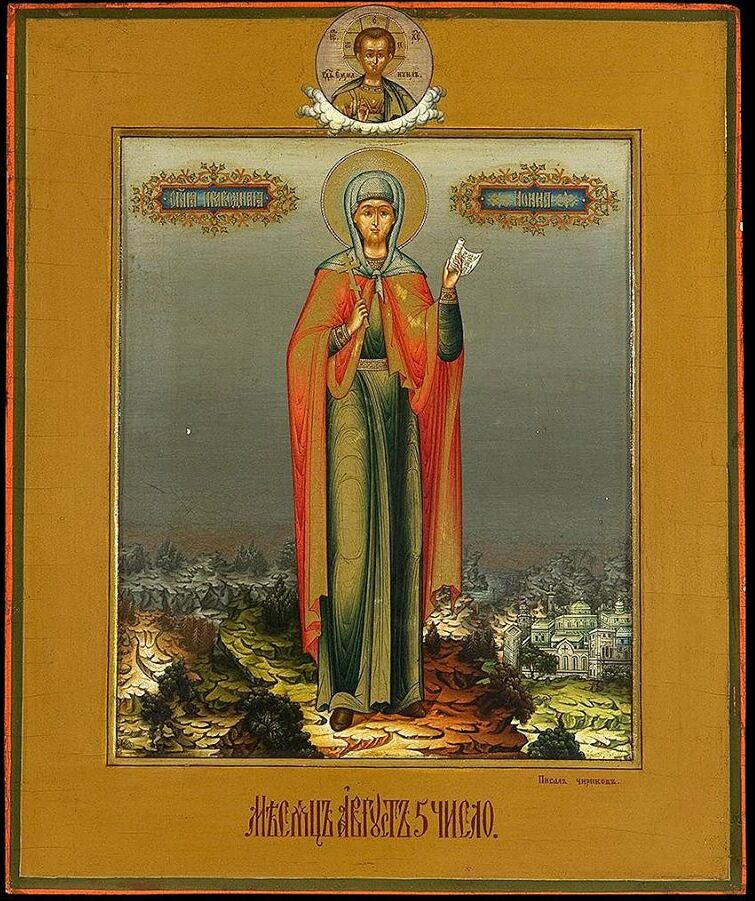
Nonna is painted as an aged matron of the fourth century, not as a nun: the long tunic and the maphorion of a Christian woman, her head covered, her right hand raised in prayer or holding a cross, her left often carrying a scroll — the scroll being the mark, in Byzantine practice, of one who taught, which in her case means the household she taught. Where the family of Nazianzus is shown together she stands beside her husband Gregory the Elder, with Gregory the Theologian, Caesarius and Gorgonia about them. In Russian usage her image is not uncommon, since Nonna remained a baptismal name.
The stored image is a nineteenth-century Russian icon signed by Osip Semyonovich Chirikov, one of the leading Moscow icon-painters of the later 1800s, made for the church of the Marble Palace in St Petersburg and now in the State Hermitage (ЭРЖ-2523; 31 × 25 cm). The saint stands full-length in a green tunic and red mantle with a white head veil, a scroll in her raised left hand, against a landscape with a monastery at the right and the Saviour "Not-made-by-hands" in a medallion above. It is inscribed on either side of the head Стая праведная Нонна ("Holy righteous Nonna") and, along the lower margin, Мѣсяцъ Августъ 5 число — "the month of August, the fifth day" — which fixes the identification beyond doubt; the painter's signature, писалъ Чириковъ, is in the lower right of the panel.
Disputed questions
- Her year of birth and her age. "About a hundred" at her death in 374 is her son's own indication and is generally accepted; the birth-year of c. 274 is a derivation from it and is given here with "c." Her husband's age at death is reported in the same round terms.
- The dates of her children's deaths. Caesarius is placed in 368 or 369 and Gorgonia about 372; some notices, including the Orthodox Church in America's, give the daughter's death in 369. The reference records the divergence and does not resolve it: Gregory himself gives no years.
- Her diaconate. That Nonna was a deaconess is the constant statement of the synaxaria. Gregory does not use the title of her in so many words; what he describes — her standing in the church, her charge over the women, her charity — is the substance of the office as it existed at Nazianzus, and the tradition has always so understood it.
- The Hypsistarians. Everything reliably known about the sect comes from Gregory's own description of his father's former religion in Oration 18, supplemented by a notice in Gregory of Nyssa. Attempts to connect it with Jewish "God-fearers", with Persian fire cult, or with a local Cappadocian syncretism all rest on that single passage.