
Gregory the Theologian
Our Father among the Saints Gregory the Theologian, Archbishop of Constantinople, Great Hierarch and Ecumenical Teacher
Bishop · b. c. 329, at Arianzus near Nazianzus in Cappadocia — d. 389 or 390, at Arianzus
Commemorated 25 January — Repose of Gregory the Theologian, 30 January — Synaxis of the Three Holy Hierarchs — Basil the Great, Gregory the Theologian, and John Chrysostom
Gregory the Theologian (c. 329 – 389/390), Gregory of Nazianzus, was Archbishop of Constantinople and — with Basil the Great and John Chrysostom — one of the Three Holy Hierarchs and Ecumenical Teachers of the Church. The most gifted orator and poet of the Cappadocian Fathers and the lifelong friend of Basil, whom he met as a student at Athens, he was drawn against his own longing for solitude into the priesthood and then the episcopate. Summoned to Constantinople in 379, when the capital had been in Arian hands for forty years, he gathered the scattered Nicene flock in the little chapel of the Anastasia and there preached the Five Theological Orations that won him alone among the Fathers, with John the Evangelist and later Symeon, the name "the Theologian." He presided for a time over the Second Ecumenical Council (Constantinople, 381), which confessed the full divinity of the Holy Spirit and gave the Creed its final form; then, weary of the intrigues of the great see, he resigned his throne in the midst of the Council and withdrew to Cappadocia, where he spent his last years in prayer, asceticism, and the writing of poems. He reposed at his family estate of Arianzus about the year 390, and is kept on January 25, and on January 30 among the Three Hierarchs.
.jpg)
Origins and early life
Gregory was born about the year 329, at the family estate of Arianzus near the small Cappadocian town of Nazianzus, into a household that the Church numbers almost entire among the saints. His father, Gregory the Elder (commemorated January 1), had been a member of the syncretistic sect of the Hypsistarii before his conversion, and was baptised and afterwards made bishop of Nazianzus, which see he governed for some forty-five years; his mother, Nonna (commemorated August 5), a Christian of deep and fervent piety, had brought her husband to the faith and dedicated her son to God before his birth, as Hannah had dedicated Samuel. Gregory was the eldest of three children: his brother Caesarius (commemorated March 9) became a celebrated physician at the imperial court in Constantinople, and his sister Gorgonia (commemorated February 23) a model of the married Christian woman; both predeceased him, and he preached the funeral orations that are our chief memorial of them. He counted his birth into such a family the first of God's mercies to him, and repaid it in the verses of his old age, in which the whole household — father, mother, brother, sister — passes before us as in no other family record of the ancient Church.
The boy was given, like Basil, the fullest education the age could offer. He studied first at Caesarea in Cappadocia — where he first met Basil — then at Caesarea in Palestine, and at Alexandria, the second school of the world; and finally, about 348, he came to Athens, still the crown of Hellenic learning, where he remained some ten years, first as student and then as teacher of rhetoric. A famous story of his voyage there tells how the ship was caught in a great storm off Cyprus and Gregory, still unbaptised, feared to die without the seal of Christ, and vowed himself wholly to God if he were spared; the storm passed, and he never forgot the vow.
Athens and the friendship with Basil
It was at Athens that Gregory sealed the friendship that runs through the whole of his life and is one of the great friendships of Christian history: with Basil the Great, the future archbishop of Caesarea. Gregory has left the classic account of it in the funeral oration he later delivered for Basil — how, in the raucous and faction-ridden student city, he took the newcomer Basil under his protection, how the two of them "knew only two streets, the one to the church and the one to the schools," how they were of one soul in two bodies, sharing every study and every hope, and how each spurred the other toward God and toward learning, "not envying, but making each other's excellence his own." Among their fellow-students was the young Julian, the emperor's cousin and the future Apostate; Gregory claims to have read even then the ruin of the Church in the restless movements of his face. Gregory outstayed Basil at Athens by a little, holding a chair of rhetoric, before he too tore himself away, about 358, and came home to Cappadocia.
Baptism, the flight to Pontus, and ordination
At Nazianzus Gregory received Baptism, and his heart was set on the monastic and contemplative life, the "philosophy" of stillness and prayer that he desired above every other good and that he would mourn losing all his days. He went to join Basil in his monastic retreat on the river Iris in Pontus, and there, in the years around 358–359, the two friends passed some of the happiest days of Gregory's life — in prayer, fasting, manual labour, and study — and together compiled the Philocalia, an anthology of the writings of Origen, and worked at the ordering of the common life for which Basil composed his Rules.
But Gregory was drawn back to Nazianzus to help his aged father, and there, at the Nativity of 361 or 362, the old bishop, without warning and against his son's will, ordained him priest before the people. Gregory received the laying-on of hands as an act of "tyranny" over his freedom, and in the first shock of it fled back to Basil in Pontus; then, mastering himself, he returned to Nazianzus for Pascha and preached the first of his surviving orations, and afterwards composed the great Oration 2, the Apologia de fuga ("On his Flight"), the classic treatise of the Eastern Church on the fearful dignity and burden of the priesthood, the care of souls as "the art of arts and the science of sciences" — a work that Chrysostom's On the Priesthood and Gregory the Dialogist's Pastoral Rule would take up after him.
The wound of Sasima
The most painful episode of Gregory's life came at the hands of the friend he loved best. When the emperor Valens in 372 divided Cappadocia into two provinces, weakening Basil's authority as metropolitan of Caesarea, Basil moved to fill the new sees with bishops he could trust, and — to multiply the suffragans of his throne against a rival metropolitan — he consecrated Gregory bishop of Sasima, a wretched, dusty little post-station at a crossroads, without water, without grace, "a thoroughfare," Gregory wrote bitterly, of dust and noise and passing wagons. Gregory felt himself used as a pawn in Basil's ecclesiastical politics; he never took possession of the see, never (by his own account) so much as performed a liturgy there, and the wound to the friendship never quite closed, though he loved Basil to the end and crowned him in death with the noblest of all his orations. For a time he assisted his father at Nazianzus instead, and on the old man's death (about 374) administered that see too, but steadily refused to be made its bishop, and withdrew for a season into solitude at Seleucia in Isauria, mourning by now the deaths of Basil (379) and of the whole elder generation of his house.
Constantinople and the little church of the Anastasia
Gregory's hour came out of his retirement. For some forty years the great see of Constantinople had been held by Arians, and the tiny Nicene remnant of the capital was without a shepherd and almost without a church. In the winter of 379, at the invitation of the orthodox of the city and with the changing of the times — Valens was dead, and the Nicene Theodosius had come to the throne of the East — Gregory came to Constantinople to gather the scattered flock. He was given the use of a private house belonging to his kinsmen, which he turned into a chapel and named the Anastasia, "the Resurrection," in hope of the raising-up of the orthodox faith in the city; and there, in that small room, he preached the sermons that made him immortal.
The summit of them is the series of Five Theological Orations (Orations 27–31), delivered in the Anastasia in 380 against the Eunomians (the neo-Arians, who denied the Son's equality with the Father) and the Macedonians or Pneumatomachi ("Spirit-fighters," who denied the divinity of the Holy Spirit). In them Gregory set out with unmatched precision and beauty the Church's confession of the Holy Trinity — one Godhead in three Persons, the Father unbegotten, the Son begotten, the Spirit proceeding, distinguished by these relations of origin and in all else one and equal — and pressed home, more boldly than Basil had thought prudent, the full and coequal divinity of the Holy Spirit, which he did not hesitate to name outright as God. It is for these Orations, above all, that a later age gave him the title borne before him only by John the Evangelist and after him only by Symeon the New Theologian: "the Theologian" (ὁ Θεολόγος) — not in the modern sense of one learned in religion, but in the ancient sense of one who speaks rightly of God himself, of the inner life of the Trinity.
The days of the Anastasia were days of struggle. Gregory was stoned by Arian mobs, slandered, and harassed; an assassin sent against him repented and confessed at his feet; and a certain Maximus the Cynic, an ambitious philosopher whom Gregory had befriended, intrigued to have himself secretly consecrated bishop of the capital in Gregory's place, a betrayal that wounded him deeply. Yet the little church filled and overflowed, the orthodox took heart, and when Theodosius entered Constantinople in 380 and expelled the Arian bishop Demophilus, he installed Gregory in the great church of the Holy Apostles, and then in Hagia Sophia, as the shepherd of the now-restored Nicene capital.
The Second Ecumenical Council and the resignation
In 381 Theodosius summoned to Constantinople the council that the Church numbers as the Second Ecumenical Council — 150 fathers of the East — to set the seal on the Nicene faith, to condemn the Macedonian denial of the Spirit, and to give the Church her Creed in its finished form, the Nicene-Constantinopolitan Creed confessed to this day, with its article on the Holy Spirit, "the Lord, the Giver of life… who with the Father and the Son together is worshipped and glorified." The Council confirmed Gregory as lawful Archbishop of Constantinople, and on the death of its first president, Meletius of Antioch, Gregory presided over its deliberations.
But his presidency was short and unhappy. When Gregory sought to heal the Meletian schism of Antioch by yielding the succession there to the rival party for the sake of peace, the Egyptian and Macedonian bishops turned against him; and his enemies revived against him the old canon of Nicaea forbidding the translation of a bishop from one see to another, on the ground that he was already bishop of Sasima and could not lawfully hold Constantinople. Gregory, who had never desired the throne and was sick in body and sick at heart of the "war of bishops" — "like jackdaws," he wrote, "like a swarm of wasps" — would not fight for it. In a moving farewell he offered himself, like Jonah, to be cast into the sea to still the storm: "If I am the cause of the tempest, take me and cast me forth… make me your Jonah." He resigned the see in the midst of the Council, took his leave of Constantinople and of Hagia Sophia in the great valedictory Oration 42, and departed for Cappadocia, never to return.
Retirement, repose, and the poems
Gregory administered the church of Nazianzus a little longer, until a bishop could be found for it, and then withdrew for good to the quiet of his family estate at Arianzus. There, in retirement and often in ill health, he gave his last years to prayer, to asceticism, and to poetry — some seventeen thousand lines of it, dogmatic, moral, and personal: hymns to God, verses against the vanity of the world, and above all the long autobiographical poem De vita sua ("Concerning his own life"), one of the earliest and most searching spiritual autobiographies in Christian literature, in which he lays bare his loves, his wounds, his flight from office, and his longing for stillness with a candour unmatched in the Fathers. He reposed at Arianzus about the year 389 or 390, and was buried there; the Church keeps his memory on January 25.
Relics and translations
Gregory was buried at Nazianzus, and his relics were later carried to Constantinople — the tenth-century tradition ascribes the translation to the emperor Constantine VII Porphyrogennetos (r. 913–959) — and laid in the church of the Holy Apostles, where they rested beside those of John Chrysostom from the tenth century until the Fourth Crusade. After the Latin sack of Constantinople in 1204 the relics of both hierarchs were taken to Rome, where they were honoured for eight centuries in Saint Peter's Basilica. On November 27, 2004, in a gesture toward the healing of the ancient rift between the Churches, Pope John Paul II returned the relics of Gregory the Theologian and of John Chrysostom to the Ecumenical Patriarchate; they are now enshrined in the Patriarchal Cathedral of Saint George at the Phanar in Constantinople. No separate fixed-date feast of the translation of Gregory's relics is universally kept in the Byzantine calendar — unlike the January 27 translation of Chrysostom — and this reference records the history in prose rather than as a ranked feast.
Veneration and later cultus
Gregory's authority as a father and teacher was supreme almost from his death. The later Church numbered him among the very greatest of the hierarchs, and from the eleventh century his memory was joined to those of Basil the Great and John Chrysostom in the common feast of the Three Holy Hierarchs (January 30), established at Constantinople about the year 1100 under the emperor Alexius I Comnenus to still a dispute over which of the three was the greatest — the three appearing, the tradition says, to Bishop John Mauropous of Euchaita to declare themselves equal before God. Uniquely among the Eastern Fathers, Gregory bears the title "the Theologian"; his Orations were quoted in the Church as second in authority almost to Scripture, were commented on by generations of Byzantine scholars, and furnished much of the language of the later councils and of the liturgical poetry of the Church. His works were translated early into Latin, Syriac, Armenian, Georgian, Slavonic, and Arabic, and no Greek Father save Chrysostom survives in so many manuscripts.
Hymnographic and literary legacy
Gregory left a body of writing of the first order in three kinds. His Orations (forty-five survive) range from the Five Theological Orations and the great festal sermons — on Pascha, on Pentecost, on the Nativity and the Theophany, sermons whose opening lines ("Christ is born, give glory; Christ from heaven, go to meet him") passed into the very hymns of the feasts — to the invectives against Julian the Apostate and the funeral orations for Basil, for his father, his brother Caesarius, and his sister Gorgonia. His Letters, carefully collected by himself, are models of the epistolary art and a chief source for the history of his age and of the Cappadocian circle; the three great doctrinal letters to the priest Cledonius, against Apollinaris — who had denied that Christ took a human mind — contain the famous axiom of the Incarnation, "that which is not assumed is not healed" (τὸ γὰρ ἀπρόσληπτον, ἀθεράπευτον), a cornerstone of Orthodox Christology. And his Poems, alone among the Fathers in their bulk and quality, made him the model of Christian verse for the Byzantine world.
Three things above all are Gregory's gift to Orthodox theology. The first is the finished doctrine of the Trinity — the clear confession of three coequal Persons distinguished only by the relations of origin, and of the Holy Spirit as fully God, worshipped and glorified with the Father and the Son. The second is the axiom of salvation through assumption — that the Son of God took upon himself the whole of human nature, body and rational soul, precisely that the whole might be healed and deified. The third is his teaching, against the presumption of Eunomius, on the incomprehensibility of God: that God's existence may be known from his works but his essence is beyond every mind, and that theology is done not by clever argument but in purity and awe, on the mountain of prayer where Moses entered the cloud — "it is only permitted to the pure to touch the pure."
Feast and commemoration
Gregory is kept universally on January 25 (church date; Old Calendar civil February 7), the traditional day of his repose. The Antiochian, Greek, and Slavic calendars agree on the day; the Roman Catholic Church, which venerates him as a Doctor of the Church, keeps him (with Basil) on January 2. On January 30 (Old Calendar civil February 12) he is honoured among the Three Holy Hierarchs with Basil the Great and John Chrysostom; that feast, established at Constantinople in the eleventh century, has its own file, Synaxis of the Three Holy Hierarchs, and Gregory's part in it is only noted here. His feast falls a little before the Three Hierarchs and, in years when the Sunday of Zacchaeus or the beginning of the Triodion approaches, may coincide with the first stirrings of the pre-Lenten season.
Hymns
Troparion — Tone 1
The shepherd's pipe of thy theology overcame the trumpets of the orators; for as thou didst search out the depths of the Spirit, so too were the beauties of eloquence added unto thee. Wherefore, O Father Gregory, intercede with Christ our God, that our souls may be saved.
Original translation from the Greek
Kontakion — Tone 3
With thy theologian's tongue, O glorious one, thou didst unravel the tangled webs of the orators, and didst array the Church in the garment of Orthodoxy, woven from on high; and clothed in it she cries aloud with us, thy children: Rejoice, O Father, thou loftiest mind of theology.
Original translation from the Greek
Appointed readings
Epistle — 1 Corinthians 12:7–11 (his proper, per the OCA lectionary, 2026; the hierarch common Hebrews 7:26–8:2 had stood here before the proper was verified)
7But the manifestation of the Spirit is given to every man to profit withal. 8For to one is given by the Spirit the word of wisdom; to another the word of knowledge by the same Spirit; 9To another faith by the same Spirit; to another the gifts of healing by the same Spirit; 10To another the working of miracles; to another prophecy; to another discerning of spirits; to another divers kinds of tongues; to another the interpretation of tongues: 11But all these worketh that one and the selfsame Spirit, dividing to every man severally as he will.
Gospel — John 10:9–16
9I am the door: by me if any man enter in, he shall be saved, and shall go in and out, and find pasture. 10The thief cometh not, but for to steal, and to kill, and to destroy: I am come that they might have life, and that they might have it more abundantly. 11I am the good shepherd: the good shepherd giveth his life for the sheep. 12But he that is an hireling, and not the shepherd, whose own the sheep are not, seeth the wolf coming, and leaveth the sheep, and fleeth: and the wolf catcheth them, and scattereth the sheep. 13The hireling fleeth, because he is an hireling, and careth not for the sheep. 14I am the good shepherd, and know my sheep, and am known of mine. 15As the Father knoweth me, even so know I the Father: and I lay down my life for the sheep. 16And other sheep I have, which are not of this fold: them also I must bring, and they shall hear my voice; and there shall be one fold, and one shepherd.
Iconography
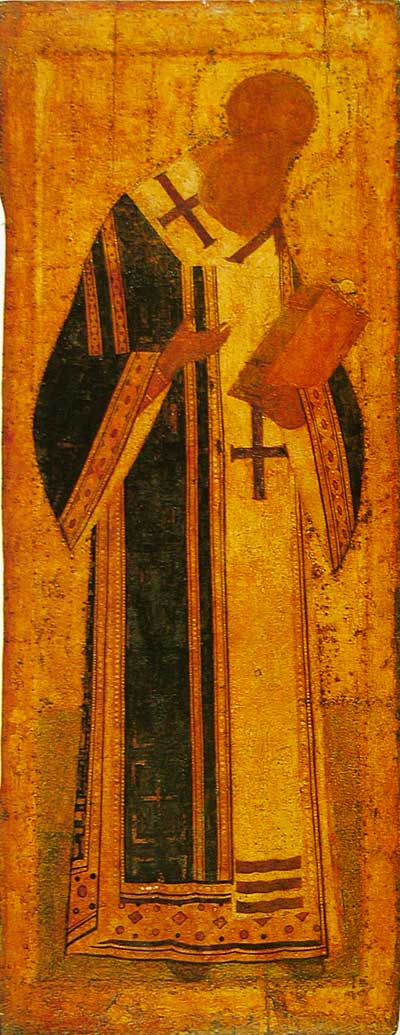
Gregory is depicted as an aged hierarch of grave and gentle aspect: a high, broad, often balding forehead — the mark of the thinker — and a full, rounded, greying or white beard, shorter and broader than the long tapering beard of Basil and distinct from the dark forked beard of John Chrysostom. He is vested as a bishop in the phelonion or the cross-figured polystavrion and the omophorion, holds the Gospel-book and blesses, or bears a scroll inscribed with the opening of one of his festal orations — most often "Χριστὸς γεννᾶται, δοξάσατε" ("Christ is born, give glory"). In the composed portraits of the Three Hierarchs he stands at the viewer's right of the central Chrysostom, balancing Basil; the two Gregorys — the Theologian and of Nyssa — are told apart in the icon chiefly by their setting and inscriptions rather than by face.
The stored image is a Russian icon of the 1420s (Moscow school), a three-quarter figure of the sort set in the deisis tier of the iconostasis: Gregory vested in the cross-marked phelonion and omophorion, blessing and holding the Gospel-book, his high forehead and full grey beard the fixed marks of his type.
Disputed questions
- The year of his repose. Gregory's death is placed by the sources in 389 or 390; this reference gives both. His birth is reckoned about 329, so that he died at about sixty.
- The name "Nazianzen." Gregory was never, strictly, bishop of Nazianzus — the see was his father's, and he only administered it — but of Sasima (which he never occupied) and then of Constantinople (which he resigned). The Church nevertheless knows him by his native town as "Gregory of Nazianzus," or by his title as "Gregory the Theologian," rather than by either of his sees.
- Not to be confused with the other Gregorys of the calendar. This Gregory — the Theologian, of Nazianzus, Archbishop of Constantinople, kept January 25 and among the Three Hierarchs on January 30 — is above all distinct from his friend and fellow-Cappadocian Gregory of Nyssa (Basil's brother, kept January 10), with whom he shares an age, a name, a cause, and a circle, and with whom he is most often confused: the two are told apart in the tradition by their sees — Nazianzus (this Gregory, the orator and poet) and Nyssa (the speculative theologian of the infinite God). He is also distinct from his own father Gregory the Elder, bishop of Nazianzus (kept January 1); from Gregory the Wonderworker of Neocaesarea (third century, November 17); from Gregory the Illuminator of Armenia (September 30); from Gregory Palamas of Thessalonica (fourteenth century, November 14 and the Second Sunday of Lent); Gregory of Sinai; and from the several later Gregorys — of Agrigentum, of the Decapolis, of Crete, of Omirits, and the Dialogist, Pope of Rome (March 12).