
Gregory the Wonderworker
Our Father among the Saints Gregory the Wonderworker, Bishop of Neocaesarea
Bishop · Wonderworker · b. c. 213 — d. c. 270
Commemorated 17 November — Repose
Gregory the Wonderworker (c. 213 – c. 270), bishop of Neocaesarea in Pontus, was the great missionary hierarch of third-century Asia Minor and the most celebrated miracle-worker of the ante-Nicene Church, whose very epithet — Thaumaturgus, "the Wonderworker" — became his name. A pagan lawyer converted under Origen at Caesarea, he returned to his native city as its first bishop and, by preaching and by an unbroken chain of miracles, all but converted the whole region: tradition holds that he found seventeen Christians in Neocaesarea and left only seventeen pagans at his death. To him belongs the first recorded apparition of the Theotokos, who appeared with John the Theologian to give him a creed of the Holy Trinity, and the famous wonders of the moved mountain and the dried marsh.

Origins and early life
Gregory was born about the year 213 into a prominent and wealthy pagan family of Neocaesarea, the chief city of Pontus Polemoniacus in northern Asia Minor. His given name was Theodore ("gift of God"); the name Gregory he received later, most likely at his baptism or consecration. He lost his father at fourteen, an event he later described as the beginning of his turning toward the one God. He received the thorough literary and rhetorical education of a young man of his class and was intended for the law, the surest road to public honour.
With his brother Athenodorus he set out for Berytus (Beirut), then the foremost school of Roman law in the East, to complete his studies. The journey was diverted by providence: escorting their sister, who was travelling to join her husband on the staff of the governor of Palestine, the brothers came to Caesarea Maritima, and there Gregory encountered the priest and teacher Origen, who had lately established his school in the city. The meeting decided his life. Origen, discerning the youth's gifts, drew him first into philosophy and then to the Gospel; Gregory abandoned the law, and for some five to eight years (c. 233–238) he sat at Origen's feet, was catechised, and was baptised by him. His parting Address of Thanksgiving to Origen — a panegyric delivered on leaving the school — survives, and is both a moving tribute to his master's method and one of the earliest first-person accounts of a Christian education.
Ministry
Returning to Neocaesarea, Gregory withdrew at first into solitude, fleeing the public offices that his fellow citizens pressed upon him, and gave himself to prayer, in which he received the gifts of insight and prophecy. But Phaedimus, bishop of Amasea, resolved to make him bishop of Neocaesarea, where the Christians were a mere handful. Gregory hid from the messengers sent to find him; whereupon Phaedimus, in an act the tradition treats as guided by God, consecrated him bishop in absentia, ordaining him across the intervening distance and praying that the Lord would ratify the unusual rite. Gregory submitted, taking the deed as the manifest will of God, and only afterward, the sources say, received the outward laying-on of hands and the canonical degrees in order. So he came to a see with, by the famous reckoning, only seventeen Christians in it.
His episcopate — some thirty years — transformed Pontus. He preached with a directness and power that the crowds could follow; he healed the sick, settled quarrels, cast out demons, and drew pagans by the thousands. Understanding the attachment of the country people to their festivals, he established annual commemorations of the martyrs with the joy and gathering the old feasts had supplied, weaning the region from idolatry by giving it a Christian calendar of its own — a pastoral strategy noted already by his biographer Gregory of Nyssa. By the end of his life the proportions were reversed: only seventeen pagans, it was said, remained in the city.
The vision of the Theotokos and the Creed
The defining event of his interior life, recorded by Gregory of Nyssa, came early. Troubled by the heresies then unsettling the doctrine of the Trinity — the modalism of Sabellius and, in the next generation, the teaching of Paul of Samosata — Gregory prayed for light. In the night the Apostle John the Theologian appeared to him in the vesture of a bishop, and with him, radiant as the sun, the Most Holy Theotokos, who bade the Apostle teach her servant the true confession of God. John then delivered to Gregory a short symbol of the faith, exact and complete, on the Father, the Son, and the Holy Spirit — one Godhead in three perfect Persons. Gregory wrote it down. This is the first apparition of the Mother of God recorded in Christian tradition, and the creed he set down survived: Gregory of Nyssa saw the autograph still preserved at Neocaesarea in his own day, and its precise Trinitarian language was honoured by Basil the Great, Gregory the Theologian, and Gregory of Nyssa as an inheritance from the Wonderworker.
Miracles and traditions
The wonders attributed to Gregory were so many that his epithet displaced his name. The most celebrated pair concerns the founding of the Church and the government of nature. Needing ground for a church, he is said to have commanded a projecting mountain to withdraw and make room for the foundations, and it moved — a deed to which the tradition attached the Lord's promise about faith that moves mountains. Two brothers who had inherited a lake and could not divide it were on the point of open battle; Gregory prayed through the night on its shore, and by morning the lake had drained away to a stream whose bed marked the boundary between them. He is said also to have curbed the flooding of the river Lycus by planting his staff on the bank, where it grew into a tree that held the waters back.
Journeying to his city after his consecration, he sheltered in a pagan temple and by his prayer drove out the demons that had given its oracles; the frightened priest, when Gregory at his request wrote a note commanding the demons to return, was converted, and became a witness to the moving of a great stone at the saint's word. During the persecution of Decius (249–251) Gregory led his flock into the hills rather than provoke a martyrdom he did not seek, and when soldiers, informed of his hiding place, combed the mountain, they passed the bishop and his deacon again and again without seeing them, taking the two figures at prayer for a pair of trees; the informer, amazed, repented and became a Christian. His counsel and even his written word were held to carry authority at a distance, and the faithful believed him present in spirit where his letters went.
Repose
Gregory returned to Neocaesarea after the persecution and continued his labours into old age. Feeling his end near, he asked how many unbelievers were left in the city, and hearing that there were seventeen — the number of the Christians he had found there at his coming — he gave thanks that the count had been so exactly reversed, and reposed in peace about the year 270. He was buried in Neocaesarea, and his memory was kept there with especial love; Basil the Great, whose grandmother Macrina the Elder had been formed in the Christianity Gregory planted, calls him "the great Gregory" and ranks his authority in Pontus with that of the Apostles.
Hymnographic and literary legacy
A body of genuine works survives under Gregory's name and makes him an important witness to pre-Nicene theology: the Address of Thanksgiving to Origen; the credal Exposition of the Faith (the symbol received in the vision); the Canonical Epistle, which legislates for the discipline of Christians who had lapsed or profited during the Gothic raids on Pontus, and which entered the canon law of the Church; the Metaphrase of Ecclesiastes; and the treatise To Theopompus, on the Impassibility and Passibility of God, preserved in Syriac. Basil the Great in his On the Holy Spirit appeals to Gregory's memory and usage as a standard of orthodoxy, and calls him a "second Moses," the epithet the hymns of his feast take up.
Feast and commemoration
November 17 (church date; Old Calendar civil November 30), the day of his repose, kept universally in the Byzantine rite, within the Nativity Fast. The Greek and Slavic Menaia appoint him the principal service of the day, with proper apolytikion and kontakion; he is commemorated together with the venerable Nikon of Radonezh, Lazarus the Iconographer of Constantinople, and (in Greek usage) the Patriarchs Gennadius and Maximus of Constantinople.
Hymns
Troparion — Tone 8
Vigilant in prayers and steadfast in the works of wonders, thou didst take thy very name from thy deeds; therefore intercede with Christ our God, O Father Gregory, to enlighten our souls, that we may never sleep unto death.
Original translation from the Greek
Kontakion — Tone 2
Having received the power to work wonders, by fearful signs thou didst put the demons to flight and drive away the diseases of men, O all-wise Gregory; wherefore thou art named the Wonderworker, having taken thy title from thy deeds.
Original translation from the Greek
Appointed readings
Epistle — Hebrews 7:26–8:2
26For such an high priest became us, who is holy, harmless, undefiled, separate from sinners, and made higher than the heavens; 27Who needeth not daily, as those high priests, to offer up sacrifice, first for his own sins, and then for the people’s: for this he did once, when he offered up himself. 28For the law maketh men high priests which have infirmity; but the word of the oath, which was since the law, maketh the Son, who is consecrated for evermore. 1Now of the things which we have spoken this is the sum: We have such an high priest, who is set on the right hand of the throne of the Majesty in the heavens; 2A minister of the sanctuary, and of the true tabernacle, which the Lord pitched, and not man.
Gospel — John 10:9–16
9I am the door: by me if any man enter in, he shall be saved, and shall go in and out, and find pasture. 10The thief cometh not, but for to steal, and to kill, and to destroy: I am come that they might have life, and that they might have it more abundantly. 11I am the good shepherd: the good shepherd giveth his life for the sheep. 12But he that is an hireling, and not the shepherd, whose own the sheep are not, seeth the wolf coming, and leaveth the sheep, and fleeth: and the wolf catcheth them, and scattereth the sheep. 13The hireling fleeth, because he is an hireling, and careth not for the sheep. 14I am the good shepherd, and know my sheep, and am known of mine. 15As the Father knoweth me, even so know I the Father: and I lay down my life for the sheep. 16And other sheep I have, which are not of this fold: them also I must bring, and they shall hear my voice; and there shall be one fold, and one shepherd.
Iconography
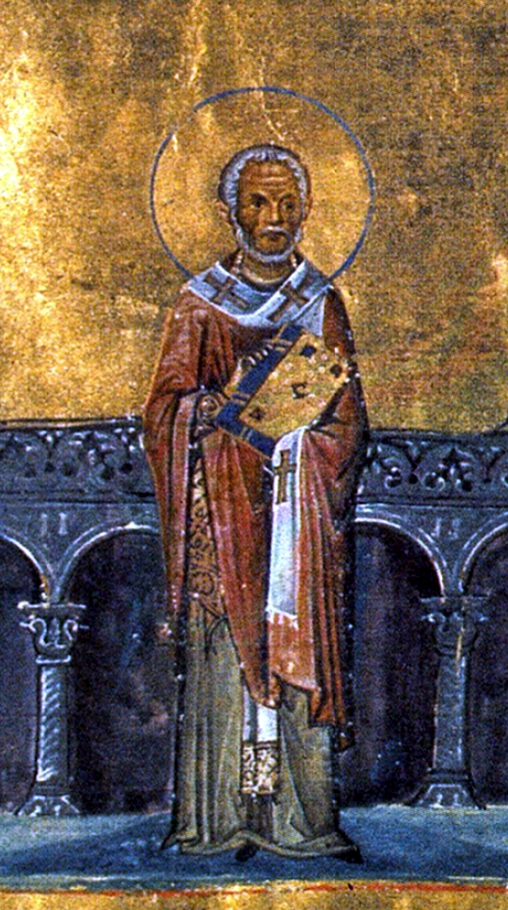
Gregory is shown as a bishop of venerable age: a high, balding forehead, a short rounded beard, in the phelonion and omophorion of a hierarch, blessing with the right hand and holding the Gospel book in the left. He is sometimes depicted with a scroll, or in scenes of his wonders — the moving mountain behind him, or receiving the creed from the Apostle John while the Theotokos looks on. The stored image is the standing portrait from the Menologion of Basil II (Constantinople, c. 1000), in which the saint is set within an architectural niche against a gold ground.
Disputed questions
- Dates. The year of birth is placed about 213 (some sources 210–215) and the repose about 270 (occasionally given as late as 275); neither is fixed precisely. His name at birth was Theodore.
- The autograph creed. Gregory of Nyssa reports the credal text still preserved at Neocaesarea in the later fourth century; some modern scholars have questioned whether the surviving form is verbatim as Gregory wrote it, but its early currency and its use by the Cappadocians are not in doubt.
- Brother Athenodorus. Gregory's brother Athenodorus, his companion at Origen's school and later a bishop, is commemorated in Greek usage on November 7 (so a footnote of the OCA synaxarion); the two are not to be conflated.
- Not to be confused with the other saints named Gregory: Gregory the Illuminator of Armenia (equal-to-the-apostles, September 30); Gregory Palamas, archbishop of Thessalonica (November 14 and the Second Sunday of Lent); Gregory the Theologian of Nazianzus; Gregory of Nyssa (his biographer, January 10); and Gregory the Dialogist of Rome. The Wonderworker is the third-century bishop of Neocaesarea in Pontus.