
Haggai the Prophet
The Holy Prophet Haggai
Prophet · b. 6th century BC, Babylon (by tradition) — d. after 520 BC
Commemorated 16 December
Haggai was the tenth of the Twelve Minor Prophets and, with Zechariah, the prophet of the return from Babylon: in the second year of the Persian king Darius (520 BC) his short book records four dated oracles urging the discouraged remnant to rebuild the Temple of the Lord, which had lain in ruins since its destruction by Nebuchadnezzar. His preaching roused Zerubbabel the governor and Joshua the high priest to resume the work, and his central promise — that the glory of this second house would surpass the first, and that in it "the Desire of all nations" would come — the Church reads as a prophecy of Christ, who entered that very Temple. He is commemorated on December 16, in the weeks of the Nativity Fast that look toward the Lord's coming.
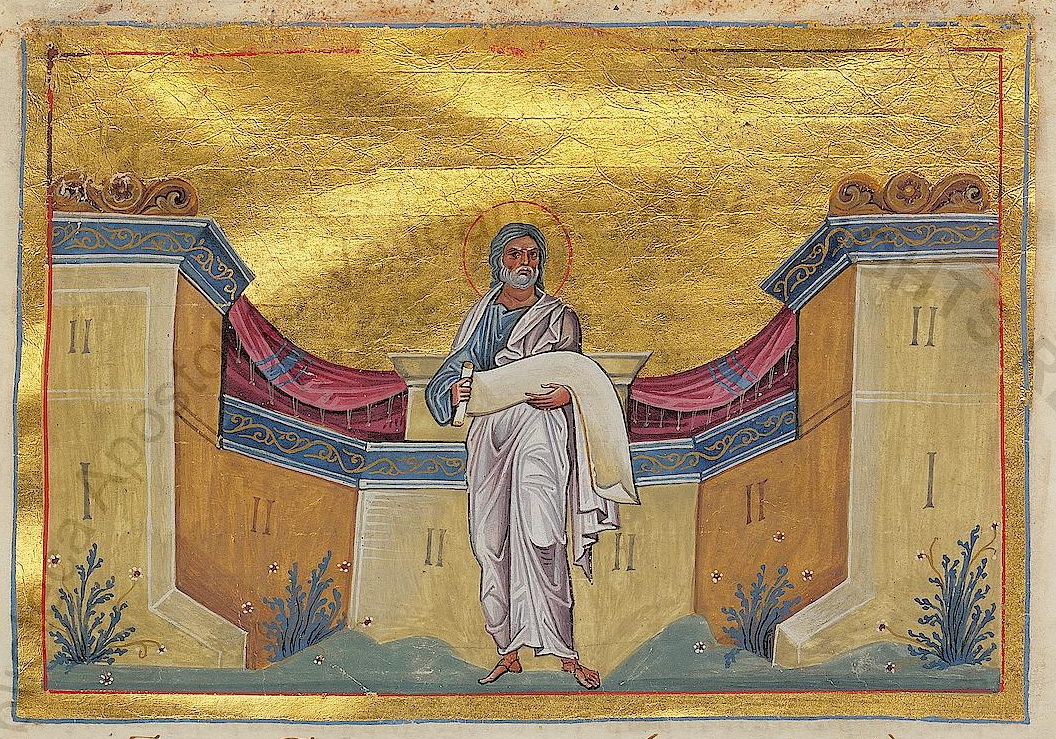
.jpg)
Time and setting
Haggai (Hebrew Ḥaggay, "festal," from ḥag, feast) prophesied in Jerusalem in the reign of the Persian king Darius I Hystaspes, and his oracles are among the most precisely dated in all the prophets: the book fixes each to the day and month of Darius's second year — 520 BC. He belongs, therefore, to the generation of the Return, when Cyrus's decree of 538 BC had permitted the exiles to go up from Babylon under Zerubbabel of the house of David and Joshua (Jeshua) son of Jozadak the high priest. The Byzantine synaxaria and the tradition following the pseudo-Epiphanian Lives of the Prophets hold that Haggai was born in Babylon during the Captivity, came up to Jerusalem as a young man with the first returning company, and was of priestly, Levitical descent — so that he was buried, they say, among the priests. Some notices add that he was the first after the exile to sing the "Alleluia" in the rebuilt sanctuary.
The oracles of the Temple
The remnant had laid the Temple's foundation soon after their return, but under the hostility of the surrounding peoples and the hardness of the years the work had stalled for some sixteen years; the people said, "The time is not come, the time that the Lord's house should be built" (Haggai 1:2), and busied themselves instead with their own "panelled houses." Into that discouragement Haggai's word fell. His first oracle (the first day of the sixth month) rebukes the misplaced priorities directly: "Ye have sown much, and bring in little… and he that earneth wages earneth wages to put it into a bag with holes" — because the house of God lies waste. "Consider your ways," he cries, twice; "Go up to the mountain, and bring wood, and build the house." The word took hold: within three weeks Zerubbabel, Joshua and "all the remnant of the people" set to work on the house of the Lord (Haggai 1:12–15).
His second oracle (the twenty-first of the seventh month) answers the grief of the old men who had seen the first Temple's splendour and wept at the poverty of the new (cf. Ezra 3:12): "Who is left among you that saw this house in her first glory? and how do ye see it now? is it not in your eyes in comparison of it as nothing?" To them comes the great consolation — "Be strong… and work: for I am with you, saith the Lord of hosts" — and the promise the Church has never ceased to read of Christ: "I will shake all nations, and the Desire of all nations shall come: and I will fill this house with glory… The glory of this latter house shall be greater than of the former… and in this place will I give peace" (Haggai 2:6–9).
The third oracle (the twenty-fourth of the ninth month) is a priestly parable of holiness and defilement — that the people's uncleanness had made even their offerings unclean — turning on the promise that from the day the Temple's rebuilding was truly taken in hand, "from this day will I bless you." The fourth, of the same day, is addressed to Zerubbabel alone: in the shaking of thrones and kingdoms the Lord will make him "as a signet," his chosen — a Davidic oracle the tradition reads toward the Messiah who would spring from Zerubbabel's line (cf. Matthew 1:12–13).
Repose
The Temple whose rebuilding Haggai urged was finished in the sixth year of Darius (516/515 BC), and the prophet, having seen the walls rise, reposed in peace not long after; the tradition places his death in Jerusalem and his burial among the priests, in his own Levitical portion. His book — two short chapters, the second shortest of the prophets after Obadiah — stands tenth among the Twelve in the Hebrew and Greek order alike.
Feast and commemoration
Haggai is commemorated on December 16 (church date; Old Calendar civil December 29) throughout the Orthodox calendars — Greek, Slavic, Antiochian and OCA use alike — always as the day's chief commemoration. His feast falls in the Nativity Fast, among the Old Testament forefeasts of the Incarnation, and stands close to those of his fellow minor prophets of the closing weeks of the church year — Nahum (Dec 1), Habakkuk (Dec 2) and Zephaniah (Dec 3) — and of Daniel and the Three Youths who close the fast on Dec 17.
Hymns
Troparion — Tone 2
Celebrating the memory of thy prophet Haggai, O Lord, through him we entreat thee: save our souls.
Original translation from the Greek
Kontakion — Tone 4
Enlightened by the Spirit, thy pure heart became a most radiant vessel of prophecy: for thou seest things far off as though near at hand. Therefore we all faithfully honour thee, O blessed and glorious prophet Haggai.
Original translation from the Greek
Iconography
Haggai is depicted in the manner of the prophets: an elderly man with a long grey beard, in tunic and mantle, holding a scroll — often inscribed with a word of his oracle — his right hand raised in address. He stands in the prophet-rows of iconostases and in the domes and drums of Byzantine and Russian churches among the Twelve. The stored image is the miniature of the Menologion of Basil II (Constantinople, c. 985), which gives the prophet standing full-length with his scroll.
Disputed questions
- "The Desire of all nations." The Hebrew of Haggai 2:7 (ḥemdath kol-haggoyim) is grammatically difficult and has been rendered both as a singular — "the Desire (or Desired One) of all nations shall come," the reading of the Vulgate and of the whole messianic tradition — and as a plural, "the treasures of all nations shall come in." The Septuagint, the Church's text, paraphrases: "the choice things of all the nations shall come." The Fathers read the verse of Christ, the true glory that filled the second Temple.
- Priestly descent and burial. That Haggai was of the tribe of Levi and buried among the priests is the received hagiographic tradition (the Lives of the Prophets, the synaxaria), not a datum of his book, which says nothing of his lineage.