
Synaxis of the Three Holy Hierarchs
The Synaxis of our Holy Fathers and Great Hierarchs and Ecumenical Teachers Basil the Great, Gregory the Theologian, and John Chrysostom
On January 30 the Church keeps the common feast of the three great hierarchs and ecumenical teachers — Basil the Great, Archbishop of Caesarea; Gregory the Theologian, Archbishop of Constantinople; and John Chrysostom, Archbishop of Constantinople — each of whom is also honoured on his own day earlier in the same month. The feast was created at Constantinople in the eleventh century to end a popular quarrel over which of the three was the greatest: the tradition relates that the three appeared together to John Mavropous, Bishop of Euchaita, and declared that they are equal before God, with no rivalry among them, and bade him gather their contending devotees into a single service. It is at once a confession that the Church's teaching is one — the three, for all their differences of gift and temper, taught one Trinity and one Gospel — and the patronal feast of Christian learning, kept in the Greek world as the festival of letters and of schools. This file treats the synaxis itself; the full Lives of the three teachers are given in their own entries and are not repeated here.
The three teachers
The feast gathers into one day the three men whom the Byzantine Church set above all other bishops as her "ecumenical teachers" (οἰκουμενικοὶ διδάσκαλοι) — the teachers of the whole inhabited world. Each already possessed a feast of the first rank, and each falls in January, so that the month came to be crowned by their common commemoration:
- Basil the Great (c. 330–379), Archbishop of Caesarea in Cappadocia, kept on January 1 — the lawgiver of Eastern monasticism, the builder of the Basiliad, the defender of the Nicene faith against Valens and of the divinity of the Holy Spirit against the Pneumatomachi, and the author of the longer of the two Liturgies that bear the hierarchs' names. His full Life is at Basil the Great.
- Gregory the Theologian (c. 329–389/390), of Nazianzus, Archbishop of Constantinople, kept on January 25 — Basil's lifelong friend from their student years at Athens, the orator and poet who preached the Five Theological Orations in the little church of the Anastasia and won, almost alone among the Fathers, the name "the Theologian." His full Life is at Gregory the Theologian.
- John Chrysostom (c. 347–407), the golden-mouthed preacher of Antioch and Archbishop of Constantinople, whose principal feast is November 13 (his repose, transferred off the Elevation of the Cross) and whose translation of relics is kept on January 27 — the greatest preacher the Church has known, the fullest of her scriptural expositors, the pastor hounded to death in exile, and the author of the Liturgy served on the greater part of the year's days. His full Life is at John Chrysostom.
Two of the three are Cappadocians and lifelong friends; the third is an Antiochene and a generation younger, formed in the exegetical school of Antioch. Basil is the man of order and government, Gregory the contemplative poet drawn against his will into the fray, John the tireless pastor and preacher. The feast does not flatten these differences: it confesses that from three such different men — the ascetic bishop, the reluctant theologian, and the golden-mouthed shepherd — one and the same faith was taught.
The dispute at Constantinople and the vision of John Mavropous
The occasion of the feast was a quarrel of devotion. By the eleventh century the veneration of the three hierarchs had hardened, in Constantinople, into rival partisanships: the faithful and the learned divided into "Basilians," "Gregorians," and "Johannites," each party exalting its own hierarch above the other two and disparaging the rest. Some urged the austere grandeur and philosophical depth of Basil; some the sublimity and poetic fire of Gregory the Theologian; some the eloquence, the accessibility, and the boundless charity of Chrysostom. The dispute, trivial in appearance, touched something real — the temptation to set the Church's teachers against one another, as though the truth were the property of a school.
The tradition relates that the strife was ended by the hierarchs themselves. About the year 1084, in the reign of the emperor Alexius I Comnenus, the three appeared — together, and then to him alone — to John Mavropous (Ἰωάννης ὁ Μαυρόπους), the learned metropolitan of Euchaita in Pontus. They told him that they were equal in the sight of God: "There is among us no first and no second; if you call upon one, the other two are present with him. We are one in God, and we contend for nothing but that the strife over us should cease." They asked that a single feast be appointed for the three of them in common, that their divided admirers might be reconciled. Mavropous accordingly set their joint commemoration on January 30, gathering the three whose separate feasts fall earlier in the month, and composed the proper service — the office, the canons, and the hymns — with such skill and beauty that it has been sung ever since. The date is not the day of any of their deaths but a day chosen to bind their three January feasts together and to seal the peace of the Church. (Some sources place the institution "a little before 1100," the vision itself about 1084; the two datings refer to the same act under Alexius Comnenus.)
The theology of the common feast
The feast's meaning is drawn out of its origin. What the three hierarchs declared to Mavropous — we are equal, and we are one — is a confession about the Church's teaching office itself. The Church does not rank her Fathers as the schools rank their masters, one truth against another; the three great teachers, for all the difference of their gifts, taught one faith: one Holy Trinity, one Godhead in three coequal Persons; one incarnate Lord, true God and true man; one Gospel of repentance, mercy to the poor, and the life of prayer. To exalt one teacher by disparaging another is to treat the truth as a party possession; the feast confesses instead that the truth is one and its teachers are its servants, "not lords over the faith, but helpers of joy." The hymns of the day return again and again to this unity in number three — the three teachers of the one Trinity, the "three-sunned" Godhead confessed by three mouths, the threefold cord not quickly broken.
From this the feast took on two enduring characters. The first is as the festival of Orthodox teaching and unity — a yearly keeping of the Church's confession that her doctrine is one and catholic, guarded by the consent of her Fathers and not by the victory of a school. The second, flowing from the first, is as the patronal feast of Christian learning. Because the three hierarchs were the supreme examples of sacred and secular wisdom joined — men who had drunk the full draught of Hellenic education (Basil and Gregory at Athens, John under Libanius at Antioch) and turned all of it to the service of the Gospel — the Church made their common day the feast of letters. In the Greek world January 30 is kept as the festival of Greek Letters and of education (ἡ ἑορτὴ τῶν Γραμμάτων), the patronal day of schools, universities, teachers, and students, on which the three appear as the patrons of the sanctified mind: the proof that learning need not be the enemy of faith, but may be its handmaid and its ornament.
John Mavropous the hymnographer
The feast is inseparable from the man who composed it. John Mavropous (c. 1000 – after 1075/81) was one of the most cultivated churchmen of eleventh-century Byzantium: a teacher of rhetoric and philosophy at Constantinople, the master and friend of the historian and polymath Michael Psellos, and the author of a large body of epigrams, letters, orations, canons, and saints' Lives. Late in life, and somewhat against his will, he was made metropolitan of Euchaita, a provincial see in Pontus far from the capital he loved. To him the tradition ascribes not only the establishment of the feast but its poetry — the three canons of the day and its proper hymns are expressly given to his hand, and the service he wrote is a small masterpiece of Byzantine hymnography, balancing the praise of the three so evenly that no one of them is set above the others. Mavropous is remembered for one epigram above all, addressed to Christ on behalf of the pagan sages he could not bring himself to condemn — a prayer that, "if thou wouldst save any of the heathen, save for my sake Plato and Plutarch" — which shows the very temper the feast honours: the Christian learning that could love what was good in the wisdom of the Greeks while giving all worship to Christ alone. He is himself commemorated in some Greek calendars (October 5).
Feast and commemoration
January 30 (church date; New Calendar civil January 30; Old Calendar civil February 12). The feast is kept universally throughout the Byzantine rite — Antiochian, Greek, Slavic, and OCA calendars agree on the day — with a full festal service of the three hierarchs: Great Vespers with proper stichera and readings, a festal Matins with the three canons of John Mavropous, and the Divine Liturgy, at which the hierarchs' own propers are sung. It ranks among the great hierarch-feasts of the fixed year. The three teachers keep their separate principal days as well — Basil on January 1, Gregory on January 25, John on November 13, with the translation of John's relics on January 27 — so that the common feast neither replaces nor competes with the individual commemorations but crowns them. In the Greek world the day carries besides its liturgical rank the civil and academic character of the feast of Letters, with school and university observances; in the Slavic Churches it is kept as the Sobor (Synaxis) of the three great hierarchs and, in the Russian academic tradition, likewise honoured as a patronal feast of theological schools. The Roman Catholic Church, which venerates all three as Doctors of the Church, keeps them on separate days (Basil with Gregory on January 2, John on September 13) and has no equivalent common feast.
Taxonomy flag — feast_type. The controlled feast_type vocabulary of PRD
§5.3 (indiction | theotokos-synaxis | icon-of-the-theotokos | angelic | dominical | theotokian | dedication | deliverance) has **no genericsynaxis
value**, and no term that fits a synaxis of named saints. Every synaxis in the
list is typed by its honoree — the angelic synaxes as angelic, the Marian
synaxes as theotokos-synaxis — and none of these is the Three Hierarchs. This
feast is a saint-synaxis: a commemoration that gathers three saints (each with
his own feast) into a single service. Following the precedent set for the
Synaxis of the Forerunner, theotokos-synaxis
is chosen here as the nearest existing "synaxis" term, though its name wrongly
implies the Theotokos as subject; no new term is minted. Unlike the Forerunner
and Theotokos synaxes, this is not a morrow-of-a-Great-Feast synaxis but a
free-standing commemoration of a group of saints, which makes the mismatch
sharper still. The gap is flagged for a deliberate decision: either generalise
theotokos-synaxis to a subject-neutral synaxis, or add a sibling term
(e.g. saint-synaxis). See the project's record of open questions (large synaxis commemorations)
and §10 (the missing generic synaxis value). A related gap is noted at
the project's record of open questions: the three teachers' own category — "Great Hierarch and
Ecumenical Teacher" — has no term in TAXONOMY.md either, and the three are typed
bishop alone in their entries, which is the very distinction this feast is built
upon.
This is one of the few feasts/ files whose subjects already possess full saint files. The Lives of the three hierarchs are not duplicated here: each of Basil the Great, Gregory the Theologian, and John Chrysostom already carries the January 30 synaxis in his own feasts: list (rank synaxis), and this file supplies the synaxis's own account, propers, and icon.
Hymns
Troparion — Tone 1
The three greatest luminaries of the triple-sunned Godhead, who with the beams of their divine teachings have set the whole world ablaze; the honey-flowing rivers of wisdom, who have watered all creation with the streams of the knowledge of God — Basil the Great, and Gregory the Theologian, together with the renowned John of the golden-flowing tongue: come, let all we who love their words be gathered together and honour them with hymns; for they ever intercede before the Trinity on our behalf.
Original translation from the Greek
Kontakion — Tone 2
The sacred and God-proclaiming heralds, the very crown of teachers, thou hast taken to thyself, O Lord, unto the enjoyment of thy good things and unto rest; for thou didst receive their labours and their toil as more than every whole-burnt offering, O thou who alone dost glorify thy saints.
Original translation from the Greek
Appointed readings
Epistle — Hebrews 13:7–16
7Remember them which have the rule over you, who have spoken unto you the word of God: whose faith follow, considering the end of their conversation. 8Jesus Christ the same yesterday, and to day, and for ever. 9Be not carried about with divers and strange doctrines. For it is a good thing that the heart be established with grace; not with meats, which have not profited them that have been occupied therein. 10We have an altar, whereof they have no right to eat which serve the tabernacle. 11For the bodies of those beasts, whose blood is brought into the sanctuary by the high priest for sin, are burned without the camp. 12Wherefore Jesus also, that he might sanctify the people with his own blood, suffered without the gate. 13Let us go forth therefore unto him without the camp, bearing his reproach. 14For here have we no continuing city, but we seek one to come. 15By him therefore let us offer the sacrifice of praise to God continually, that is, the fruit of our lips giving thanks to his name. 16But to do good and to communicate forget not: for with such sacrifices God is well pleased.
Gospel — Matthew 5:14–19
14Ye are the light of the world. A city that is set on an hill cannot be hid. 15Neither do men light a candle, and put it under a bushel, but on a candlestick; and it giveth light unto all that are in the house. 16Let your light so shine before men, that they may see your good works, and glorify your Father which is in heaven. 17Think not that I am come to destroy the law, or the prophets: I am not come to destroy, but to fulfil. 18For verily I say unto you, Till heaven and earth pass, one jot or one tittle shall in no wise pass from the law, till all be fulfilled. 19Whosoever therefore shall break one of these least commandments, and shall teach men so, he shall be called the least in the kingdom of heaven: but whosoever shall do and teach them, the same shall be called great in the kingdom of heaven.
Iconography
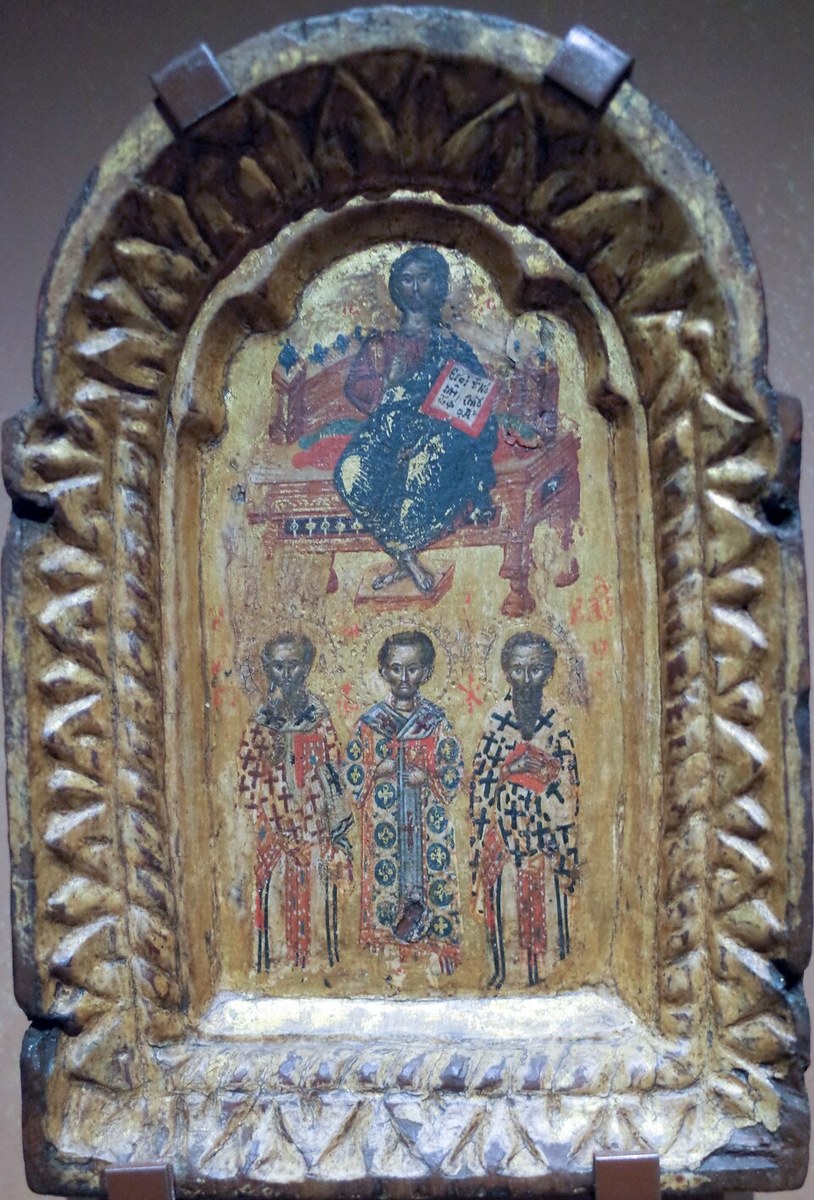
The proper icon of the feast shows the three hierarchs standing together, vested as bishops and named by inscription, most often in a row of three (or two flanking a central figure) and frequently beneath the blessing Christ enthroned above. Each keeps his fixed portrait type, so that the three are told apart at a glance: Basil the Great tall and lean, with a long, narrow, dark tapering beard and a high thinker's brow; Gregory the Theologian with a fuller, rounded, greying beard and a broad balding forehead; John Chrysostom lean and short-bearded, with hollow ascetic cheeks and a high domed head. All three wear the phelonion or the cross-figured polystavrion and the omophorion, hold the Gospel-book or a scroll, and raise the right hand in blessing; in many examples each bears a scroll inscribed with a line of his own — a phrase of Basil's Liturgy, Gregory's "Christ is born, give glory," a sentence of Chrysostom's preaching. A distinct and very ancient arrangement sets the three, with the other great liturgists, concelebrating about the altar in the sanctuary of a church, where the historical teachers become the eternal ministers of the Church's worship. Because the three each have well-fixed individual icons, the composition depends for its meaning on their togetherness: it is the pictured form of the feast's confession that the three are one and equal.
The stored image is a seventeenth-century Greek icon (tempera on wood; Museum of Byzantine Culture, Thessaloniki) of the type "Christ enthroned and the three hierarchs": the blessing Christ enthroned above, and below him the three great teachers standing side by side in episcopal vestments, each named and each keeping his portrait type — the visual statement of the January 30 feast. (A distinct Novgorod icon of the Three Holy Hierarchs, late fifteenth century, is stored with the entry of John Chrysostom; a separate image is kept here so that the feast file carries an icon of its own.)