
Andrew of Crete the Martyr
The Holy Venerable-Martyr Andrew of Crete, called "of Krisis"
Venerable Martyr · Martyr · d. 767
Commemorated 17 October
Andrew of Crete (†767), called "of Krisis" after the quarter of Constantinople where his relics came to rest, was a Cretan monk who gave his life for the holy icons under the iconoclast emperor Constantine V Copronymus. Hearing that the emperor was imprisoning the pious as if they were criminals, he came to the capital and denounced the persecutor to his face in the church of the martyr Mamas, answering the charge of wood-worship with the confession that whoever suffers for the icon of Christ suffers for Christ himself. Scourged and dragged through the streets to execution, he died when a fanatic cut off his foot. He is not to be confused with his earlier namesake, Andrew of Crete the hymnographer of the Great Canon (†740, July 4).
_-_October_-_32_-_Andrew_of_Crete_(d._767).jpg)
A monk of Crete in the age of iconoclasm
Andrew was born and tonsured on the island of Crete, and there pursued the ascetic life — the hymns of his feast remember him "trained first in asceticism on the mountain," destroying the invisible arrays of the demons with the armour of the Cross before ever he faced a visible persecutor. His manhood fell in the reign of Constantine V (741–775), son of Leo the Isaurian, whom posterity nicknamed Kopronymos — the most determined iconoclast of all the emperors. After the council he convened at Hieria in 754 had condemned the making and veneration of icons, Constantine turned decree into persecution: icons were effaced or burned, and the monks — the stubborn backbone of icon-veneration — were mocked, mutilated, exiled, and killed. The synaxaria of this era fill with the monastic confessors and martyrs of his reign: Stephen the Younger (November 28), Peter the Stylite, Paul of Crete, and Andrew.
The confession in the church of Saint Mamas
What drew Andrew from Crete to the capital, the tradition says, was the report that the emperor was casting virtuous and pious Christians into prison in the place of thieves and robbers — that piety itself had become the crime. He found Constantine at the church of the great-martyr Mamas in Constantinople, and there, before the whole assembly, rebuked him openly as a persecutor of Christ in his members and in his image. To the emperor's defence — that it is folly to give veneration to wood and paint — the monk made the answer that is the whole theology of the icon in one sentence: whoever suffers for the holy icons suffers for Christ, and whoever insults the icon on which Christ is depicted offers the insult to Christ himself.
The enraged emperor had him seized on the spot. Andrew was beaten without mercy, imprisoned, and tortured; the hymnography adds that he was rolled and dragged over the ground until the way was, in the words of his sticheron, "made smooth" by his body — another precious stone, not shattered by the blows but levelling the road of the faith and overturning the "rotten foundation" of Copronymus's doctrine. Finally he was dragged through the streets toward the place of execution; and as he was dragged, one of the mob — the tradition says a fish-seller, a partisan of the emperor's heresy — cut off his foot with a knife (the Greek synaxarion's distich knows the detail exactly: "Cut off, Andrew, in one of thy two feet, thou completest the course of thy contest"). Of this wound the martyr died, in the year 767, released by death from his torments. His body, the accounts say, was cast out with the corpses of criminals; the faithful recovered it and buried it at a place in the city called Krisis (ἡ Κρίσις), where in later times a monastery of Saint Andrew stood — and from that resting-place the martyr took the epithet the Greek books use of him to this day, "Andrew in Krisei," which conveniently distinguishes him from his great hymnographer namesake.
Veneration and later cultus
At his tomb in the Krisis quarter healings were worked; the tradition particularly credits the martyr with healing those afflicted with seizures and demonic torment, and his kontakion sings of Constantinople keeping radiant festival as the possessor of "a great treasure, thy much-suffering body." A century after his death, Joseph the Hymnographer (†886, April 4) composed a canon in his honour, in Tone 2, with the acrostic "With longing I hymn the namesake of courage" — playing, as the whole service plays, on the meaning of the name Andreas, "manly." The site of the Krisis monastery in Constantinople is commonly identified with the church that survives, much rebuilt, as the Koca Mustafa Pasha mosque (the former monastery of Saint Andrew in Krisei).
Feast and commemoration
October 17 on the church calendar (Old Calendar civil October 30), kept jointly with the prophet Hosea: the received Greek Menaion provides one service for the two, the martyr's stichera in Tone 4 and his canon by Joseph the Hymnographer in Tone 2, with the kontakion in Tone 3 after the sixth ode. The day is shared with the unmercenaries Cosmas and Damian of Arabia and the translation of the relics of Lazarus of the Four Days.
Hymns
Troparion — Tone 4
Trained first in asceticism upon the mountain, with the whole armour of the Cross thou didst destroy the spiritual arrays of the enemy, O all-blessed one; and again thou didst manfully strip for the contest of martyrdom, slaying Copronymus with the sword of faith; and for both struggles thou hast been crowned by God, O venerable-martyr Andrew, ever-memorable.
Original translation from the Greek
Kontakion — Tone 3
The Imperial City keepeth festival today, the most radiant feast of thy light-bearing memory, and calleth every city and country to it; for she rejoiceth as one possessing a great treasure, thy much-suffering body, O martyr Andrew, beacon of Orthodoxy.
Original translation from the Greek
Iconography
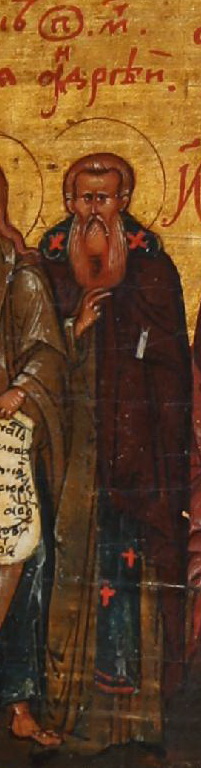
Andrew is painted as a monk: aged, with a long pointed beard, in mantle and monastic habit, his right hand raised in blessing or holding the martyr's cross — the standard type for a venerable-martyr, distinguished from his hymnographer namesake, who bears a bishop's vestments. He appears chiefly in calendar (menaion) icons and menologion cycles under October 17. The stored image is his figure from a Central-Russian menaion icon for October of the first quarter of the seventeenth century (Church-Archaeological Cabinet of the Moscow Theological Academy), inscribed "venerable-martyr Andrew"; it is a narrow crop of low resolution, and a finer pre-modern image of this Andrew — ideally the Menologion of Basil II miniature of his martyrdom — is wanted as an upgrade.
Disputed questions
- Not to be confused with the hymnographer. The calendar knows two famous Andrews of Crete: this venerable-martyr (†767, October 17), a simple monk who died under the iconoclasts; and Andrew of Crete the hymnographer (†740, July 4), archbishop of Gortyna, author of the Great Canon read in Lent. The two lived a generation apart and died a generation apart; the confusion is ancient and constant because both were Cretans, monastics, and contemporaries of the first iconoclasm. In this repository the plain slug andrew-of-crete is reserved for the hymnographer, whose entry carries the reciprocal caution. The confusion runs in one direction in particular: it is this Andrew, the monk, who denounced an iconoclast emperor to his face, and popular accounts that credit the hymnographer with resisting Leo III have simply exchanged the two men. In iconography the hymnographer wears the phelonion and omophorion of a hierarch, this Andrew the monastic habit. Nor is he the fool-for-Christ Andrew of Constantinople (October 2).
- The OCA's "Hieromartyr." The OCA life's opening sentence styles him "Hieromartyr Andrew of Crete," though its own heading says "Monastic Martyr"; nothing in the tradition makes him a priest. The Greek books call him ὁσιομάρτυς — venerable-martyr — and he is so classified here; the loose styling is recorded, not adopted.
- Date of death. The year is usually given as 767; some reckonings place the martyrdom in 766, and October 17 as the day of his death versus the day of his burial is not distinguishable in the sources. The divergence does not affect the calendar.