
Hypomone the Empress
Our Venerable Mother Hypomone, formerly the Empress Helena Palaiologina
Venerable · Queen · b. c. 1372, in the lands of the Dragaš in eastern Macedonia — d. 23 March 1450, at Constantinople
Commemorated 29 May — Commemoration of the nun Hypomone, mother of the last emperors, kept with the fall of the City
Hypomone — "Patience" — was the monastic name of Helena Dragaš, the Serbian-born empress of Manuel II Palaiologos, mother of two Byzantine emperors and grandmother of none, who after her husband's death took the veil in the convent of Kyra Martha at Constantinople and lived out her life there as a nun while remaining the moral centre of the imperial house. She bore John VIII and Constantine XI, the last emperor, who took her family name and reigned as Constantine Dragases Palaiologos; she governed as regent in the interval between their reigns; and she held firmly against the union of Florence. She died on 23 March 1450, three years before the City fell, and the Greek Church keeps her memory on May 29 — the day of the fall — so that the mother is commemorated with the son and the end of the empire.

The Serbian bride
Helena was born about 1372, the daughter of Konstantin Dejanović, called Dragaš, the Serbian lord of the country about Kumanovo and Štip in eastern Macedonia, and a descendant through his line of the Serbian royal house of the Nemanjići. Her father held his lands as an Ottoman vassal in the years of the empire's dismemberment and fell in 1395 at the battle of Rovine, fighting in the sultan's army; his principality died with him. Her marriage belongs to the diplomacy of that ruin: on 10 February 1392 she was married at Constantinople to the emperor Manuel II Palaiologos, and on the following day was crowned Augusta in Hagia Sophia.
The reign into which she married was one long emergency — the blockade of Constantinople by Bayezid, the years of Manuel's journey through Italy, France and England begging help for the City, the deliverance at Ankara in 1402, and the slow shrinking of the empire to the capital and the Morea. Helena bore Manuel six sons who survived — John, Theodore, Andronikos, Constantine, Demetrios and Thomas — and daughters, and the household she kept was noted by contemporaries for its gravity and its learning. The scholars of the last Byzantine generation speak of her with real reverence, and one of them, in a funeral oration, made her the pattern of the Christian empress.
The nun Hypomone
Manuel II died on 21 July 1425, having received the monastic habit on his deathbed as Matthew. Helena withdrew to the convent of Kyra Martha in Constantinople and was tonsured with the name Ὑπομονή, Hypomone — "Patience," or "endurance": the virtue named in the Gospel promise that he who endures to the end shall be saved, and the one virtue left to the Romans of the fifteenth century. She kept the monastic rule for a quarter of a century.
Withdrawal did not mean absence. She remained the most respected person of the dynasty, and her sons — quarrelsome, jealous of one another's shares of what was left — brought their disputes to her; she is repeatedly found composing the family's feuds over the Morea and the succession. In the great question of the age, the proposed union with the Latin Church, she stood with the opponents of union: her sympathies were with the party of Mark of Ephesus, and the anti-unionists in the City looked to her as the empress-mother who had not sold the faith for Western galleys. When John VIII died on 31 October 1448, leaving no son, she governed as regent through the winter, holding the throne against the claims of her son Demetrios until Constantine could be crowned at Mistra in January 1449 and enter Constantinople in March. That her fourth son reigned at all was substantially her doing; and he honoured her by taking her father's name, so that the last emperor of the Romans is styled Constantine XI Dragases Palaiologos — a Serbian name on the last Byzantine throne, her name.
Repose, and the day of her memory
She died a nun on 23 March 1450. She was spared the three years that followed and the 29 May 1453, when Constantinople fell and Constantine died in the breach.
The Greek Church honours her as Saint Hypomone, and her memory is appointed not on the day of her death but on 29 May — the day of the fall of the City, and the feast of Theodosia of Constantinople, at whose shrine the last vigil of Byzantium was kept. The placing is deliberate and is itself a piece of theology: the empress named Patience is remembered on the day the empire ended, with her son who died for it. Her veneration is strongest in Greece and among the Serbs, who claim her as one of their own.
Feast and commemoration
May 29 (church date; New Calendar civil May 29, Old Calendar civil June 11) in Greek usage, kept with the memory of the fall of Constantinople; also honoured among the Serbs. She is not on the Antiochian or the Russian calendar, and this collection records the commemoration as Greek and Serbian rather than universal.
Because Orthodox Pascha falls between April 4 and May 8, this day always stands within the Pentecostarion; whatever belongs to the movable cycle in a given year takes precedence over the fixed commemorations.
Hymns
Apolytikion — Tone 8 (common of a venerable woman)
In thee, O mother, the image of God was preserved with exactness; for taking up the Cross, thou didst follow Christ, and by thy deeds thou didst teach us to despise the flesh, which passeth away, and to care for the soul, a thing immortal. Wherefore, O venerable Hypomone, thy spirit rejoiceth with the angels.
Kontakion — Tone 2
Thou wast crowned in the Great Church as empress and didst lay the crown down for the black habit, and thy very name became thy labour; for thou didst endure the ruin of the City's hope, and didst keep the faith undivided when others would have bartered it. O venerable mother Hypomone, teach us thy patience.
Original translation from the Greek
Iconography
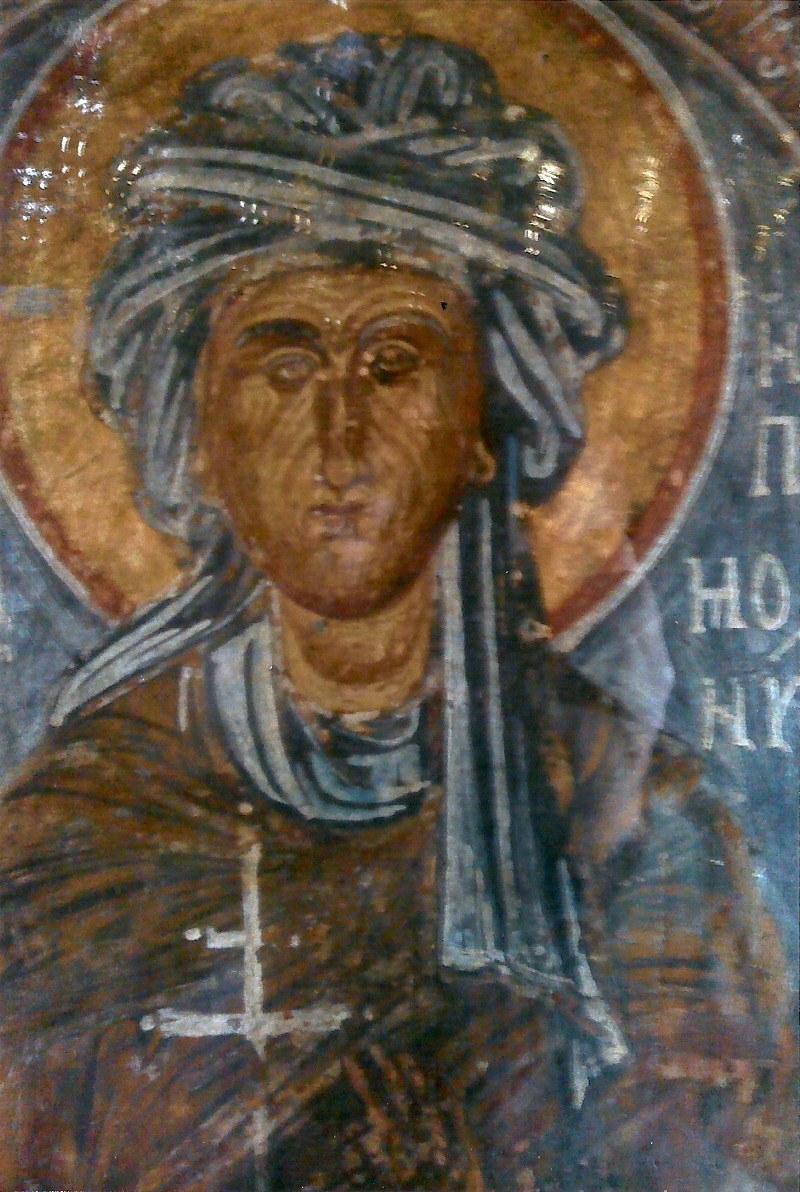
Hypomone is painted in the way proper to a crowned head who died a monastic: in the dark monastic mantle and veil, with the imperial crown either laid aside at her feet, held in her hands, or — most often in modern Greek icons — set upon the veiled head, the two states of her life shown together. She holds a scroll or a cross, and the inscription names her Ὑπομονή. Icons of the fall of the City place her beside her son Constantine Palaiologos, and the composite modern icons of the last days of Byzantium show her with the double-headed eagle and the walls behind. Greek painting sometimes gives her the epithet ἡ βασίλισσα, "the empress."
No pre-1900 icon has been secured for this collection. Her veneration, though rooted in her own century, took its present iconographic form only in modern Greek practice, and the images in circulation are the work of living or recent iconographers, none of them free-licensed; the project's constitution forbids storing them. A pre-modern possibility exists in principle — the surviving Byzantine donor portraits of Manuel II with Helena and their sons, notably the miniature in the Louvre manuscript of the works of Dionysius the Areopagite (MS Ivoires A 53) — but a donor portrait of the reigning empress is not an icon of the saint and would misrepresent the entry; it is noted here rather than stored.
The stored image is the fresco of the cave chapel of Saint Patapios at Loutraki, the veiled saint inscribed Η ΑΓΙΑ ΥΠΟΜΟΝΗ beside the halo — the received image of her veneration at the shrine that keeps her memory with Patapios.
Disputed questions
- The day of her commemoration. Her repose was 23 March 1450, and some Greek notices accordingly commemorate her in March; the settled Greek usage, and the one this collection follows, is 29 May, the day of the fall of Constantinople, on which she is kept together with the memory of her son. The two datings are not rival traditions about the same event but a death-date and a commemoration-date, and the difference should not be reported as a contradiction.
- Her sanctity and her son's. Hypomone is venerated as a saint; Constantine XI Palaiologos, who fell on 29 May 1453, is honoured in Greek popular devotion — often as "blessed," and in some modern lists with an ethnarchic and national rather than a strictly synodal veneration — but he has not been formally glorified by any Orthodox Church, and no entry is made for him here. The distinction between the two is real and is frequently blurred on May 29.
- Her name. Hypomone is her monastic, not her baptismal, name; she is "Helena" in every civil document of her life and "Hypomone" in every ecclesiastical one after 1425. Serbian usage keeps Jelena; the family name appears as Dragaš and, in the Greek of the chancery, as Δραγάσης / Dragases.
- Not to be confused with the other imperial Helenas — above all with Constantine and Helen, Equal to the Apostles (May 21) — nor with Helena Palaiologina, queen of Cyprus, her granddaughter's generation, nor with the fifteenth-century Serbian nun-queens (Jefimija, Angelina) with whom the Serbian calendars place her.