
Mark of Ephesus
Our Father among the Saints Mark Eugenikos, Metropolitan of Ephesus
Bishop · Confessor · b. 1392, at Constantinople (baptised Manuel) — d. 23 June 1444, at Constantinople
Commemorated 19 January — Principal commemoration (repose kept 23 June)
Mark of Ephesus (1392–1444), Mark Eugenikos, Metropolitan of Ephesus, is honoured by the Orthodox Church as the Pillar of Orthodoxy — the one bishop of the Eastern delegation who, at the Council of Ferrara–Florence (1438–1439), refused to sign the decree of union with the Church of Rome, and so preserved the Orthodox confession at the moment of its gravest political pressure. A brilliant teacher of Constantinople in its last decades, tonsured a monk and unwillingly made a metropolitan, he was the chief theological spokesman of the Orthodox at the council, opposing the Latin doctrines of the Filioque, purgatory, the azymes, and papal supremacy. When emperor and the greater part of the delegation signed the union out of fear and hope of Western aid against the Turk, Mark alone withheld his name — and Pope Eugenius IV, learning it, is said to have answered, "then we have accomplished nothing." Imprisoned and exiled for his refusal, he never ceased to teach and write against the union until his death, entrusting the cause to his disciple Gennadios Scholarios, who would be the first patriarch after the fall of the City. The union collapsed; Mark's confession stood. He is commemorated on January 19.

Origins and early life
Mark was born at Constantinople in 1392 and baptised Manuel. His father, George Eugenikos, was a deacon and sakellarios of the Great Church of Hagia Sophia and a teacher; his mother Maria was the daughter of a physician. His younger brother John Eugenikos became a deacon, nomophylax, and himself a learned defender of Orthodoxy and hymnographer, who would compose the first service in his brother's honour. Orphaned of his father while still young, Manuel completed his education under the leading masters of the dying capital — the scholar John Chortasmenos (later Ignatius, Metropolitan of Selybria) and the philosopher George Gemistos Plethon, the reviver of Platonism — and became himself the most admired teacher of Constantinople, keeping his father's school. Among his pupils was George Scholarios, the future Gennadios II, first Ecumenical Patriarch after 1453.
Monk and metropolitan
At the height of his fame as a teacher, and about the age of twenty-six, Manuel renounced the world. He withdrew first to a hermitage on the island of Antigoni near the ascetic Symeon, and then to the Monastery of Saint George of Mangana in Constantinople, where he was tonsured with the name Mark and in time ordained priest. There he gave himself to the study of the Fathers and to writing — theological, liturgical, and polemical works, and hymnography — and became known as a defender of the hesychast theology of Gregory Palamas, the God-given distinction of the divine essence and energies that the fourteenth-century councils of Constantinople had vindicated. This Palamite formation is the key to his later stand: for Mark the faith defended on Mount Athos and at the councils of 1341–1351 and the faith to be defended at Florence were one and the same Orthodox confession of God as he is known and communed.
Against his own wish, and pressed by the Emperor John VIII Palaiologos, Mark was consecrated Metropolitan of Ephesus about 1437, and made one of the Orthodox representatives — bearing also the proxies of the ancient Eastern patriarchates of Alexandria, Antioch, and Jerusalem — for the council of union that the emperor had agreed to attend, in the desperate hope that reunion with the West would bring military aid to the last remnant of the Roman Empire against the advancing Ottomans.
The Council of Ferrara–Florence
The council opened at Ferrara in 1438 and moved to Florence in 1439. Mark went as a genuine seeker of a true union, and in the early sessions he was conciliatory; but as the chief theological spokesman of the Orthodox he set out plainly the points on which East and West stood divided, and he would not have union bought by the surrender of the faith. The central and irreducible question was the Filioque — the Latin addition to the Creed of the procession of the Holy Spirit "and from the Son" — which Mark held to be both an unlawful tampering with the Creed of the Ecumenical Councils and a doctrinal error; and with it the Latin teachings of a purgatorial fire, the use of unleavened bread in the Eucharist, and the universal jurisdiction of the Pope. Against the schoolmen of the Latin party — above all the formidable John of Montenero — Mark argued from the Scriptures, the Ecumenical Councils, and the Greek Fathers, refusing to concede that a doctrine not held by the undivided Church could be imposed as a condition of communion.
As the months wore on, and the exhausted, homesick, and impoverished Greek delegation came under relentless pressure from the emperor (who wanted his fleet and his soldiers) and from the Latins (who held the purse), the Orthodox will to resist gave way. One by one the Greek bishops were brought to accept formulae that papered over the differences. Mark ceased to take active part once he saw that union on false terms was being forced through; he would neither be persuaded nor silenced.
The refusal to sign
On 5–6 July 1439 the decree of union, Laetentur Caeli, was solemnly promulgated, and the Orthodox bishops set their signatures to it — some convinced, most yielding to fear, weariness, and the emperor's command. Mark of Ephesus alone among them refused to sign. When the completed act was brought to Pope Eugenius IV, he is reported to have asked whether Mark had subscribed; told that he had not, the Pope answered, "Then we have accomplished nothing" — knowing that a union rejected by the one bishop the Orthodox conscience trusted was no union at all. The Pope summoned Mark to appear before him; Mark came, and, refusing to bend, delivered instead a defence of the Orthodox faith, so that the Latins did not dare to proceed against him.
The emperor and the bishops returned to Constantinople, where the people received the union with revulsion and honoured Mark as the one man who had not betrayed the faith — the crowds, the sources say, venerating him as a new Moses and Aaron, and shunning the communion of those who had signed. Several of the signatories, back on Orthodox soil, repudiated their signatures. The hoped-for Western crusade came to nothing; and the union of Florence, never received by the Orthodox faithful, was formally repudiated by the Churches of the East.
Confession, exile, and repose
Mark withdrew from a Constantinople whose patriarchal throne was held by unionists. He set out for his see of Ephesus (by then under Turkish rule) and thence sought to reach Mount Athos, the stronghold of Orthodox resistance, but was arrested by imperial order on the island of Lemnos and held in confinement for about two years. From his imprisonment he issued his most famous work, the Encyclical Letter to all Orthodox Christians throughout the world, denouncing the false union, the Latin innovations, and the unionist hierarchy, and calling the faithful to hold fast to the tradition of the Fathers. Released at last on account of failing health, he returned to the Monastery of Saint George of Mangana, where he continued to teach and to write against the union, and where the growing party of the "anti-unionists" (the Anthenotikoi) looked to him as their head.
Mark reposed at Constantinople on 23 June 1444, aged fifty-two, of a painful illness he bore with great patience. On his deathbed he charged his disciple George Scholarios — later Gennadios II, who would be enthroned as the first Ecumenical Patriarch after the City fell to the Turks in 1453 — to take up the defence of Orthodoxy and never to yield to the union; and Scholarios did so, so that the cause Mark had held alone at Florence became the settled mind of the whole Church. The union of Florence was solemnly rejected by the Orthodox at Constantinople in 1450 and again after the Fall.
Veneration and later cultus
Mark was venerated as a saint almost from the moment of his death — even a hostile Latin-minded contemporary, Joseph, the unionist bishop of Methone, complained that the Orthodox "glorify and praise" Mark (with Palamas), depict him in icons, keep his feast, and venerate him. His memory became inseparable from the whole Orthodox rejection of the Florentine union and, more broadly, from the Church's confession against every reduction of the faith to a political instrument. His commemoration was formally established by the Church of Constantinople — the service of the saint is commonly dated to a synodal act of the eighteenth century (1734) under Patriarch Seraphim I, though his veneration was continuous from his repose. He is one of the most beloved of the later Greek saints, "the Atlas and pillar of Orthodoxy," and his stand at Florence is kept as a pattern of episcopal courage.
Feast and commemoration
Mark is kept universally on January 19 (church date; Old Calendar civil February 1), by a happy coincidence the day of the two great fathers of the Egyptian desert, Macarius the Great and Macarius of Alexandria — so that the confessor of the fifteenth century is honoured beside the ascetics of the fourth. His repose (23 June) is also kept. The Greek Churches especially observe his feast with solemnity as the defender of Orthodoxy against the union; the Antiochian and Slavic calendars keep him on the same day.
Hymns
Troparion — Tone 3
In the confession of the divine faith the Church found thee a great zealot, O all-praised and holy Mark, champion of the mind of the Fathers and caster-down of the strongholds of darkness. Wherefore entreat Christ God to grant remission of sins to us who honour thee.
Original translation from the Greek
Kontakion — Tone 3
O all-wise and God-bearing Mark, thou wast shown a great luminary of Orthodoxy, the unshaken tower of the Church and her invincible champion, who by thy word laid low the pride of the Latins. Cease not to intercede for them that honour thee.
Original translation from the Greek
Iconography
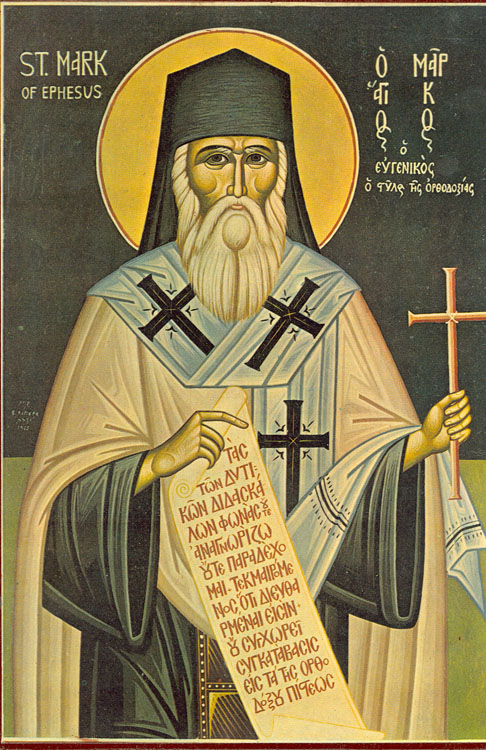
Mark is depicted as a bishop in the full vesture of a hierarch — the cross-figured sakkos or the phelonion, the omophorion, and often the episcopal mitre of the later Byzantine and post-Byzantine style — holding the Gospel-book and blessing, with a dark, pointed beard and the features of a man of middle age (he died at fifty-two). He is frequently shown holding a scroll inscribed with a phrase of his confession against the union, and he is paired in icons with Gregory Palamas, the two together representing the Church's defence of Orthodoxy in the last Byzantine centuries. His iconographic type is settled and widely reproduced in the Greek world.
The stored image is a fresco of the saint from the late nineteenth century — Mark vested as a hierarch, in the received type of the confessor-bishop of Ephesus (source, public domain, pd-old-work).
Disputed questions
- The date and reason of the January feast. Mark reposed on 23 June 1444, and that day is kept in some usage; but his principal and universal commemoration is January 19, associated in the tradition with the translation of his relics to the Monastery of Saint Lazarus at Galata. This entry ranks January 19 as the primary feast, following the calendars, and records the 23 June repose in the biography.
- The year of death. The repose is given by most sources as 1444; a few place it in 1445. The day, 23 June, is constant.
- Not to be confused with Mark the Ascetic (Mark the Faster, the fifth-century desert father and Philokalic writer, kept March 5), a wholly different saint of a wholly different age. This Mark is Mark Eugenikos, the fifteenth-century metropolitan of Ephesus.