
Irenaeus of Lyons
The Holy Hieromartyr Irenaeus, Bishop of Lyons
Hieromartyr · Bishop · b. c. 130–140, at Smyrna — d. c. 202
Commemorated 23 August — Martyrdom of the bishop of Lyons under Septimius Severus
Irenaeus, second bishop of Lyons (Lugdunum in Gaul), is the greatest theologian of the second century and the hinge on which the memory of the apostolic age turns. Born at Smyrna about 130–140, he heard Polycarp preach as a boy and never forgot it; carried west into the Greek-speaking colony of the Rhône, he was a presbyter of Lyons during the persecution of 177, was sent to Rome with the confessors' letter while his church died in the amphitheatre, and returned to inherit the widowed see. His five books Against Heresies broke the Gnostic systems and, in breaking them, set out for the first time the whole shape of catholic Christianity: one God who is both Creator and Redeemer, one Christ who recapitulates in himself the whole of Adam's race, one Church holding one rule of faith through the succession of the apostles, and one fourfold Gospel. The Byzantine calendar keeps him on August 23 and calls him hieromartyr, the tradition holding that he was put to the sword at Lyons about 202 under Septimius Severus.

Smyrna: the boy who heard Polycarp
Irenaeus was an Asian Greek, born at Smyrna in the years around 130–140 — the Orthodox synaxaria give 130; modern scholars will not close the range more tightly than "before c. 155." He was raised in a Christian household and given the ordinary literary education of a Greek city — poetry, rhetoric, the elements of philosophy — an education whose marks are everywhere in his later writing, in his easy handling of the Homeric centos and his patience with the technical vocabulary of the systems he refutes.
The decisive thing in his boyhood was not the school but the bishop. In the celebrated Letter to Florinus, written decades later to a fellow-Asian who had drifted into Valentinian error and preserved for us by Eusebius (Ecclesiastical History V.20), Irenaeus reaches back to what the two of them had seen together as boys in the lower part of Asia, "when I was still a child": the place where blessed Polycarp sat and taught, his going out and coming in, the manner of his life and the look of his body, the discourses he made to the people — and above all his accounts of his converse with John and with the others who had seen the Lord, how he recalled their words and the things he had heard from them about the Lord, his miracles and his teaching. Irenaeus says he wrote none of it down at the time but noted it "not on paper but in my heart," and that by the mercy of God he ruminates on it faithfully still. It is the most vivid sentence in the whole literature of the second century about how Christian memory was actually transmitted, and it is the ground of Irenaeus's lifelong conviction that the faith is a thing received, not a thing constructed.
Presbyter of Lyons and the persecution of 177
How Irenaeus came to Gaul is not recorded, but the movement was a common one: the church of Lugdunum, capital of the Three Gauls and the commercial hub of the West, was an Asian transplant, its bishop Pothinus a nonagenarian said to have been Polycarp's disciple, its people Greek-speaking merchants and craftsmen from Asia and Phrygia mixed with native Gauls. Irenaeus was a presbyter of that church. He records, in the preface to his great work, that he lived among the Celts and conversed for the most part in a barbarous tongue, and asks his reader not to expect fine Greek from a man in the provinces — an apology which is also a piece of biography: the bishop of Lyons was a working missionary among people whose language was not his own.
In the summer of 177, under Marcus Aurelius, the mob and the governor of Lugdunum broke upon the church. Pothinus was beaten to death in prison at over ninety; the slave-girl Blandina, the deacon Sanctus, the boy Ponticus and their companions died in the amphitheatre over the days of the provincial festival. Irenaeus was not there. The confessors in prison, occupied even in their extremity with the Montanist disturbance in Phrygia, had sent letters to the churches of Asia and to Eleutherius, bishop of Rome, urging peace; and they sent them by the hand of the presbyter Irenaeus, whom they commended in a line Eusebius preserves — that they had sent him because they judged him zealous for the covenant of Christ, and would have him held in the honour of a presbyter of the church. He came back from Rome to a decimated congregation, and about 177–178 was made its bishop, second after Pothinus. Of his episcopate the record keeps two things: the mission — the tradition, carried by the Orthodox lives, that he preached until Lugdunum was a Christian city, and that he sent men out into the surrounding country and towards the Rhine — and the writing.
Against Heresies
About 180, Irenaeus wrote the five books whose Greek title is Ἔλεγχος καὶ ἀνατροπὴ τῆς ψευδωνύμου γνώσεως — the Detection and Overthrow of Knowledge Falsely So Called — known ever since by the Latin Adversus Haereses. Book I is a patient, damaging exposition of the Valentinian system in its own words: the Pleroma, the thirty aeons, the fall of Sophia, the Demiurge who made the material world in ignorance, the three classes of men, and the elaborate myths by which the Gnostic teachers claimed a knowledge above the Church's faith. Irenaeus's method is to state the system fully and accurately and let its own extravagance destroy it — "to expose is to refute." Book II argues against it from reason; Books III and IV from the Scriptures and the tradition; Book V from the resurrection of the flesh and the last things.
The work is the single most important document of the second-century Church, and it very nearly did not survive. The Greek original is lost but for quotations, chiefly in Epiphanius and Eusebius; the whole survives in an ancient and extremely literal Latin version, probably made in the third century; books IV and V survive complete in Armenian, with a number of fragments in Syriac. Almost everything the modern world knows of Valentinus, Ptolemy, Marcus the magician, Basilides, Saturninus, Cerdo and Marcion, it knows through Irenaeus — a debt the Nag Hammadi discoveries of 1945 largely confirmed rather than overturned, for the Gospel of Truth and the Apocryphon of John proved to answer closely to what he had reported.
A second book, the Demonstration of the Apostolic Preaching (Epideixis), a short and warm catechetical summary of the faith from the creation to the Church, written for a certain Marcianus, was known only by name for seventeen centuries until an Armenian manuscript of it was identified in 1904 and published in 1907. Of his other writings — On the Ogdoad, On Knowledge, the letters to Florinus, to Blastus and to Victor — only fragments remain.
The theology: recapitulation
Irenaeus is not a systematiser but the first great biblical theologian, and everything in him hangs on one word taken from Ephesians 1:10: ἀνακεφαλαίωσις, recapitulation, the gathering-up of all things under Christ as head. Against the Gnostics, who divided the God of the Old Testament from the Father of Jesus, matter from spirit, and creation from redemption, Irenaeus answers with an unbroken unity: it is the same God who made Adam of the earth and who redeems him; the same Word who fashioned man in the beginning and who took his flesh; the same economy running from Genesis to the Church. Christ did not come to rescue souls out of a botched creation but to become what Adam was and to retrace his steps rightly — "he passed through every age of life," Irenaeus says, sanctifying infancy by being an infant, youth by being a youth, and manhood by being a man — and to undo on the wood of the Cross the disobedience committed at a tree.
From this come the sentences the whole later tradition repeats:
- The exchange: the Word of God became what we are, that he might make us what he is — the formula which Athanasius will sharpen and which stands behind the Orthodox doctrine of theosis.
- Mary the new Eve: Irenaeus is the first to set the two women side by side — what the virgin Eve bound by unbelief, the Virgin Mary loosed by faith; "the knot of Eve's disobedience was untied by the obedience of Mary." No Marian text of the Fathers is older.
- The two hands of God: the Father made all things by his two hands, the Son and the Spirit — a figure that keeps creation immediate, personal and Trinitarian, and leaves no room for intermediary aeons.
- "The glory of God is a living man, and the life of man is the vision of God" (IV.20.7): against a piety that despised the body, the assertion that the flesh is capable of God.
- The Eucharist: as the bread which receives the invocation of God is no longer common bread but Eucharist, made of an earthly and a heavenly thing, so our bodies which receive it are no longer corruptible but have the hope of resurrection (IV.18.5). It is the earliest full statement of the eucharistic argument for the goodness of matter.
Against the Gnostic appeal to secret oral tradition, Irenaeus sets the public tradition: the rule of faith confessed everywhere in the same terms — he gives it three times, in substance a creed — and the succession of bishops from the apostles, which he demonstrates by naming the bishops of Rome in order from Linus, and by pointing to Polycarp at Smyrna, "whom I saw in my early youth," appointed by apostles (III.3.3–4). Tradition for him is not a supplement to Scripture but the Church's continuous public possession of the one apostolic preaching, held in the open where anyone may check it. And it is Irenaeus who first argues for a fourfold Gospel — neither more nor fewer than four, as there are four zones of the world and four winds (III.11.8) — the earliest witness we have to the four-Gospel canon.
His one large idiosyncrasy is in Book V: a frank millenarian expectation of an earthly reign of the righteous before the end, which he says he received from the elders who had seen John, and which he supports with a saying attributed to Papias. Later Greek tradition did not follow him there; the Church has honoured the man and quietly set aside the chiliasm.
The peacemaker: the Paschal controversy
About 190–192 the question of the date of Pascha came to a crisis. The churches of Asia kept the Christian Passover on 14 Nisan, whatever the day of the week, as they said they had received it from the Apostle John and from Polycarp; Rome and most others kept it on the Sunday following. Victor of Rome, meeting resistance from Polycrates of Ephesus, moved to cut the Asian churches off from communion. Irenaeus wrote to him — with the whole weight of a bishop who was himself an Asian, in the West, and neither party's man. Eusebius (V.24) quotes him: that the difference was not only about the day but about the manner of the fast, which had varied for generations; that those before them who did not observe it strictly nevertheless kept peace with those who did, and the difference in the fast established the agreement in the faith; and that Polycarp, coming to Rome in the time of Anicetus, had been unable to persuade Anicetus and had not been persuaded by him, and yet the two communed together and parted in peace, Anicetus yielding to Polycarp the Eucharist in his own church. Eusebius adds the epigram which has stuck to him ever since: that Irenaeus, peacemaker by his very name (εἰρήνη, peace), was a peacemaker in fact. The excommunication did not stand. It is the earliest surviving argument in Christian literature that unity of faith does not require uniformity of usage — the ground of his Latin title, conferred in 2022, Doctor unitatis.
Martyrdom
Of his death nothing certain is transmitted. Eusebius, who quotes him at length and had every reason to say so, does not call him a martyr; nor does Tertullian. The Byzantine synaxaria and the Latin tradition alike hold that he was beheaded at Lyons, with a great multitude of his flock, in the persecution under Septimius Severus, about the year 202 — the first writer to record the tradition being Gregory of Tours in the sixth century (History of the Franks I.29), who says that almost the whole Christian population of the city was massacred with him and the streets ran with blood. The Greek Menaion enrols him unhesitatingly among the hieromartyrs and gives him the sword. Whether he was martyred or reposed in peace, the Church commemorates him with the crown; and the silence of Eusebius, though real, is not decisive, since Eusebius is silent about a great many Gallic things.
Relics and later cultus
He was buried at Lyons beneath the crypt of the church of Saint John, which came in time to bear his own name, Saint-Irénée — one of the oldest continuously venerated tombs in Gaul. In 1562 the Huguenots sacked the church and scattered the relics; the head, which had been kept in a reliquary, was lost. Fragments survive: a relic in the crypt at Saint-Irénée, and a heel-bone at the cathedral of Lyons which testing has at least shown to belong to the right period.
In the East his memory was carried by the synaxaria and by the immense authority of his book: he is the first Father cited against the iconoclasts on the reality of the Incarnation, and he stands behind the Christology of Athanasius and of Maximus the Confessor. In the West he was named the thirty-seventh Doctor of the Church by Pope Francis on 21 January 2022, with the unique title Doctor unitatis, "Doctor of Unity," in recognition of the Paschal letter and of a life spent joining East and West.
Feast and commemoration
August 23 (church date; Old Calendar civil September 5). The day is the leavetaking (apodosis) of the Dormition of the Theotokos, so that the whole festal office of the Great Feast is repeated and the commemorations of the saints are sung at compline or in the ordinary places left to them: Irenaeus has no full proper service in the printed Menaion, only his synaxarion notice and distich, precisely because the leavetaking governs the day. He is kept together with the martyr Lupus, with Irenaeus of Sirmium, with Callinicus, Patriarch of Constantinople, and with the thirty-eight martyrs of Thrace. In the Latin calendar his feast is June 28; among the Eastern Catholics and in the Oriental Orthodox calendars, August 23 as in the Byzantine books.
Hymns
Apolytikion — Tone 4
As a sharer in the ways and a successor to the thrones of the Apostles, O divinely-inspired one, thou didst find in contemplation the means to ascend to divine heights; rightly dividing the word of truth, thou didst struggle for the faith even unto blood, O hieromartyr Irenaeus: intercede with Christ God that our souls may be saved.
Kontakion — Tone 4
Taught by the disciple of the Beloved, thou didst keep in thy heart the words of the Apostles, and didst overthrow the many-headed error of false knowledge; thou didst show forth Christ as the Head who gathers all things into himself, and didst make peace among the Churches, O wise Irenaeus: wherefore we cry to thee, Rejoice, unshaken pillar of the apostolic tradition.
Original translation from the Greek
Iconography
Irenaeus is written as a hierarch of the early Church: middle-aged to elderly, with a short rounded dark beard going grey, in the phelonion and the crossed omophorion, blessing with the right hand and holding the jewelled Gospel in the left — the standard bishop-type, since no distinguishing attribute attaches to him. Where he appears as a hieromartyr he may carry the cross of martyrdom instead. Greek and Slavonic examples caption him Ο ΑΓΙΟΣ ΕΙΡΗΝΑΙΟΣ or СВ. ІРИНЕЙ, which does not by itself distinguish him from Irenaeus of Sirmium or from the deacon Irenaeus, so that identification of an isolated panel usually depends on the menologion context. In the West he is shown in mitre and cope, often with a book — the Adversus Haereses — and sometimes trampling a serpent or a scroll of the heresies.
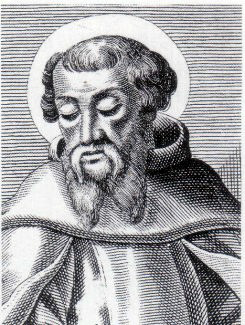
The stored image is a line engraving of unknown authorship, published before 1931 and in the public domain: a bust of the saint in three-quarter view, haloed, with a high domed forehead, deep-set downcast eyes and a forked beard, in a hooded mantle. It is a Western engraving and not a Byzantine icon, and it carries no inscription; it is stored because it is the only genuinely public-domain image of the saint located, and it is flagged here so that a proper pre-1900 Orthodox icon or fresco may replace it when one is found. Two candidates on Wikimedia Commons were examined and rejected: "Saint Irenaeus icon.jpg" and its derived crop are photographs of a modern painted icon released under a Creative Commons licence by the photographer, which leaves the iconographer's rights untouched, and are therefore not storable under the repository's icon policy. The Menologion of Basil II, the usual first resort for a minor saint of the fixed year, covers only September to February and offers nothing for August 23.
Disputed questions
- Not to be confused with Irenaeus of Sirmium, bishop of Sirmium in Pannonia and martyr under Diocletian (†c. 304), whose principal feast in this collection is March 26 — and who is entered in the Greek Menaion on the same August 23, one line above the bishop of Lyons. The two hieromartyr Irenaei therefore stand side by side in the synaxarion of this day and are constantly confused: the Lyonnais is the second-century theologian and disciple of Polycarp; the Sirmian is a fourth-century Latin bishop of the Danube who was beheaded and thrown into the river Sava.
- Not to be confused with the martyr Irenaeus of Sirmium the deacon, commemorated with Irene and Peregrinus (see Irenaeus, Irene and Peregrinus), nor with Irenarchus of Sebaste or of Rostov.
- Date of birth. The synaxaria say 130; the evidence — that he was a boy when he heard Polycarp (†155/156) and an active presbyter in 177 — admits anything from about 120 to about 140. Nothing turns on it except the vividness of his memory of Polycarp, which reads like a man recalling his early boyhood.
- The fact of martyrdom (see above): asserted by the whole liturgical tradition, East and West; unattested before Gregory of Tours; treated with reserve by modern historians. The entry follows the Church's usage in calling him hieromartyr while recording the silence of the earliest witnesses.
- The date of the feast. August 23 is the Byzantine date; the West keeps June 28. The divergence is old and has no doctrinal weight.