
Irenarchus of Rostov
Our Venerable Father Irenarchus the Recluse of Rostov
Venerable · b. 1548, at Kondakovo — d. 1616, at the Borisoglebsky Monastery near Rostov
Commemorated 13 January — Repose at the Borisoglebsky Monastery
Irenarchus the Recluse (1548–1616) was a Russian ascetic of the Borisoglebsky (Saints Boris and Gleb) Monastery near Rostov, remembered for an extreme struggle in chains and for the part his prophetic word played in Russia's deliverance during the Time of Troubles. Born a peasant in the village of Kondakovo and baptised Elias, he was tonsured a monk in his thirtieth year and took up a life of enclosed asceticism, loading himself with iron crosses, chains, and fetters — the "bonds" of Christ he wore for some twenty-five years. Foreseeing the Polish-Lithuanian invasion and the desolation of Moscow, he wept and warned Tsar Vasily Shuisky; and in the darkest hour of the interregnum he blessed the liberators Prince Dmitry Pozharsky and Kuzma Minin, sending them his own cross for the campaign that freed Moscow. He reposed in 1616 and is commemorated on January 13.
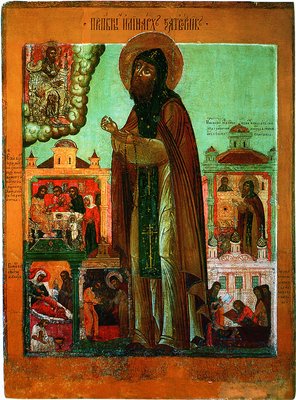

Elias of Kondakovo
The saint was born in 1548 into a peasant family in the village of Kondakovo in the district of Rostov, and given in baptism the name Elias (Ilya). The tradition holds that even as a boy he showed the marks of his calling, once telling his mother that he would wear irons and labour for God. After some years spent in trade at Rostov and Nizhny Novgorod, he renounced the world, and in his thirtieth year was tonsured a monk at the Borisoglebsky Monastery, the house of Saints Boris and Gleb some eighteen versts from Rostov, receiving the name Irenarchus.
The ascetic in chains
At the monastery Irenarchus gave himself to labours of an extraordinary severity. Moved by the sight of a poor man going barefoot in the cold, he gave away his own boots and went unshod; he withdrew into reclusion, shutting himself in a narrow cell, and there took up the "bonds" (Russian verigi) for which he is famous — binding himself with iron chains and fetters and hanging heavy crosses upon his body, adding to them year by year. The inventory the tradition preserves of what he left behind is itself his portrait: some 142 copper crosses, chains for the shoulders and the neck, iron fetters for the hands and feet, heavy weights worn at the belt, and iron rods with which he chastised his flesh. Chained to the spot, he passed some twenty-five years in prayer, fasting, and the making of clothing for the poor, enduring cold, sickness, and the hostility of those who thought his way excessive — for at times he was driven out or ill-used by superiors who did not understand him, and returned each time to his cell and his chains.
Prophet of the Time of Troubles
Irenarchus lived through the catastrophe of the Time of Troubles (1598–1613), the years of dynastic collapse, famine, pretenders, and foreign invasion that nearly destroyed the Muscovite state. In his reclusion he was given, the tradition says, a vision of the coming disaster — that the armies of Poland and Lithuania would overrun Russia, take Moscow, and lay waste its churches — and he wept bitterly over it. At his abbot's bidding he went to Moscow to warn Tsar Vasily Shuisky (1606–1610) of the ruin to come. When the invasion came as he had foretold and the Poles occupied the country, the interventionist commanders — even the Polish leaders Sapieha and others who passed through the region — are said to have come to see the recluse in his chains, and to have been struck by his fearless confession that the Russian land was God's and would be freed.
The blessing of Minin and Pozharsky
In the decisive hour, when the national militia gathered to expel the invaders, Irenarchus sent his blessing to its leaders, Prince Dmitry Pozharsky and the merchant Kuzma Minin, and — the tradition holds — gave them his own cross to carry into the campaign, promising in God's name that they would see the glory of God and that Moscow would be delivered. In 1612 the militia retook the Kremlin and drove out the Poles, and the recluse's word was counted among the spiritual causes of the deliverance; his memory is bound up with the national resurrection that ended the Troubles.
Repose
Irenarchus reposed at the Borisoglebsky Monastery on January 13, 1616, after some thirty-eight years of monastic struggle and reclusion. His chains and crosses were kept at the monastery as relics and instruments of healing, and his tomb became a place of pilgrimage; he was soon numbered among the venerable saints of the Russian Church. His cell, and the spring he is said to have opened, remain sites of veneration at the monastery to this day.
Feast and commemoration
Irenarchus is commemorated on January 13 (church date; Old Calendar civil January 26), the day of his repose, within the afterfeast of the Theophany. His feast is kept by the Russian Church, and above all at the Borisoglebsky Monastery near Rostov, where his relics and his chains are venerated. Several Russian sources add local commemorations and a festal procession that carries his cross to the spring associated with him.
Hymns
Troparion — Tone 8
In thee, O Father, was preserved with exactness that which is according to the image; for taking up thy cross, thou didst follow Christ, and by thy deeds thou didst teach us to despise the flesh, for it passeth away, but to care for the soul, a thing immortal. Wherefore, O venerable Irenarchus, thy spirit rejoiceth together with the angels.
Original translation from the Slavonic
Iconography
Irenarchus is depicted as a Russian monastic ascetic — an aged, gaunt figure in the monastic schema, characteristically laden with chains and crosses, the iron verigi that were the mark of his struggle shown upon his shoulders and breast; vita-icons surround the central portrait with scenes of his life and of the deliverance of Moscow. The stored image is a Russian vita-icon of the saint "with his life" (с житием) of the late seventeenth or early eighteenth century, from Rostov.
Disputed questions
- Not to be confused with the martyr Irenarchus of Sebaste (†c. 303, November 28), converted by the courage of the seven women martyrs, nor with Irenarchus of Solovki (†1628, July 17). This Irenarchus is the recluse of Rostov, the ascetic in chains of the Time of Troubles.