
Irenarchus of Solovki
Our Venerable Father Irenarchus, Igumen of Solovki, Wonderworker
Venerable · Priest · Wonderworker · d. 17 July 1628
Commemorated 17 July — Repose at the Solovki monastery, 9 August — Synaxis of the Saints of Solovki
Irenarchus was igumen of the Solovki monastery in the White Sea from 1613 to 1626, in the years immediately after the Time of Troubles, and one of the very few Russian saints whose life can be traced almost entirely through account-books rather than through a hagiographer. He came to the islands as a young man in the 1580s, served as a salt-agent and a boat-master before he was cellarer, and was elected abbot on the death of St Antony; he then spent thirteen years rebuilding the monastery's ruined estates, negotiating a truce with the Swedes, digging the ditch and raising the wall of a frontier fortress that he also commanded, and, at the same time, restoring monastic discipline within the walls, for which he wrote out a cell-rule for his brethren with his own hand. He blessed and equipped the Anzer skete of St Eleazar. Having asked to be released, he lived his last two years in silence in his cell and reposed on 17 July 1628. His disciple Hilarion of Suzdal collected the Tale of the Wonders of Igumen Irenarchus; his relics were uncovered about 1675, during the Solovki siege.

The islands, and the years before the abbacy
Nothing is transmitted of Irenarchus's life before he came to Solovki. The monastery's seventeenth-century synodikon, into which his personal memorial list was entered while he was still alive, shows that he was born of a devout family and that his parents both took the monastic habit, under the names Ephrem and Eudokia. He was tonsured at the Solovki monastery, apparently in the 1580s, under the holy igumen Jacob (1581–1597) — that is, within living memory of the founders Zosimas, Sabbatius and Herman, whose lives he was zealous to imitate.
The first documentary traces of him are not spiritual but commercial, and they are the more valuable for it. Between 1583 and 1588 he was the prikaznyi starets, the managing elder, at the Ludskoe salt-works, and in those years and after he repeatedly sailed as lodeinyi kormshchik — the helmsman of the monastery's boat — carrying salt. Early in the seventeenth century he was ordained priest. In 1607 the brethren elected him cellarer, and he held the office about a year; in 1608 he and his friend Alexander (Bulatnikov) bought jointly, out of the effects of a dead elder, an Apostol, a Psalter with the appointed offices, a Book of Hours, the Life of the Solovki wonderworkers and two volumes of saints' calendars — the reading of a man who meant to be a monk and not a merchant.
Igumen in the aftermath of the Troubles
On the death of the igumen St Antony the brethren chose Irenarchus as superior. In June 1613 he set out for Moscow to be installed. He should have been installed by the metropolitan of Novgorod, Isidore, but Novgorod had been under the Swedish crown since 1611 and the road was shut; the party got as far as the Trinity–Sergius monastery and could go no further, the Moscow road being held by Cossack bands, until the Trinity cellarer Avraamy Palitsyn gave them an escort of fifty musketeers. He reached Moscow on 2 August and was installed as igumen on 8 August 1613 by Cyril (Zavidov), metropolitan of Rostov. He came home through Vologda, burnt out by the "Lithuanian men," and through Ustiug and Kholmogory, to find the monastery's Pomorye estates being plundered.
What followed was thirteen years of hard, unromantic administration undertaken as an act of obedience. The tsar granted the monastery the district of Shuya Karelskaya with its people, mills and salt-pans, and Irenarchus, taking counsel with the brethren, at once sent a thousand roubles of silver to Moscow "for the pay of the fighting men." In the summer of 1614 he opened negotiations with the Swedish governors of Uleåborg and Kajaani, writing that the monastery had no wish "to make war or to give any provocation" but desired to live with its neighbours "in love and in unity" — and that September a truce was concluded in Pomorye. In 1616 and again in 1619 he went to Moscow to plead for relief from the extraordinary war-taxes, and won it in part. He opened new salt-works at Gridina Bay (1617) and Pon'goma (1621); he built a two-storey icon-painting chamber (1615), a tannery, a vaulted treasury; he had the iconostasis of the Transfiguration cathedral rebuilt with a fifth, forefathers' tier of twenty-eight icons, and commissioned from the tsar's own iconographer Nazary Istomin a Dormition and a Saviour for the local tier, paying for both out of his own money and having them set in silver.
The fortress on the frontier
The igumen of Solovki in those years was also the crown's plenipotentiary in Pomorye and the commander of two fortresses — the stone citadel on Great Solovetsky Island and the wooden stockade at Suma. In 1621 the garrison of the two came to 1,040 men. In 1619 the tsar ordered him to take precautions against a Danish attack, Christian IV having laid claim to the Lapp lands; in August 1621 he was warned that Danish ships had appeared off the Kola stockade and was told to build stone quarters against a siege and to finish the defensive ditch. Under his direction the walls were extended with a pristenok and two towers taking in the bakehouse and brewhouse, the drying-house was faced with stone and given machicolations, and a boulder-lined ditch with a palisade was dug on the north and south sides. It is this work that the later synaxaria compress into the sentence that he fortified Solovki against the Swedes and the Danes.
The inward wall
He was as concerned, the sources insist, with the monastery's inward defences. The long presence of soldiers and lay workmen on the islands had loosened monastic discipline, and in February 1621 the tsar wrote requiring the igumen to deal with monks who wished "to live slackly and turn aside to worldly business, or take to drink, or go outside the monastery, or make disturbances"; the patriarch Philaret and the tsar's mother, the nun Martha, wrote to the same effect. His answer was to compose for the brethren an order of the cell rule, to which he appended short chapters of monastic manners — How a brother should come into the cell of another brother; What a brother shall say when brother meets brother; What to say on coming into your cell after working with the brethren at any labour. A copy of the rule survives in a Kanonnik of the Trinity–Sergius monastery, carried there by his disciple Ioasaph Sorotsky.
He was "exceedingly humble and meek," the later redaction of the Tale says of him, and his disciple Benjamin remembered that the abbacy had not been peaceful — that he had suffered much "from those who rose against him," and that he was able to end disturbances by gentleness. The same evenness has a harder edge in one episode: about 1618 the infirmary elders complained that the infirmary cellarer Kirik had gone off into the wilderness with the hermit Damian, and that the hermits "live in idleness and do not labour in the monastery." Irenarchus ordered them brought back, sent monks, workmen and musketeers after them, and had their cells pulled down. He did not encourage the eremitical impulse in the newly tonsured.
Anzer, and Eleazar
With the Anzer skete it was otherwise. In 1620 the nun Martha gave a hundred roubles for a church on Anzer Island; the patriarch Philaret blessed its dedication to the Holy Trinity with a chapel of St Michael Maleinos, the tsar's patron, and sent two iconostases and the vessels. Irenarchus laid the foundation and consecrated the church in 1621, and when St Eleazar of Anzer asked for the order of skete worship he sent him a copy of the Skete Typikon and dispatched Dionysius Kryuk, long the ustavshchik of the Nilo-Sorsky hermitage, to put it in practice. He was, all the same, slow to release Solovki brethren to go and live there, and in 1624 the tsar had to instruct him not to hinder "good elders" who wished to go to Anzer. The friendship held: it is from Eleazar that three of the stories of Irenarchus's gift of foresight come down.
Two other events of his abbacy belong to the history of the North: the uncovering of the relics of St Herman in 1623, and the return to Solovki in 1620 of Avraamy Palitsyn, who there wrote the final redaction of his History in Memory of Generations to Come.
Departure, repose, and the wonders
On 12 July 1626 Irenarchus served his last Liturgy at the Anzer skete, telling Eleazar who the next igumen would be and that the government would be "with great affliction." That same year he went to Moscow to ask the tsar and the patriarch to release him. Philaret would not let him go until he had seen his successor; Irenarchus wintered in Moscow, and only after the new igumen Macarius had been confirmed did he leave, on 18 August 1627, reaching Solovki probably in the late autumn. He gave back the abbot's panagia to the treasury, took leave of the brethren, and settled in his cell by the Holy Lake gate, where he lived out the remaining months in silence. He reposed on 17 July 1628, and was buried by the church of Sts Zosimas and Sabbatius, beside the founders of the house.
Veneration began at once. He appeared to the monk Vitaly on the fortieth day after his death, with a shining face, in an epitrachelion, censing the brethren; he appeared to his disciple the priest-monk Benjamin to console him. In the spring of 1629 seal-hunters carried adrift on the ice of the White Sea came to the monastery and told how an elder had blessed them with a cross and shown them the way to shore with an abbot's staff, saying, "I am Irenarchus, igumen of the Solovki monastery." Between the late 1620s and the 1650s his disciple Hilarion of Suzdal gathered thirteen such accounts into the Tale of the Wonders of Igumen Irenarchus — prophecies, apparitions, deliverances at sea, six of them granted to a single lay workman, Ivan Emelianov — a text notable for its scrupulous circumstantial precision, announcing itself as a "true and trustworthy telling."
Relics
His grave was covered by a wooden chapel-tomb, first attested in a donation record of 1669–1676. Archpriest Avvakum, expounding Isaiah's "instead of the dust shall come up the myrtle," wrote that "now a new saint has appeared — Ilinarkh in the Solovki monastery... he was dust, he lay in the earth, who knew him? and now like the myrtle he has come up, and has become exceeding fragrant through all the Russian land." From Avvakum's reckoning the uncovering of the relics falls in 1675, seven years into the Solovki siege, and probably on 29 March, the day given as a memory of the saint in the eighteenth- and nineteenth-century iconographic manuals. The Old Believers of the besieged monastery made much of both the uncovering and the healings at his tomb, and the oldest copy of the Tale was edited by one of their leaders, the hierodeacon Jeremiah (Lisin). The relics were soon reinterred and rested under a shrine; the wooden chapel was rebuilt in stone in 1753, and in 1856–1859 was absorbed into the undercroft of the new Trinity cathedral. On 21 September 1925 the tomb was opened by the commission of the Solovki camp museum, the slab reading "Here lies the body of the venerable Irenarchus, Solovetsky wonderworker"; the remains were exhibited in a glass case in the Annunciation church, removed to the Central Anti-Religious Museum in Moscow in 1940 and thence in 1946 to the Leningrad museum of the history of religion. Whether the relics of Irenarchus were among the Solovki relics that survived that journey is not known.
Feast and commemoration
July 17 (church date; New Calendar civil July 17, Old Calendar civil July 30), the day of his repose. He is commemorated also on 9 August in the Synaxis of the Saints of Solovki, and on the third Sunday after Pentecost in the Synaxis of the Saints of Novgorod — the latter a movable commemoration which belongs to the movable sweep of this corpus and not to a fixed calendar day. The iconographic manuals additionally record 29 March, the probable day of the uncovering of his relics in 1675. His veneration is Russian, kept by the Moscow Patriarchate, the Russian Church Abroad and the OCA; it is not on the Greek or Antiochian calendars.
Hymns
Troparion — Tone 8 (common of a venerable one)
In thee, O father, was the divine image preserved unimpaired; for taking up the cross thou didst follow after Christ, and by thy deeds thou didst teach us to despise the flesh, for it passeth away, but to have care for the soul, which is a thing immortal. Wherefore, O venerable Irenarchus, thy spirit rejoiceth with the angels.
Original translation from the Slavonic
Kontakion — Tone 8
Set as a shepherd over the island house of the wonderworkers, thou didst build up its walls against the enemy without, and its rule of prayer against the enemy within; and having laid down thy staff, thou didst finish thy course in silence. Wherefore we cry to thee: Rejoice, O Irenarchus, adornment of Solovki.
Original translation from the Slavonic
Iconography
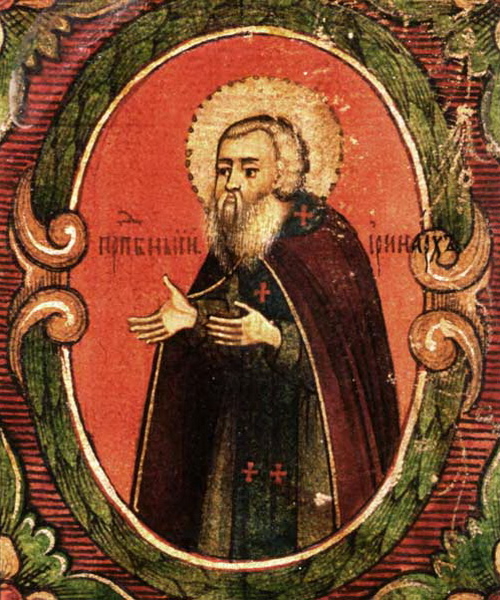
Irenarchus is painted as a Russian monastic elder of middle years — a broad, rounded beard, brown going to grey, the head bare, in the dark mantiya and analav — most often with the hands open in prayer or holding a scroll, and frequently as one of a company: with St Eleazar of Anzer, his friend and the founder of the skete he blessed, or in the ranks of the Synaxis of the Saints of Solovki, where he stands behind Zosimas, Sabbatius and Herman in the assembly ranged before the island monastery. A fresco of him survives in the Annunciation church of the Solovki monastery from the second half of the nineteenth century.
The stored image is a Russian icon of 1711 (published from the archive of the Orthodox Encyclopedia): the saint half-length in an oval cartouche wreathed in green and gold on a red ground, in a dark habit with a brown mantle, the hands open before him, and the inscription ПРПБНЫЙ ІРИНАРХ — "the venerable Irenarchus" — set in the field on either side of the head.
Disputed questions
- The dates of the abbacy. The Orthodox Encyclopedia, working from the Moscow travel accounts, has him installed on 8 August 1613 and abbot until 1626. The Life as restyled about 1830 by archimandrite Dositheus (Nemchinov) gives "from 7122 [1614] to 7134 [1626], and two years in retirement," and this 1614 date has passed into most calendar notices, including the OCA's. The documentary evidence favours 1613.
- The installing hierarch. Because Novgorod was in Swedish hands, the installation was performed not by the metropolitan of Novgorod but by Cyril (Zavidov) of Rostov — a detail the short notices lose.
- Whether he is one man. A "priest Irenarchus" who sang a forty-day memorial in 1604 may be the saint or an elder of the same name; the sources do not settle it.
- Not to be confused with Irenarchus of Rostov, the recluse of the Borisoglebsky monastery (†1616, 13 January), nor with the martyr Irenarchus of Sebaste (28 November). The Solovki saint is the only one of the three who was an abbot.