
James the Son of Zebedee
The Holy and Glorious Apostle James the son of Zebedee, brother of John the Theologian
Apostle · Martyr · d. 44, beheaded at Jerusalem
Commemorated 30 April — Beheading at Jerusalem by Herod Agrippa I, 30 June — Synaxis of the Twelve Apostles
James the son of Zebedee is one of the Twelve, the elder brother of John the Theologian, and — with his brother and with Peter — one of the three disciples whom the Lord took apart with Him to the raising of the daughter of Jairus, to the Transfiguration on the mountain, and to the agony in Gethsemane. Christ named the two brothers Boanerges, "sons of thunder," and told them they would drink His cup; James drank it first. About the year 44, at Jerusalem, Herod Agrippa I "killed James the brother of John with the sword" (Acts 12:2) — the first of the apostles to be martyred, and the only one whose death the New Testament records. In the Latin West he became Santiago, patron of Spain, whose reputed relics at Compostela made the greatest pilgrimage of medieval Europe; the Eastern synaxaria keep his memory on April 30 on the plain ground of the Acts of the Apostles.

Origins and family
James was a Galilean fisherman, the son of Zebedee and of Salome. His father's boat worked the Sea of Galilee (also called Tiberias, and Gennesaret) in partnership with Simon Peter and his brother Andrew (Luke 5:10); St Mark's notice that Zebedee was left in the boat "with the hired servants" (Mark 1:20) suggests a household of some substance rather than destitution, and the Fourth Gospel's remark that one disciple was "known unto the high priest" (John 18:15) has long been read as pointing to connections of the same family in Jerusalem.
His mother is named Salome in Mark 15:40 and identified in Matthew as "the mother of Zebedee's children" (Matt 27:56); she followed Christ, ministered to Him of her substance, stood by the Cross, and came with spices to the tomb, and she is honoured among the myrrhbearing women. Orthodox tradition, following the ancient reading that makes Salome a daughter of Joseph the Betrothed by his first marriage, therefore reckons James and John as kinsmen of the Lord according to the flesh — a genealogy that also helps to explain Salome's boldness in asking a place for her sons in the Kingdom.
James is always named before John in the Gospel lists of the Twelve (Matt 10:2; Mark 3:17; Luke 6:14; Acts 1:13), which is the reason he is called in the West "James the Greater" or "the Elder" — not for any pre-eminence of sanctity but because he was the elder brother, and because the naming had to distinguish him from James the son of Alphaeus, who stands ninth in the same lists.
The calling by the sea
The Synoptics place his call at the very beginning of the Lord's Galilean ministry. Walking by the sea, Christ had already called Peter and Andrew; "and going on from thence, he saw other two brethren, James the son of Zebedee, and John his brother, in a ship with Zebedee their father, mending their nets; and he called them. And they immediately left the ship and their father, and followed him" (Matt 4:21–22). St Luke sets the same event after the miraculous draught of fishes, when the nets broke and the boats began to sink, and Peter's partners — "James and John, the sons of Zebedee" — were struck with the same amazement and left all (Luke 5:8–11). The hymnography of April 30 fastens on precisely this: that James "passed by the love of his kindred" and followed straightway, and that the reward of that abandonment was to see the uncreated light on Tabor.
Among the inner three
Of the Twelve, three are repeatedly separated out — Peter, James and John — and James is of that number at each of the three decisive openings of the Lord's glory and of His passion:
- at the raising of the daughter of Jairus, when Christ "suffered no man to follow him, save Peter, and James, and John the brother of James" (Mark 5:37) into the house of mourning, and gave the child back alive;
- at the Transfiguration, when He "taketh Peter, James, and John his brother, and bringeth them up into an high mountain apart" (Matt 17:1), and was changed before them, and they heard the Father's voice out of the cloud;
- in Gethsemane, when He took "Peter and the two sons of Zebedee" a stone's cast from the rest, and began to be sorrowful, and asked them to watch with Him (Matt 26:37).
With Peter, John and Andrew he also asked the question on the Mount of Olives that drew forth the Lord's discourse on the last things (Mark 13:3), and he is among the seven at the Sea of Tiberias to whom the risen Christ appeared at the third showing, when the net was filled and the coals were laid on the shore (John 21:2). After the Ascension he is in the upper room at Jerusalem, named third in the roll of Acts 1:13, and he received the Spirit in tongues of fire at Pentecost.
"Sons of thunder"
St Mark alone preserves the surname: "James the son of Zebedee, and John the brother of James; and he surnamed them Boanerges, which is, The sons of thunder" (Mark 3:17). The word is a Greek transcription of a Semitic phrase (commonly explained from benê regesh or benê ragshâ, sons of tumult or of thunder), and the Gospels supply the temperament that earned it. When a Samaritan village would not receive the Lord on His way to Jerusalem, "his disciples James and John" said, "Lord, wilt thou that we command fire to come down from heaven, and consume them?" — and were rebuked (Luke 9:54–55). The Fathers read the surname in two directions at once: as a rebuke of a zeal not yet tempered by the Spirit, and as a prophecy of the voice that would afterwards go out to the ends of the earth, thundering the Gospel — John in his theology of the Word, James in the swiftness of his blood.
To the same fire belongs the request for the two thrones. Matthew places it in the mouth of their mother Salome, Mark in the mouth of the brothers themselves: that they might sit on His right hand and on His left in His glory. The Lord answered, "Ye know not what ye ask. Are ye able to drink of the cup that I drink of, and to be baptized with the baptism that I am baptized with?" They said, "We are able." And He said, "Ye shall indeed drink of the cup that I drink of" (Mark 10:35–40; Matt 20:20–23). The Church has always read that word as fulfilled twice over, and differently: James by the martyrdom of blood, dying first of all the apostles; John by the long martyrdom of witness, exile and old age, dying last.
Preaching
The canonical record says nothing of James's labours between Pentecost and his death, a silence of perhaps a dozen years. The synaxaria fill it soberly: he preached in Jerusalem, Judea and Samaria, and in the regions round about, and returned to Jerusalem to confess Christ openly before the rulers of the people, which is what brought him to the sword.
Two further traditions attach to this period, of unequal weight. The first is the apocryphal contest with the magician Hermogenes and his disciple Philetus, which comes from the Latin Passion of St James of the Pseudo-Abdias collection of apostolic histories: Philetus, sent to refute the apostle, was convinced by him instead; Hermogenes' demons proved powerless and were bound; the magician burned his books of magic, was baptised, and became a disciple. This episode passed from the Latin passio into several recensions of the Greek and Slavonic synaxaria and is carried in the lives printed by the modern jurisdictional calendars, but it is not attested in any early Eastern source and is best read as edifying legend. The second is the tradition of a mission to Spain, treated below.
Martyrdom under Herod Agrippa I
Acts 12 gives the fact in one sentence, without drama: "Now about that time Herod the king stretched forth his hands to vex certain of the church. And he killed James the brother of John with the sword" (Acts 12:1–2). The Herod in question is Agrippa I, grandson of Herod the Great, whom Caligula and then Claudius had made king over the whole of his grandfather's territory, and who courted the Jerusalem establishment by a display of strictness in the Law. The killing pleased the leaders of the people, and Agrippa followed it by arresting Peter during the days of unleavened bread, intending the same end — from which Peter was delivered by the angel in the night. Since Agrippa died in the summer of 44 (Acts 12:20–23; Josephus, Antiquities XIX), James's death falls within a year or two before that, and the year 44 is the date the calendars give. Execution "with the sword" means beheading, the swifter Roman penalty; James is thus both the first of the Twelve to die a martyr and the only apostle whose martyrdom is narrated in Scripture. (The protomartyr of the whole Church, Stephen, was a deacon, not one of the Twelve.)
One precious detail survives outside the New Testament. Clement of Alexandria, in the seventh book of his lost Hypotyposes, told a story that Eusebius preserved in his Church History (II.9.2–3): the man who had led James to the tribunal, hearing him bear witness, was so moved that he confessed himself a Christian on the spot, and was led away to die with him; and on the road he begged the apostle's forgiveness, and James, after a moment's silence, said, "Peace be to thee," and kissed him — and so the two were beheaded together. Eusebius introduces the account as a tradition Clement had received from his elders. Later hagiography gave the accuser the name Josiah (Josias), which the early witnesses do not supply.
Relics, Compostela, and the Spanish tradition
The Eastern tradition knows James's grave at Jerusalem, where he suffered; the Cathedral of St James in the Armenian Quarter of the Old City — the seat of the Armenian Patriarchate — is built on the traditional site of his beheading and is held to enshrine his head.
The Western story is different in kind, and is honestly to be described as a later development of the Latin West, not as part of the apostolic record:
- The earliest text to assign James a Spanish mission is the Latin Breviarium Apostolorum, a short list of the apostles and their provinces of the late sixth or seventh century, which gives him "Spain and the western places." A similar notice stands in the De ortu et obitu patrum ascribed to Isidore of Seville (†636), where it may well be an interpolation. The older apostolic lists of the East — those circulating under the names of Hippolytus and of Dorotheus — say nothing of Spain, and no Greek synaxarion of April 30 mentions it.
- The claim that his body lay in Galicia arises in the early ninth century. About 820–830, in the reign of Alfonso II of Asturias and under Bishop Theodemir of Iria Flavia, a tomb was identified at the place afterwards called Compostela and declared to be the apostle's. A church was built over it, then a greater one; Theodemir's own inscribed tombstone was recovered on the site in 1955, which confirms the ninth-century activity without confirming what was found.
- The translatio legend — that after the beheading his disciples carried the body by sea from Jaffa to Galicia in a rudderless (later, a stone) boat, and buried it after dealings with a pagan queen "Lupa" — is a growth of the ninth to twelfth centuries, gathered up with the pilgrim's guide, the miracle collection and the liturgy in the Liber Sancti Jacobi (Codex Calixtinus, c. 1140).
- Santiago Matamoros, "the Moor-slayer," the apostle on a white horse at the legendary battle of Clavijo, belongs later still: the battle is unhistorical, and its earliest document, the Privilegio de los Votos, is a twelfth-century forgery. The image served the Reconquista and has no counterpart whatever in Orthodox iconography or hymnography.
What is beyond dispute is the scale of what grew from Compostela: from the eleventh century the Camino de Santiago was, with Rome and Jerusalem, one of the three great pilgrimages of Christendom, and the scallop shell picked up on the Galician shore became the badge of the pilgrim as such. An Orthodox account can honour that piety, and honour the apostle whom it honours, while declining to convert a medieval Iberian cultus into first-century history.
Feast and commemoration
April 30 (church date; New Calendar civil April 30, Old Calendar civil May 13) is the feast of the Apostle James throughout the Byzantine rite, kept as the commemoration of an apostle with a full sung office in the Menaion and, where the parish custom allows, with the Great Doxology. Because of where the date falls, the day comes now in the closing weeks of Great Lent and Holy Week, now in the Paschal season, according to the year's Pascha, and the office is combined accordingly with the Triodion or the Pentecostarion — in some years, as in the year the OCA calendar prints for 2024, the apostle's memory yields almost entirely to Great and Holy Tuesday.
He is commemorated again on June 30 in the Synaxis of the Twelve Apostles, and he is named in the Byzantine liturgical commemoration of the Twelve at the proskomedia and in the dismissals. The Antiochian and Greek calendars head the day "the Holy Apostle James, brother of John the Theologian," which is itself a useful safeguard against the confusion of the Jameses.
Hymns
Apolytikion — Tone 3
O holy Apostle James, make intercession with the merciful God, that He grant unto our souls forgiveness of sins.
Kontakion — Tone 2
Having heard the divine voice that called thee, thou didst pass by the love of thy kindred, O James, and together with thy brother didst straightway follow after Christ; and with him wast thou counted worthy to behold His divine Transfiguration.
Original translation from the Greek
Appointed readings
Epistle — Acts 12:1–11
1Now about that time Herod the king stretched forth his hands to vex certain of the church. 2And he killed James the brother of John with the sword. 3And because he saw it pleased the Jews, he proceeded further to take Peter also. (Then were the days of unleavened bread.) 4And when he had apprehended him, he put him in prison, and delivered him to four quaternions of soldiers to keep him; intending after Easter to bring him forth to the people. 5Peter therefore was kept in prison: but prayer was made without ceasing of the church unto God for him. 6And when Herod would have brought him forth, the same night Peter was sleeping between two soldiers, bound with two chains: and the keepers before the door kept the prison. 7And, behold, the angel of the Lord came upon him, and a light shined in the prison: and he smote Peter on the side, and raised him up, saying, Arise up quickly. And his chains fell off from his hands. 8And the angel said unto him, Gird thyself, and bind on thy sandals. And so he did. And he saith unto him, Cast thy garment about thee, and follow me. 9And he went out, and followed him; and wist not that it was true which was done by the angel; but thought he saw a vision. 10When they were past the first and the second ward, they came unto the iron gate that leadeth unto the city; which opened to them of his own accord: and they went out, and passed on through one street; and forthwith the angel departed from him. 11And when Peter was come to himself, he said, Now I know of a surety, that the Lord hath sent his angel, and hath delivered me out of the hand of Herod, and from all the expectation of the people of the Jews.
Gospel — Luke 5:1–11
1And it came to pass, that, as the people pressed upon him to hear the word of God, he stood by the lake of Gennesaret, 2And saw two ships standing by the lake: but the fishermen were gone out of them, and were washing their nets. 3And he entered into one of the ships, which was Simon’s, and prayed him that he would thrust out a little from the land. And he sat down, and taught the people out of the ship. 4Now when he had left speaking, he said unto Simon, Launch out into the deep, and let down your nets for a draught. 5And Simon answering said unto him, Master, we have toiled all the night, and have taken nothing: nevertheless at thy word I will let down the net. 6And when they had this done, they inclosed a great multitude of fishes: and their net brake. 7And they beckoned unto their partners, which were in the other ship, that they should come and help them. And they came, and filled both the ships, so that they began to sink. 8When Simon Peter saw it, he fell down at Jesus’ knees, saying, Depart from me; for I am a sinful man, O Lord. 9For he was astonished, and all that were with him, at the draught of the fishes which they had taken: 10And so was also James, and John, the sons of Zebedee, which were partners with Simon. And Jesus said unto Simon, Fear not; from henceforth thou shalt catch men. 11And when they had brought their ships to land, they forsook all, and followed him.
Iconography
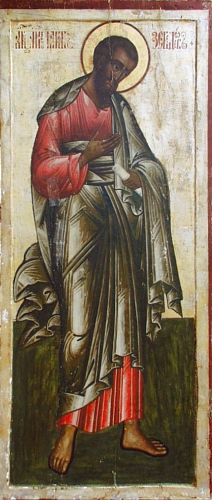
In Orthodox iconography James the son of Zebedee is an apostle of the fisherman type: middle-aged rather than old, with dark hair and a short rounded beard, in the chiton and himation of the apostles (the mantle very often red), holding a scroll or a codex of the Gospel, sometimes with the right hand raised in speech or blessing. He is regularly painted beside his brother John, and in the great programmes he appears three times over in narrative: in the calling of the fishermen, in the Transfiguration (where the three disciples are cast down at the foot of the mountain — James is normally the middle or the leftmost figure, and John the youngest and beardless), and in the Gethsemane scene of the Passion cycle. Menologion cycles for April show his beheading: the apostle kneeling, hands bound or joined, and the executioner with the raised sword.
The two safeguards for identifying him are the inscription and the company: he is never vested as a bishop — that is James the Brother of the Lord, shown in phelonion and omophorion (or in sakkos) with a high forehead and a long beard, as first hierarch of Jerusalem — and he is not normally the grey, pointed-bearded elder of the son of Alphaeus type. The scallop shell, broad pilgrim's hat, staff, gourd and the mounted "Moor-slayer" are Western attributes of Santiago and have no place in Orthodox images of the apostle.
The stored image is a full-length panel from the iconostasis of the Transfiguration church at Kizhi in Karelia (first quarter of the eighteenth century). The apostle stands on a green ground in a rose-red himation over a pale chiton, the right hand raised to the breast, and the identification is put beyond doubt by the Slavonic inscription flanking the nimbus, which names him not merely "Apostle James" but Іаковъ Зеведеовъ — James, son of Zebedee.
Disputed questions
-
The three Jameses. The Orthodox calendar keeps three distinct apostolic Jameses, and the distinction must be held firmly:
- this James, son of Zebedee, one of the Twelve and of the inner three, beheaded at Jerusalem in 44 (Acts 12:2), feast April 30;
- James the Brother of the Lord, first bishop of Jerusalem, author of the Epistle and of the Liturgy that bears his name, put to death about 62, feast October 23 — he was not one of the Twelve, and he is portrayed as a hierarch in vestments, never as a fisherman-apostle;
- James the son of Alphaeus, of the Twelve, of whom the Gospels record no separate deed, feast October 9.
The Western tradition, on the Hieronymian reading, merges the Brother of the Lord with the son of Alphaeus and so speaks of only two apostolic Jameses, "the Greater" and "the Less"; the Eastern books keep all three apart. Confusion is worsened by the shared Greek name Ἰάκωβος, by the fact that the Slavonic and Greek inscriptions on icons often read simply "the Apostle James," and by the Western epithets Greater/Less, which say nothing about which James is meant to a reader unused to them. Note also the non-apostolic Jameses of the synaxaria: James the Persian (Nov 27), James of Nisibis (Jan 13), James the Ascetic (Jan 28 / Mar 4), and others.
-
Did James preach in Spain? No first-millennium Eastern source says so, and the earliest Western witness is more than five centuries after his death; the chronology is also hard, since Acts leaves him in the ambit of Jerusalem and gives him at most a dozen years. The Orthodox commemoration therefore rests on the Acts and on his place among the inner three, and the Spanish mission is recorded here as a Western tradition of the sixth century and after, not as a fact of the apostolic age. That judgement carries no slight to the shrine or to the pilgrims: what the Church venerates at Compostela is the memory of the apostle, and the memory is true even where the itinerary is not demonstrable.
-
The year. Because Agrippa's death is firmly dated to 44, the martyrdom is placed variously at 42, 43 or 44; the calendars conventionally give 44, and some Western chronologies, following the order of Acts, prefer 43 or 42. The difference is of a season or two, and no source allows more precision.
-
The day. The Byzantine calendars keep April 30, and this is the date used by all Orthodox jurisdictions. The Latin West keeps July 25, the Mozarabic use kept December 30, and the Armenians keep him with his brother on a movable day near the Nativity. The origin of neither the Eastern nor the Western date is known; neither can plausibly be the anniversary of the beheading, which fell near Passover.