
James of Nisibis
Our Father among the Saints James the Wonderworker, Bishop of Nisibis
Bishop · Venerable · Wonderworker · b. mid-3rd century — d. c. 350, at Nisibis
Commemorated 13 January — Repose at Nisibis
James of Nisibis (†c. 350) was the first known bishop of Nisibis, the great Roman frontier-city on the edge of the Persian empire, and one of the most revered fathers of the fourth-century Syrian Church. An ascetic from his youth, he lived as a hermit in the mountains around the city — under the open sky, clothed in goatskins, feeding on wild plants — before his fame drew the people of Nisibis to make him their bishop. He was numbered among the 318 Fathers of the First Ecumenical Council at Nicaea in 325, a firm opponent of Arius; he founded and taught in the school of Nisibis, where his most famous pupil was Ephrem the Syrian, who revered him as father and teacher; and he was celebrated as a wonderworker whose prayers were believed to have delivered Nisibis from the armies of the Persian king Shapur II. He reposed in peace about the year 350, and is kept on January 13.

Origins and ascetic life
James — in Syriac Yaʿqub, in Greek and English "James" or "Jacob" — was born in the region of Nisibis in the middle of the third century, in the borderland between the Roman and Persian empires. A later tradition, transmitted in the OCA life and in Armenian sources that claim him as a kinsman of Gregory the Illuminator, makes him the son of a prince named Gefal and gives him an Armenian princely descent; the Syriac tradition simply knows him as a native of Nisibis. What the sources agree on, and what his greatest witness Ephrem confirms, is the manner of his early life. From his youth he loved solitude, and he withdrew to the mountains around Nisibis, living as a hermit in the open air — on the heights in summer, in caves in winter — clothed in a rough garment of goats' hair, eating no cultivated food but only the wild fruits and plants that grew of themselves, and giving himself wholly to prayer and the reading of Scripture. Theodoret of Cyrrhus, who opens his History of the Monks of Syria (the Philotheos Historia) with the life of James, presents him as the founding pattern of Syrian asceticism, the first and greatest of the mountain-solitaries whose lives he records, and attributes to him even in these hidden years a gift of foresight and of wonders.
Bishop of Nisibis
So great was the reputation of his holiness that the Christians of Nisibis drew him from his solitude and made him their bishop — no later than about the year 314, the first occupant of the see whose name is remembered, and the shepherd of a frontier church that stood, quite literally, on the edge of the Christian world. He did not lay down his ascetic rigour with his election but carried it into the episcopate, adding to it the labours of a pastor: he defended his flock against paganism, Judaism, and the sects, cared for the poor, and governed with the authority that his manifest sanctity gave him. Theodoret gathers under his episcopate a series of miracles of the sterner, prophetic kind — the punishment of insolent beggars who feigned death to cheat him and were found dead in earnest, a spring dried and restored — miracles which the hagiographer reads as the acts of a man clothed with the power of Elijah.
The Council of Nicaea
In the year 325 James took his place among the fathers of the First Ecumenical Council summoned by Constantine to Nicaea, one of the bishops of the Christian East who confronted the teaching of Arius that the Son of God was a creature. He is remembered by the tradition as one of the notable confessors of the council — some of the fathers, like the bishops of the great Persian-frontier and Armenian churches, bore in their bodies the scars of the persecutions only just ended — and as a firm defender of the consubstantiality of the Son with the Father that the council confessed in the Creed. His name stands in the traditional lists of the signatories, and the Church honours him among the 318 God-bearing Fathers whose faith Nisibis, through him, professed at the frontier of the empire.
The school of Nisibis and Ephrem the Syrian
Returning to his city, James is credited by the tradition with founding and teaching in a school at Nisibis — the seed, in the Syriac memory, of the famous theological School of Nisibis that would flourish there and, after the city passed to Persia in 363, be refounded at Edessa and again at Nisibis as the great academy of the Syriac-speaking Church. In that school his most celebrated disciple was Ephrem the Syrian (commemorated January 28), the incomparable poet-theologian and Doctor of the Church, who was born at Nisibis and grew up under James's eye. Ephrem revered him as his father in the faith and his teacher (malpānā), served the church of Nisibis under him and his successors, and in his own Carmina Nisibena — the cycle of hymns on the sieges of the city — looked back on James as the bishop whose holiness had been the city's true wall. Through Ephrem, the ascetic bishop of the frontier stands at the head of the whole tradition of Syriac Christian poetry and theology.
The deliverance of Nisibis
The miracle for which James is most famous in the Byzantine tradition is the deliverance of Nisibis from the Persians. The city, the strongest Roman fortress of Mesopotamia, was repeatedly besieged by the Persian king Shapur II (Sapor) — the great siege the tradition attaches to James falling about 337–338, at the very end of his life. When the vast Persian army encircled the walls and the city seemed lost, the bishop mounted the ramparts and prayed; and — as the tradition, following Theodoret and Ephrem, tells it — his prayer called down upon the besiegers a plague of gnats and mosquitoes that maddened the horses and elephants of the Persians, filled the trunks and ears and nostrils of the beasts, threw the camp into confusion, and, with famine and pestilence, forced Shapur to raise the siege and withdraw. The people of Nisibis saw in their bishop's prayer the salvation of the city, and the memory of James as the wall and defender of Nisibis outlived the city's own Roman period. (Ephrem's hymns and the historians attach to Nisibis three great sieges by Shapur, in 337, 346, and 350; the tradition of the gnats belongs to the first, within James's lifetime.)
Repose
James reposed in peace at Nisibis about the year 350 — the traditional Byzantine date; some reckonings place his death a little earlier, about 338, soon after the first siege. He was buried within the walls of the city he had guarded, and his tomb was honoured there. When Nisibis was ceded to Persia by the emperor Jovian in 363 and its Christian population withdrew, his relics are said to have been carried away with them — in one tradition to Edessa, in another eventually to Constantinople and to the West — so that the bishop who in life had been the city's wall did not remain in it once it passed from Roman hands.
Writings
An Armenian corpus of homilies or "demonstrations" — a set of discourses on faith, love, fasting, prayer, the resurrection, and the Christian life, surviving complete only in Armenian and long ascribed to James of Nisibis — was for centuries read as his work, and the OCA life still describes him as the author of a Discourse in eighteen chapters. Modern scholarship has shown that these Demonstrations are in fact the work of Aphrahat ("the Persian Sage," fl. 337–345), a different and slightly younger Syriac writer whose name dropped out of the Armenian transmission in favour of the more famous bishop of Nisibis. The genuine writings of James himself, if he wrote, have not survived apart from this misattributed corpus; his monument is not a body of texts but the school, the disciple, and the memory that Ephrem and Theodoret preserved.
Feast and commemoration
James is commemorated on January 13 (church date; Old Calendar civil January 26), within the afterfeast of the Theophany. The Greek Menaion appoints for him the office of a holy hierarch, with proper stichera and kontakion that hail him as a pillar of Nicaea and the wall of Nisibis; the calendars style him ὅσιος, "venerable," as an ascetic bishop, and θαυματουργός, "wonderworker," for the deliverance of his city. The Antiochian, Greek, and Slavic calendars keep the day in common; the Syriac Churches, who count him among the founders of their tradition, honour Mar Yaʿqub of Nisibis in their own synaxaria as well.
Hymns
Troparion — Tone 4
A rule of faith and an image of meekness, a teacher of temperance, the truth of things did reveal thee to thy flock; therefore hast thou gained by humility the things that are exalted, and by poverty the things that are rich. O Father and Hierarch James, intercede with Christ our God that our souls may be saved.
Original translation from the Greek
Iconography
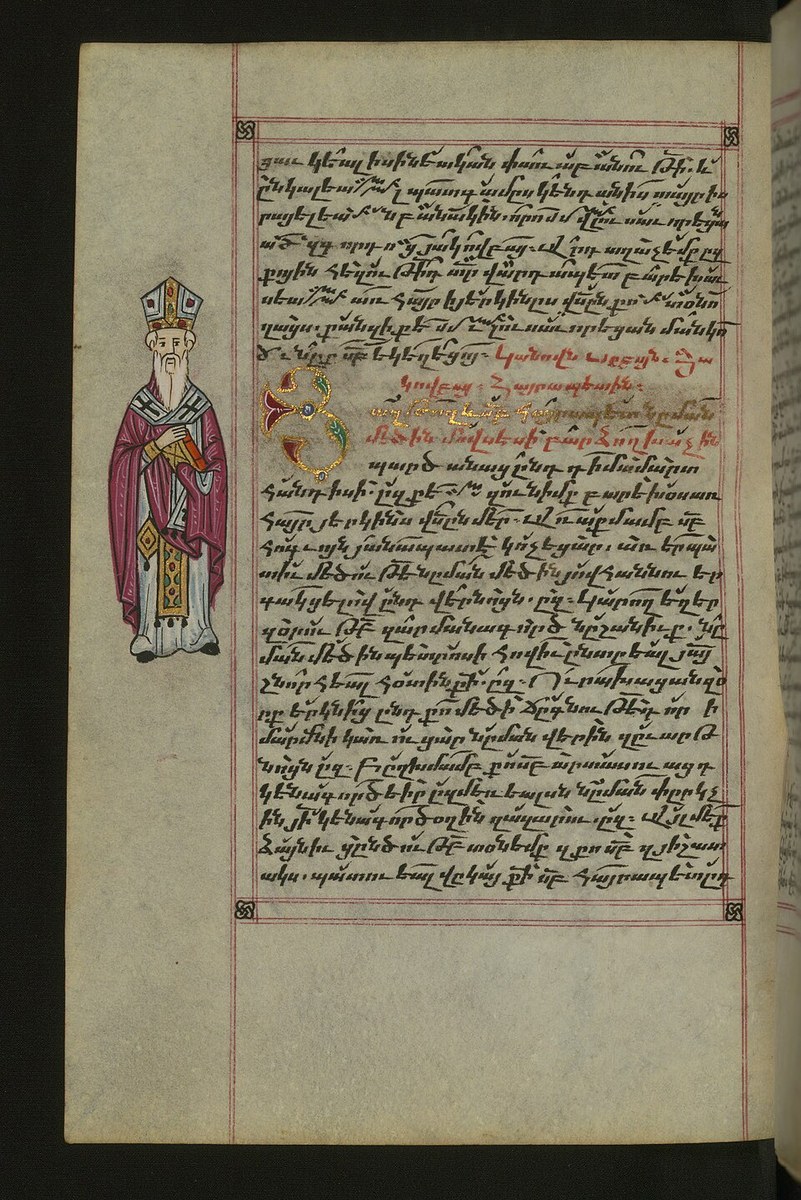
James is depicted as a bishop of venerable age — grey-haired and bearded, vested in the phelonion and omophorion and holding or blessing over the Gospel-book — in the settled type of the Nicene hierarch; his ascetic origin is sometimes marked by a gaunt face and a mountain setting. The stored image is a miniature of Saint James of Nisibis from an Armenian hymnal written at Constantinople in 1678 (the Walters Art Museum, Ms. W.547, fol. 216v), which shows the bishop vested and enthroned — a witness to his veneration in the Armenian tradition that claimed him as a kinsman of Gregory the Illuminator.
Disputed questions
- The date of his death. The Byzantine tradition places his repose about 350; the Syriac sources and much modern scholarship put it soon after the first siege of Nisibis, about 338. The two are reconciled if the great deliverance belongs to 337–338 and James lived a little longer; the entry gives "c. 350" with the earlier date noted.
- The Demonstrations. The discourses long circulated under James's name are now securely assigned to Aphrahat the Persian Sage; the attribution to James is an accident of the Armenian transmission (see Writings above).
- Not to be confused with the several other saints named James or Jacob: James the Persian the Great-martyr "the sawn-asunder" (†c. 421, November 27), a Persian courtier martyred a lifetime later; James the Hermit of Syria (5th c., November 26), a solitary of the region of Cyrrhus; the apostles James the son of Alphaeus, James the son of Zebedee (April 30) and James the Brother of the Lord; and the Russian James the Wonderworker, Bishop of Rostov (†1392). This James is the ascetic bishop of Nisibis, the father of Ephrem and the Nicene confessor of the Persian frontier.