
Joachim of Osogovo
Our Venerable and God-bearing Father Joachim of Osogovo, the Wonderworker of Sarandapor
Venerable · Wonderworker · d. 16 August 1105, in his cave on Mount Osogovo
Commemorated 16 August — Repose in the cave above the Sarandapor
Joachim of Osogovo (†16 August 1105) is one of the four great hermit-saints of the Bulgarian and Macedonian lands — with John of Rila, Prohor of Pčinja and Gabriel of Lesnovo — whose caves, in the century after the Byzantine conquest of Bulgaria, became the seed-beds of a native monasticism. A boyar of the village of Gradec gave him a cave above the river Sarandapor, in the Osogovo mountains near the modern Kriva Palanka, and there he lived out his life in fasting and prayer, unknown to almost everyone. After his death a widowed priest named Theodore settled at the place, took the monastic name Theophan, and uncovered his wonderworking relics; a church rose over them, and around the church the Osogovo Monastery, which has carried his name for nine centuries.

The land and the moment
Joachim's lifetime falls entirely within the period of direct Byzantine rule over the Bulgarian lands, which followed the fall of the First Bulgarian Empire in 1018. The Bulgarian patriarchate had been reduced to the archbishopric of Ohrid, the Slavonic literary tradition was under pressure from a Greek hierarchy, and the native Church's survival ran, to a remarkable degree, through the hermitages. Within a hundred years four solitaries — John in the Rila massif, Prohor above the Pčinja, Gabriel at Lesnovo, and Joachim on Osogovo — drew to themselves a veneration that outlasted every political arrangement of the region, and each of their caves became a monastery. All four are remembered together in the Slavic calendars, and the later Bulgarian tradition treats Joachim, Prohor and Gabriel expressly as the disciples and successors of John of Rila, though the chronology allows this only in the loosest spiritual sense.
Origins
Neither the date nor the place of his birth is recorded. The vita says only that he came to the Osogovo mountains from the west, which the historian Ivan Snegarov took to point to Zeta — the Serbian principality on the Adriatic — while the iconographic tradition, which paints him already old, suggests a birth about the middle of the eleventh century. The uncertainty is real and is not concealed here: what the sources give is a man arriving alone in the mountains from somewhere else, looking for a place to be hidden.
The cave above the Sarandapor
He found his patron in a boyar of the village of Gradec, near what is now Kriva Palanka in North Macedonia, who made over to him a cave beside the river Sarandapor (the "forty fords" — today the Kriva Reka). There Joachim spent the remainder of his life as an anchorite, in fasting and unceasing prayer, and there he died on 16 August 1105. The local people had already begun to honour him as a saint in his lifetime. He founded nothing, wrote nothing, and left no disciples; the whole of his recorded life is the cave and the discipline kept in it. His by-name in the older Slavonic sources is taken from the river rather than the mountain — Sarandaporski — and it is under that form that his cult first travelled.
The finding of the relics and the monastery
The sequel is what made him a saint of more than one valley. A widowed priest of Ovče Pole named Theodore settled at the deserted hermitage and took the monastic name Theophan; to him, the vita relates, Joachim appeared, and by that revelation the wonderworking relics were found. They were laid in a church built over the place, and in the course of the twelfth century — probably under Manuel I Komnenos — a monastery grew up around the church. This is the Osogovo (Sarandapor) Monastery of St Joachim, which stands to this day above Kriva Palanka.
At the monastery, and consciously on the model of the vita of John of Rila, a Slavonic Life of Joachim was composed, together with a liturgical service of the saint. Both survive only in later copies, and the dependence on the Rila model is plain enough that the biographical content of the vita must be handled with care; but the fact of a twelfth-century monastic cult with its own hagiography and its own office is itself the strongest evidence for the antiquity of the veneration.
The spread of the cult
By the middle of the fourteenth century the veneration of Joachim had spread from north-western Macedonia into the eastern Bulgarian lands, and by the end of that century into Russia. The Serbian kingdom took him up as well: the elevation of Joachim of Osogovo and Prohor of Pčinja is associated with the church of St George at Staro Nagoričane, rebuilt by King Stefan Milutin, and their cults were fostered as part of the same movement that made the holy hermits of the Slav lands into national patrons. His image appears among the Slavic venerable fathers in Bulgarian, Serbian and Macedonian churches from the fourteenth century onward, and prominently in the great nineteenth-century programme of Rila Monastery, where the four hermits are painted together.
Feast and commemoration
August 16 (church date; New Calendar civil August 16, Old Calendar civil August 29), within the afterfeast of the Dormition, kept by the Bulgarian, Serbian and Macedonian Churches, in the Russian calendar, and by the OCA. At the Osogovo Monastery the day is the patronal feast and draws a large pilgrimage. In the general calendar of the day he is a local commemoration standing beside the Translation of the Image Not-Made-by-Hands and the martyr Diomedes; the Greek synaxaria do not carry him.
Hymns
Troparion — Tone 8
Thou didst flee the tumult of the world and take the wilderness for thy dwelling, and in a cave of the mountain thou didst wrestle unseen, made rich in poverty and in fasting glorious; wherefore the Lord glorified thee after thy repose with a fountain of healings, O venerable father Joachim: intercede with Christ God that our souls may be saved.
Original translation from the Slavonic
Iconography
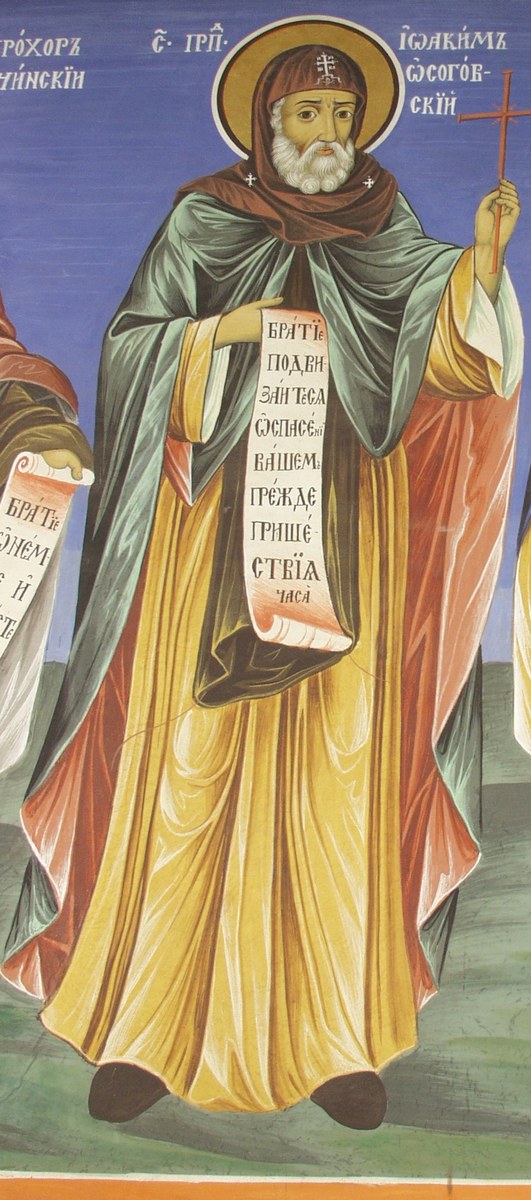
Joachim is painted as an aged monk in the full habit of the Slavic tradition — the brown or ochre tunic, the great analavos-marked mantle, and the pointed koukoulion drawn over the head and marked with crosses — with a long white beard falling to the chest. He commonly holds an unrolled scroll bearing an exhortation in Church Slavonic, and in some recensions a cross in the raised right hand. His proper company is the group of the four Slav hermits: he is regularly painted beside Prohor of Pčinja, Gabriel of Lesnovo and John of Rila, and the four are treated as a set in the mural programmes of Bulgarian, Serbian and Macedonian churches. Scenes of his life — the boyar of Gradec giving him the cave, the appearance to the priest Theodore, the finding of the relics — appear in the narrative cycles of the Osogovo monastery.
The stored image is from the chapel of the Archangels at Rila Monastery, painted in 1845 by Dimitar Zograf of the Samokov school: the saint standing full-length in the brown koukoulion marked with a cross, holding a red cross in the raised left hand and an unrolled scroll reading "Brethren, strive for your salvation before the hour of the coming"; the figure at his left in the same register is Prohor of Pčinja, his constant companion in the Slav iconographic tradition.
Disputed questions
- Eleventh century or twelfth? Every calendar — Bulgarian, Serbian, Russian and the OCA — styles Joachim an eleventh-century hermit, and the description is right about his life; but the transmitted date of his repose, 16 August 1105, falls in the twelfth century by strict reckoning. This entry indexes him under the twelfth century, since the index is by century of repose, and records the universal calendar usage here.
- Bulgarian, Serbian or Macedonian? He is claimed by all three, and the claim is in each case defensible: he lived and died in territory that is now North Macedonia, in a population and a literary culture that was then Bulgarian, and his cult was promoted by the medieval Serbian kingdom. Wikidata styles him a Serbian saint, the Bulgarian Church a Bulgarian one, and the monastery is Macedonian. The corpus records the veneration of all three Churches without adjudicating the nationality of an eleventh-century anchorite.
- The value of the vita. The Slavonic Life was written at the monastery on the model of the vita of John of Rila, more than a century after Joachim's death, and its narrative detail is correspondingly conventional. The elements that are not conventional — the boyar of Gradec, the cave on the Sarandapor, the priest Theodore of Ovče Pole, and the date 1105 — are the ones on which this entry rests.