
Job the Long-suffering
The Holy and Righteous Job the Long-suffering
Righteous · Forefather · d. c. 1350 BC (traditional reckoning; see Disputed questions)
Commemorated 6 May — Commemoration of the Righteous and Long-suffering Job
Job, called by the Church the Long-suffering (ὁ πολύαθλος, "of many contests"), is the righteous man of the land of Uz — blameless, upright, God-fearing and turning away from evil — whom God permitted Satan to strip of children, wealth and health, and who through the whole ruin blessed the Name that had given and had taken away. Seated on the ash-heap outside his city, scraping his sores with a potsherd, contradicted by his wife and lectured by his friends, he neither cursed God nor accepted their arithmetic of guilt, but demanded to speak with God himself — and was answered out of the whirlwind. His book, one of the summits of Israel's wisdom writing, is read through the first days of Holy Week, because the Church sees in the innocent sufferer who is vindicated and restored the shadow of the innocent Sufferer who is buried and raised. He is commemorated on May 6.
.jpg)
The man in the land of Uz
The book that bears his name opens with a formula that keeps him deliberately outside the history of Israel: "There was a man in the land of Uz whose name was Job" — in the Greek of the Septuagint, "a certain man in the land of Ausis," described as "true, blameless, righteous and godly, abstaining from every evil thing" (Job 1:1). He is no Israelite, has no priesthood, no temple and no Law; he sacrifices for his children as the patriarchs did, in his own household, "lest my sons have sinned in their hearts." The tradition therefore treats him as a saint of the natural law, a man who pleased God before Sinai and outside the covenant — which is exactly why the Fathers reach for him when they argue that righteousness is possible to human nature as such.
He was the greatest of the men of the East: seven sons and three daughters, seven thousand sheep, three thousand camels, five hundred yoke of oxen, five hundred she-asses, and a great household. The Septuagint's appendix to the book (42:17b–e) adds a genealogy absent from the Hebrew: Job is identified with Jobab, king of Edom, son of Zare (Zerah) of the line of Esau and of Bosorrha, the fifth generation from Abraham, dwelling "in the land of Ausitis, on the borders of Idumea and Arabia." It is this Greek text that the synaxaria follow, so that the Orthodox calendars call Job a descendant of Abraham and a ruler over Edom, and the icon-painters crown him.
The wager and the stripping
The prologue lifts the reader above Job's horizon into the divine council, where "the Adversary" — ὁ διάβολος in the Greek — answers God's praise of Job with the insinuation that has haunted religion ever since: does Job serve God for nothing? Take away the hedge and the man will curse. God gives Satan power over everything Job has, but not over the man himself.
The blows fall in a single day and in a deliberate crescendo: Sabean raiders take the oxen and asses; fire falls and burns the sheep; Chaldean bands take the camels; and a wind out of the desert throws down the house where his ten children are feasting, and kills them all. Four messengers arrive, each while the last is still speaking. Job rises, rends his mantle, shears his head, falls to the ground and worships:
Naked came I out of my mother's womb, and naked shall I return; the Lord gave, the Lord hath taken away — as it seemed good to the Lord, so has it come to pass; blessed be the name of the Lord. (Job 1:21)
At the second council Satan asks for his flesh, and Job is struck with a "grievous sore" from the soles of his feet to the crown of his head. The Greek text sets him "upon the dung-heap outside the city," scraping himself with a potsherd, his body running, his friends and townsmen keeping their distance. His wife — whom the Septuagint gives a long, bitter and very human lament, and whom the Testament of Job names Sitis — urges him to "say some word against the Lord and die." He answers: "If we have received good things from the hand of the Lord, shall we not endure evil things?" (Job 2:10). The narrator closes both scenes with the same verdict: in all this Job did not sin with his lips.
The friends, and the refusal to lie about God
Three friends come from a distance to mourn with him: Eliphaz the Temanite, Bildad the Shuhite and Zophar (Sophar the Minaean in the Greek). They sit seven days and seven nights in silence, and the silence is the best thing they do. When Job at last breaks out and curses the day of his birth, they begin the long cycles of speeches that make up the body of the book, and their argument never really changes: God is just, suffering is punishment, therefore Job has sinned and must confess. A fourth and younger speaker, Elihu son of Barachel the Buzite, adds a more subtle version of the same case.
Job's greatness in the dialogue is that he refuses both halves of the trap. He will not accuse God of injustice, and he will not accuse himself of crimes he has not committed in order to keep the theology tidy. He insists on his integrity, appeals past his accusers to a hearing before God, asks for an arbiter to lay a hand upon them both, and in the passage the Church has always read as prophecy declares that his Vindicator lives and that he will see God in his own flesh (Job 19:25–27; the Greek runs, "For I know that he is eternal who is about to deliver me"). Out of the ash-heap the patience becomes something more than endurance: it becomes the demand for God himself, and it is granted.
The whirlwind and the restoration
God answers, not with an explanation but with a theophany. Out of the whirlwind he questions Job out of the created world — the foundations of the earth, the storehouses of snow, the wild ass and the ostrich and the war-horse, and finally Behemoth and Leviathan, the two beasts whom no man masters and whom God handles as playthings (Job 38–41). Job's reply is the end of the argument: "I have heard of thee by the hearing of the ear, but now mine eye seeth thee; wherefore I abhor myself, and repent in dust and ashes." The Fathers read the answer as the gift of the vision of God, which makes the question of justification unnecessary.
The Lord then rebukes the three friends — "ye have not spoken of me the thing that is right, as my servant Job hath" — and makes Job intercede and sacrifice for them, so that the sufferer becomes priest for his accusers. His possessions are restored twofold, his brethren and acquaintance return, and ten children are born to him again; the Septuagint preserves the names of the three daughters, Hemera, Kasia and Amaltheia's Horn (42:14). The Hebrew says he lived a hundred and forty years afterward; the Greek says a hundred and seventy after the plague, "and all the years he lived were two hundred and forty," and adds the line on which the Church's Holy Week reading turns: it is written that he shall rise again with those whom the Lord raises up.
Job in the two Covenants
Already within the Old Testament Job stands as a byword for righteousness so personal that it cannot be transferred: Ezekiel names him with Noah and Daniel as three men whose righteousness would deliver their own souls but not their children (Ezekiel 14:14, 20). In the New Testament the Apostle James makes him the pattern Christians are to look at under trial — "ye have heard of the endurance of Job, and have seen the end of the Lord" (James 5:11) — and the epistle's word ὑπομονή, patient endurance, is the word the Greek office of May 6 repeats over him. Saint Paul quotes the book (1 Corinthians 3:19, from Job 5:13), and the liturgical tradition puts Job's protestation of innocence and God's answer from the whirlwind into the mouth of the Church at the very hour when she is burying Christ.
The reading of Job in Holy Week
The Triodion appoints the Book of Job to be read at the Vespers of the first days of Great and Holy Week, in parallel with Exodus: the prologue and the loss of his goods on Great Monday and Great Tuesday, the smiting of his body and his wife's counsel on Great Wednesday, the voice from the whirlwind with Job's submission on Great Thursday, and on Great Friday, at the Vespers of the taking down from the Cross, the last chapter — the restoration of Job, his new children, his long life and the promise that he shall rise again. The juxtaposition is the whole reason the righteous Job stands so high in Orthodox devotion: as the liturgical books are sung, Job's undeserved wounds interpret the wounds of Christ, his friends' theology of retribution is refuted by the Cross, and his restoration is read over the tomb of the buried Lord as the pledge of the Resurrection. In the Byzantine and Antiochian usage this makes Job, uniquely among Old Testament saints other than the Prophets, a figure heard from at length by every worshipper every year.
The tomb, the shrine and the cult
Christian pilgrimage to a tomb of Job is attested early and in the Syrian south — the Hauran, the basalt plateau east of the Jordan and south of Damascus, ancient Bashan, which the Greek Bible's "land of Ausitis" was taken to name. The pilgrim Egeria, travelling in the early 380s, describes a journey to the town of Carneas, also called Dennaba, in the land of Ausitis, where a church had been raised over the place at which Job's body was said to have been found, and where the bishop of the place — a monk — received her, showed her the memorial, and offered the sacrifice at Job's tomb. The neighbouring sites still carry his name: the village of Sheikh Saʿd (identified with Carneas/Karnaim) with its "Stone of Job," the bath and spring called Ḥammām Ayyūb, the ruined Dayr Ayyūb, the "monastery of Job." The Hauran shrines lie in the historic territory of the see of Bosra within the Patriarchate of Antioch, and the name Ayyūb has remained a common Christian as well as Muslim name in Syria and Lebanon, where Job's endurance is proverbial. (The "Stone of Job" itself is a cautionary case for hagiographical topography: when it was examined at the turn of the twentieth century the basalt monument proved to be a pharaonic stele of Ramesses II, re-used by the local tradition.) Rival tombs are shown in Oman, at Salalah, and near Urfa in upper Mesopotamia, with a "well of Job" — the multiplicity is the ordinary fate of a patriarch whose homeland the Bible itself does not locate.
Job in the Fathers and in the ascetic tradition
The Greek Fathers commented on Job continuously: John Chrysostom left a commentary and read Job as the athlete whose crown is his refusal of his wife's counsel; Didymus the Blind (whose commentary was recovered on papyrus at Tura), Julian the Arian and Olympiodorus of Alexandria all wrote on the book, and their fragments were gathered into the Greek catenae on Job, which the Byzantine scribes copied and illustrated. In the West Gregory the Great's Moralia in Iob, thirty-five books of moral and allegorical exposition, made Job the schoolmaster of medieval spirituality. In the monastic literature of the East Job is the standing example in the treatises on patience, on the profit of temptation, and on thanksgiving in affliction; Saint Basil the Great and Saint Gregory the Theologian hold him up in their consolatory letters, and the Paterikon repeats his answer to his wife almost as a formula of the ascetic life.
Feast and commemoration
Job is commemorated on May 6 (church date; New Calendar civil May 6, Old Calendar civil May 19) throughout the Byzantine rite, in Antiochian, Greek and Slavic usage alike, with the rank of a simple commemoration furnished with proper stichera and a canon. Because his memory falls in the weeks after Pascha, the office of the day is sung together with the Pentecostarion, and in years in which the fixed date coincides with Mid-Pentecost or with the leave-taking of a Paschal Sunday the resurrectional and festal hymns take precedence — an accident of the calendar that suits him, since it is precisely as a witness to the resurrection of the flesh that the Church reads his last chapter.
His deeper liturgical presence, however, is not on May 6 at all but in Holy Week, where the whole book is read (see above); and he is named among the righteous of the Old Covenant in the hymnography of the Sunday of the Forefathers before the Nativity, which is why the classification here carries forefather alongside righteous, although Job is not an ancestor of Christ according to the flesh. The Coptic Church keeps him on 2 Baramuda (April 27 in Julian reckoning) and on 4 Mesori; the Roman calendar has kept May 10, and Lutheran usage May 9.
Hymns
Troparion — Tone 4
Thy righteous one, O Lord, shall be held in everlasting remembrance; he shall not be afraid of any evil report, for his heart is ready to hope in the Lord. By his intercessions, O Christ God, save our souls.
Original translation from the Greek
Iconography
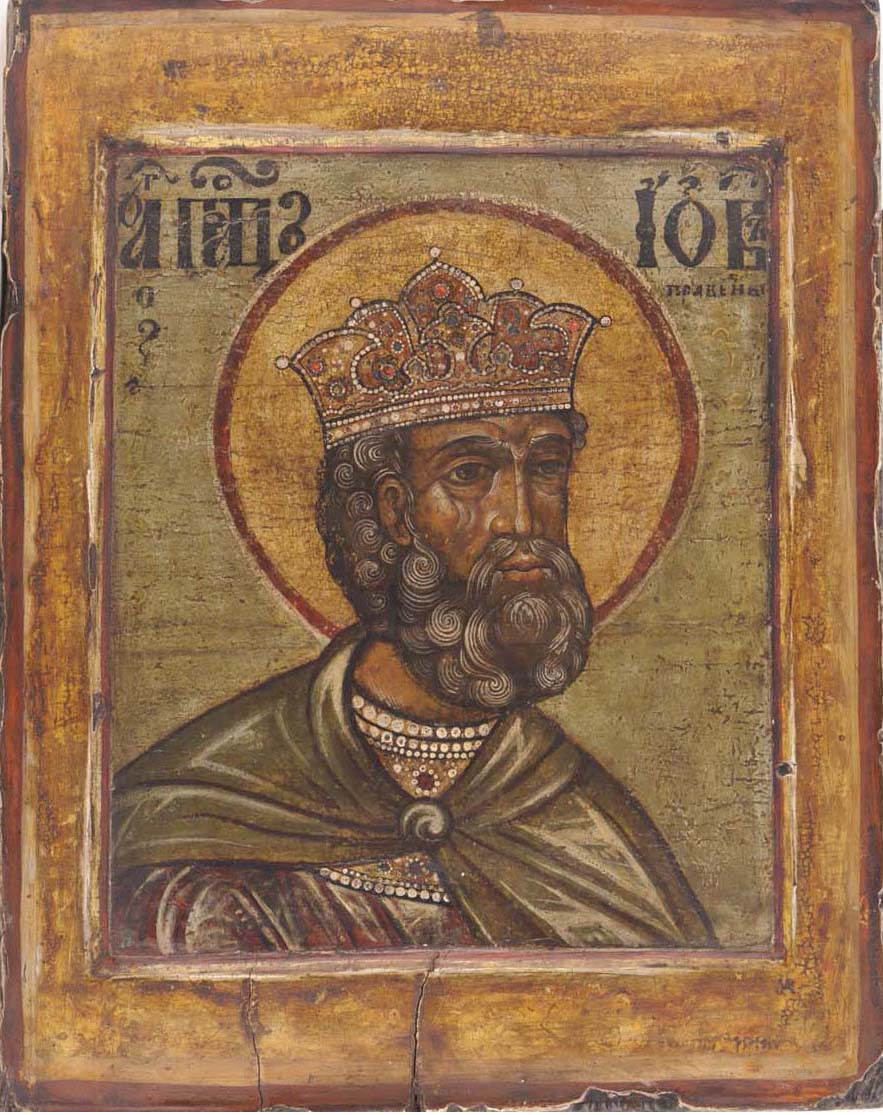
Job is painted as an old man with a long grey beard, and — following the Septuagint's identification of him with Jobab, king of Edom — very frequently crowned, in the mantle and jewelled collar of a king, so that the viewer meets not a beggar but a monarch who has been stripped and restored. His scroll, where he carries one, bears the words of Job 1:21. The narrative type shows the Job of the dung-heap: naked or half-naked on the ash-heap outside the city, covered with sores, one hand scraping himself with a potsherd, his three friends seated or standing in argument on one side, and his wife approaching from the other and holding out bread to him on the end of a long pole or forked stick — a detail of the Byzantine cycles, expressing both her care and her revulsion — while a small dark winged figure of Satan may be shown afflicting him. Full narrative cycles of his life illustrate a distinctive family of Greek catena manuscripts of Job, of which Vaticanus graecus 749 (ninth century) is the best-known witness, and Job appears among the righteous forefathers in the prophet tiers of Russian iconostases and in the menologion icons for the month of May.
The stored image is a Northern Russian panel of the late seventeenth century, inscribed СТЫ ІОВЪ ПРАВЕДНЫ ("Holy Job the Righteous"): a half-length figure, crowned with a jewelled crown, dark-bearded and curled in the northern manner, wearing a green mantle over a pearled collar — the royal type of the Septuagint tradition rather than the sufferer on the ash-heap.
Disputed questions
Job and Jobab. The identification of Job with Jobab king of Edom (Genesis 36:33) rests on the Septuagint's appendix and the "Syriac book" it cites, not on the Hebrew text, which gives Job no genealogy at all. The synaxaria and the Orthodox service books follow the Greek, and it is the source of Job's regal iconography; modern biblical scholarship treats the appendix as a later harmonising addition. The entry keeps the traditional identification because it is the Church's, while recording its basis.
Date and lifespan. The Slavic and Greek synaxaria place Job's repose about 1350 BC, on the reckoning of the Septuagint's 240 years of life; a second reckoning found in the same tradition makes the trial last one year rather than seven and the whole life 210 years, following the Hebrew's "a hundred and forty years afterward." No date is derivable from the book, which is deliberately set in the patriarchal age; the composition of the book in its present Hebrew form is generally dated far later than the man it portrays, and the two questions should not be confused.
The length of the trial. Job 7:3 in the Greek speaks of months of emptiness, and the tradition read the affliction as seven years; other synaxarion notices give one year. The office of May 6 does not settle it.
Historicity. The Fathers insist on Job as a historical man, and the anathemas against Theodore of Mopsuestia received at the Fifth Ecumenical Council (553) include his treatment of the Book of Job as a poetic fiction composed after the manner of the Greek dramatists. The Orthodox commemoration is of a man, not of a literary character; the book's genre — a prose frame around a great poem — is a separate question that the tradition has generally been content to leave open.
The Testament of Job. A Greek pseudepigraphon of the turn of the era retells the story with Job as a king who destroys an idol-temple and is attacked by Satan in revenge, names his wife Sitis and gives his daughters miraculous girdles at his death. It is not Scripture and the Church has never read it liturgically, but some of its details (the name of the wife, the crown) have coloured the iconography and the popular retellings.
Not to be confused with. Three later saints bear the same name and are unrelated to the patriarch: Job of Pochaev (†1651), abbot of the Pochaev Lavra; Job of Anzersk (†1720), the Solovki hermit; and Patriarch Job of Moscow (†1607), the first patriarch of Russia. The similarity of name is a real source of confusion in Russian usage, where all are called Iov.