
John the Long-suffering of the Kiev Caves
Our Venerable Father John the Long-suffering, Recluse of the Near Caves of Kiev
Venerable · d. 18 July 1160, at the Caves monastery of Kiev
Commemorated 18 July — Repose in his cave in the Near Caves, 28 September — Synaxis of the Venerable Fathers of the Near Caves
John the Long-suffering (†18 July 1160) was a recluse of the Near Caves of the Monastery of the Caves at Kiev whose whole ascetic life was one prolonged war against the passion of the flesh. Denied relief by fasting, thirst and iron chains, he shut himself into a cave beside the relics of Antony of the Kiev Caves, stayed there thirty years, and in one Great Lent had himself buried standing in the earth up to the shoulders for the whole of the fast, his legs burning as though in fire. On the night of Pascha a fiery serpent that had tormented him for days took his head into its jaws; he cried out, and at a flash of lightning it vanished, and a voice told him that the trial had been sent to purify him as gold is purified, and that heavy work is given to strong servants. He is the saint to whom the Orthodox traditionally turn in temptations of impurity, and his relics lie in the cave where he fought.

The Caves and the beginning of the struggle
John came to the Monastery of the Caves at Kiev — the mother-house of Russian monasticism, founded by Antony and Theodosius — in the twelfth century, when the community was at the height of its strength. His trouble began at once and did not leave him: from his youth he was assailed by carnal desire, and the ordinary weapons of the monastic life made no impression on it. He fasted for days together, went without water so that his mouth dried, wore heavy irons on his body, and passed whole nights without sleep; and the passion burned on.
Thirty years in the cave
At length he went down into the cave where the relics of Antony lay and prayed there a day and a night without rising. He heard the founder's voice: he was to become a recluse, that silence and enclosure might wear down what open struggle could not, and the Lord, by the prayers of the saints of that place, would help him.
He took the word as a command. He walled himself into a cave and remained in it, by the Paterikon's reckoning, thirty years before the passion left him. The narrative is candid about how nearly he failed: more than once he thought of leaving the enclosure, and each time answered the thought by increasing what he was already doing — more prostrations, longer standing, less bread.
The pit and the fiery serpent
In one Great Lent he dug a pit in the floor of his cave, went down into it, and had the earth filled in around him up to his shoulders, and so stood, buried and immovable, for the whole of the forty days. He says himself, in the account preserved of him, that his legs felt as if they were in fire, the sinews shrank and cracked, and flame seemed to come up out of the ground about his feet; and even so the old temptation went on burning in him.
Then the assault changed its character. A serpent of terrible appearance, breathing fire, came upon him and for several days tried to devour him, seizing his head and his arms. On the night of the Resurrection it took his whole head into its jaws. John cried out from the pit: "O Lord my God and my Saviour, why hast Thou forsaken me? Have mercy on me, Master, for Thou alone art the lover of mankind." At the word a flash of lightning filled the cave, the serpent was gone, and a divine light shone, and a voice said: "John, here is thy help; henceforth take heed to thyself, that nothing worse befall thee." And to his question why he had been left so long to suffer, the answer came that the temptation was measured to his strength, that he might be tried like gold in the furnace, since it is to the strong and able servants that a master gives the heavy work.
From that hour, the Paterikon says, he was free. He lived on in his cave in peace, and reposed on 18 July 1160.
Counsel to the tempted
The Paterikon preserves one act of his out of the years of freedom. A young brother of the monastery, tormented as John himself had been, came to him for help; and John — who never told him to fast harder — sent him to pray at the relics of the venerable Moses the Hungarian (Moses Ugrin, †c. 1043, commemorated July 26), the eunuch-martyr of chastity of the same house, and gave him a bone from Moses' relics to lay upon his body. The passion left the brother from that hour and never returned. The story fixes the character of John's own sanctity: he had learned that this warfare is not won by the strength of the ascetic but is given as a gift, and he sent men where the gift was to be had.
Relics and veneration
His relics remained where he died, in the Caves of St Antony (the Near Caves) at the Kiev Caves Lavra, and are venerated there still; the tradition of the Lavra shows the place where he stood buried in the earth. He is numbered in the Synaxis of the Venerable Fathers of the Near Caves (September 28) and in the synaxis of all the Caves fathers kept on the second Sunday of Great Lent. In Russian, Ukrainian and now general Orthodox practice, he is the saint invoked by those fighting bodily impurity — the one father of the calendar whose entire recorded life is that fight — and prayers to him for that intention stand in the Slavonic prayer-books.
Feast and commemoration
July 18 (church date; New Calendar civil July 18, Old Calendar civil July 31), the day of his repose, together with the Synaxis of the Fathers of the Near Caves on September 28 and the movable Caves synaxis of the second Sunday of Great Lent. The commemoration is Russian and Ukrainian in origin and is kept by the OCA and by the wider Orthodox world; the Greek calendars of July 18 do not carry it. On the same day the Lavra keeps a second of its own — Pambo the Recluse of the Far Caves — so that July 18 is, at Kiev, a feast of two confessors of the same house, one from each of the two caves.
Hymns
Troparion — Tone 8
In thee, O Father, was preserved unimpaired that which is according to the image; for taking up thy cross thou didst follow Christ, and by thy deeds thou didst teach us to despise the flesh, for it passeth away, but to care for the soul, a thing immortal. Wherefore, O venerable John, thy spirit rejoiceth with the angels.
Original translation from the Slavonic
Kontakion — Tone 2
Buried alive in the earth for the love of purity, and unconsumed by the fire that rose about thy feet, thou didst cry out in the jaws of the serpent, and the lightning of God delivered thee; wherefore, O long-suffering John, thou art a help to all who are burned by the passions, and a witness that the crown is given, not seized.
Original translation from the Slavonic
Iconography
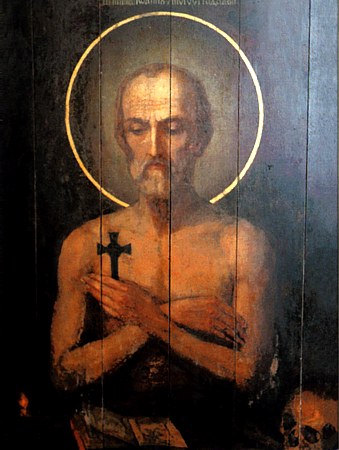
John is painted according to the manner of his struggle, and his image is unmistakable among the Caves fathers: an emaciated ascetic, naked to the waist, the ribs and sinews showing, the arms crossed on the breast and a small cross in the hand, standing sunk in the earth — the lower half of the figure either buried or shown as within the pit — with the cave dark behind him and, in fuller versions, the fiery serpent and the ray of light from above. A skull or an open book at his feet marks the recluse's cell. He is bearded, with long hair, and inscribed Прп. Іоаннъ Многострадальный.
The stored image is the panel of 1890 set over his reliquary in the Kiev Caves Lavra: the saint bust-length and half-buried, arms crossed, holding the blessing-cross, with the inscription above and the skull below at the right — the standard recension of the type. It is a nineteenth-century academic-style icon rather than a medieval one; no earlier image of him alone has been located.
Disputed questions
- Authorship and date of the account. The life belongs to the Kiev Caves Paterikon, the thirteenth-century compilation grown out of the correspondence of Bishop Simon of Vladimir and the monk Polycarp with the abbot Akindynos; it is therefore about a century later than the events, though it draws on the monastery's own memory and, in this tale, on words given in the first person as John's. Nothing outside the Paterikon corroborates it.
- The year 1160 is the Paterikon's, and is generally accepted; some Russian menologia give only "the twelfth century."
- Not to be confused with the righteous Job the Long-suffering (May 6), the patriarch of the Old Testament, who bears the same epithet in Slavonic (Многострадальный) — the commonest confusion in English lists — nor with the many other Johns of the Caves.