
Julian of Anazarbus
The Holy Martyr Julian of Anazarbus in Cilicia
Martyr · d. c. 305, in Cilicia
Commemorated 16 March — Martyrdom by drowning in a sack of vipers, 21 June — Kept as Julian of Tarsus in Greek usage, the day of St John Chrysostom's homily on him
Julian (†c. 305) was a martyr of Cilicia, in the south-east of Asia Minor — a young man of senatorial family from Anazarbus who confessed Christ in the Great Persecution under the Roman governor and, after a year of being dragged from city to city and tortured, was sewn into a sack filled with sand and venomous vipers and scorpions and cast into the sea. The waves bore his body to the Cilician shore (the tradition says to Alexandria), whence his relics were gathered and at last enshrined at Antioch. There, some ninety years later, John Chrysostom preached a celebrated homily in his honour, which remains the chief witness to his martyrdom. He is commemorated on March 16.
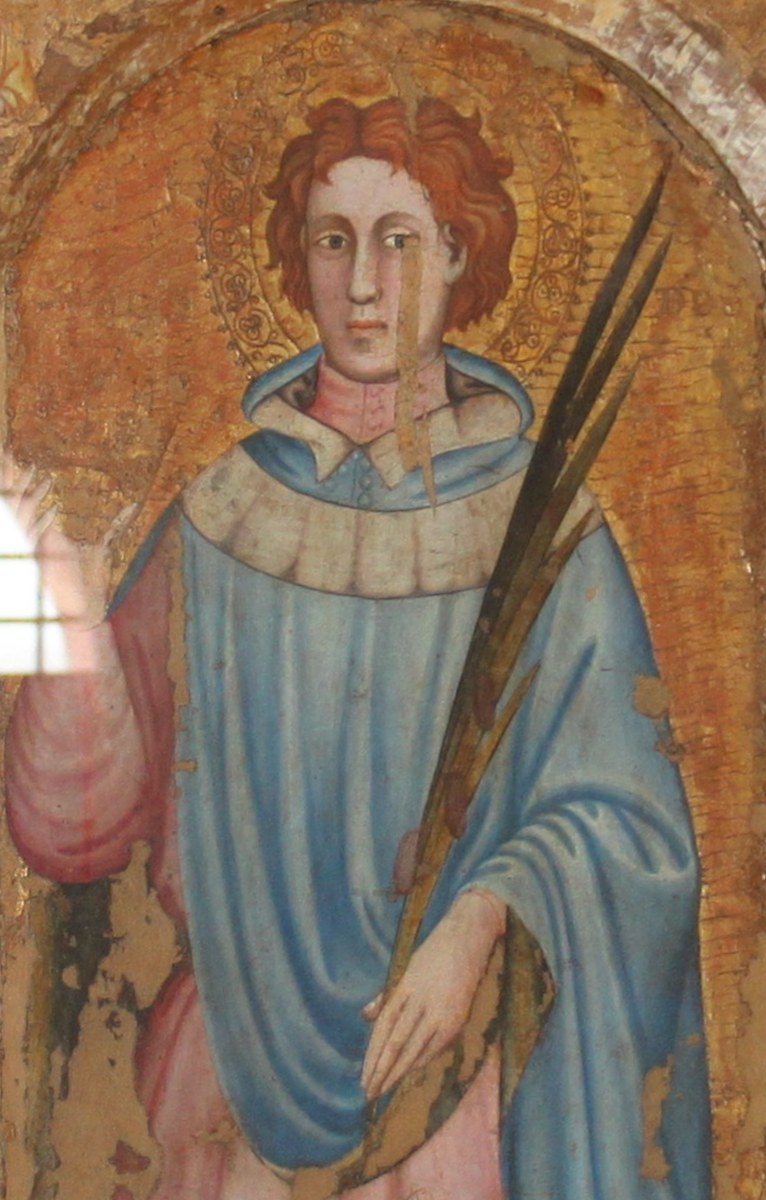

Julian belonged to Anazarbus, a city of the Cilician plain in south-eastern Asia Minor, and was, the tradition holds, of senatorial rank — a young man of good family, well-born and educated, who in the persecution of Diocletian and his colleagues (the sources place his contest about the year 305, under the Caesar Maximian Galerius and a governor variously named) openly professed himself a Christian and refused to sacrifice to the gods. He was about eighteen years old.
His martyrdom was not the swift stroke of the sword but a long ordeal. The governor, unable to move him by argument, torture, or the pleading of his own pagan family, resolved to break his constancy by shame and exhaustion: for a whole year Julian was led about through the cities of Cilicia, tortured afresh in each and put on display, that the sight of his sufferings might terrify the faithful and wear down his own resolve. It availed nothing; through every torment he held fast to his confession. At the last the judge condemned him to a death of studied cruelty: he was sewn up in a leather sack filled with sand and with living vipers, scorpions, and serpents, and the sack was cast into the sea, that he might die at once by drowning, by venom, and by the sting.
So Julian received the martyr's crown. The sea, however, did not swallow his witness: the tradition holds that the waves carried his body ashore — some accounts say it was borne as far as Alexandria in Egypt before returning — and that the faithful gathered up his remains as a treasure. His relics came in time to Antioch the Great, where they were enshrined and became a place of resort and healing.
John Chrysostom and the memory of Julian
The martyr's fame at Antioch is fixed forever by a single monument: about the year 390, while a presbyter of that city, John Chrysostom delivered a panegyric on the martyr Julian (In sanctum Julianum martyrem), preached on his feast before the Antiochene people at his shrine. In it Chrysostom dwells on the martyr's youth and courage, the venom that could not defile him, the sea that gave back his body, and the crowds who flocked to his relics — and it is this homily, more than any synaxarion, that carries Julian's memory into the tradition and secures the historical fact of his cultus at Antioch in the fourth century. For the Church of Antioch he is thus one of the martyrs of her own soil, praised by her greatest preacher.
Feast and commemoration
Julian is commemorated on March 16 (church date; Old Calendar civil March 29) in the Greek Menaion, the Slavic Menaion, and the OCA synaxarion. Because the day falls within Great Lent, his memory ordinarily lands on a weekday of the Fast, when the full Liturgy is not served and no fixed Epistle and Gospel are appointed; his office is joined to the Lenten order.
Hymns
Troparion — Tone 4 (common of a martyr)
Thy martyr Julian, O Lord, in his contest has received from thee our God the crown of incorruption; for having thy strength, he cast down the tyrants and shattered the impotent insolence of the demons. By his supplications, O Christ God, save our souls.
Original translation from the Greek
Iconography
Julian is depicted in the type of a young lay martyr — a beardless or lightly bearded youth in the tunic and cloak, holding the small cross of the martyrs — and, where his passion is shown, bound within the sack cast upon the waves, the serpents and scorpions about him, or with the sea giving up his body on the shore, the narrative sign proper to him.
The stored image is a Western work: the panel of Bittino da Faenza's polyptych of 1409 in the church of San Giuliano at Rimini — the city that holds the martyr's relics and keeps him as patron — the young saint red-haired and mantled in blue, bearing the palm of martyrdom. Stored under the ruling that admits Western works for saints with no located Eastern image (the project's record of open questions); an Orthodox icon remains wanted and is listed among the upgrade-wanted icons.
Disputed questions
- Julian of Anazarbus and Julian of Tarsus. The martyr kept on March 16 as "Julian of Anazarbus" is very difficult to separate from the martyr Julian of Tarsus (Julian of Cilicia), commemorated in the Byzantine calendar on June 21, whose passion — a young Cilician of senatorial rank, tortured for a year through the cities of the province and drowned sewn in a sack of vipers, his relics venerated at Antioch — is told in the very same terms, and who is likewise the subject of John Chrysostom's homily. The dominant scholarly view is that the two are one and the same Cilician martyr, kept on two days and under two civic names (Anazarbus and Tarsus being neighbouring cities of the one province); the synaxaria, however, transmit the March 16 and June 21 commemorations separately, and this collection follows the calendars in keeping the March 16 notice of "Julian of Anazarbus" as they present it, while recording the identity with the June 21 martyr as the strong likelihood it is. He is to be distinguished from the many other saints named Julian in the calendar (the martyr of Emesa, Julian and Basilissa, Julian of Galatia, and the rest) — and in particular from the deacon Julian of Novara, brother of the presbyter Julius, who is commemorated on June 21 on the very same page of the synaxarion as this martyr's Tarsian feast, and who is not a martyr at all.
- The June 21 commemoration. The addition of the June 21 feast to this entry's frontmatter, as a second commemoration of the same Cilician martyr under the name "Julian of Tarsus," is outstanding; the June 21 calendar file lists him from this entry rather than minting a duplicate slug. See the coordination note for June 21.
- The Wikidata identifier. The Wikidata item recorded here (Q724454) is labelled "Julian of Antioch" with the aliases "Julian of Anazarbus" and "Julian of Tarsus"; it correctly gathers this Cilician martyr, but it also conflates him with a Latin Julian of Rimini and carries mixed feast-day data — used here for the core identity only, with the conflation flagged.