
Julius and Julian of Novara
Our Venerable Fathers Julius the Presbyter and Julian the Deacon, his brother, of Novara
Venerable · Priest · Deacon · d. c. 401 (Latin tradition); after the middle of the 5th century (Byzantine synaxaria)
Commemorated 21 June — Joint commemoration of the two brothers, builders of churches
Julius and Julian were brothers, a presbyter and a deacon, Greeks by birth who in the fourth or fifth century carried the Gospel into the north Italian lake country and spent their lives throwing down the altars of the old religion and raising churches in their place — a hundred of them, the tradition says, the last of which Julius built on the island in Lake Orta that has borne his name ever since. Their memory is Western in its soil and Eastern in its calendar: the Latin Church keeps Julius at Novara on January 31 and Julian at Gozzano, while the Byzantine books commemorate the two brothers together on June 21, and the Slavonic synaxarion tells their story at length. Both reposed in peace and are honoured as venerable rather than as martyrs.

Two brothers out of the Greek East
The brothers were Greeks. The Byzantine notice calls their homeland Myrmidonia — the land of the Myrmidons, that is the island of Aegina in the Saronic Gulf, whose ancient people bore that name — and the Latin tradition likewise knows Julius as Julius of Aegina. Julius, the elder, was ordained presbyter; Julian, the younger, deacon; and the two of them, unwilling to serve a quiet church at home, went west to Rome and thence into the provinces, preaching to the still largely pagan countryside and confirming the word with signs.
Their work fell in the decades when the imperial legislation against sacrifice was turning from threat to demolition, and the tradition places them at the centre of it. They obtained an imperial rescript authorising them to pull down the temples and the sacred groves and to build churches on the sites — the Latin accounts naming Theodosius the Great as the emperor who gave it, the Slavonic accounts Theodosius the Younger, and the Byzantine notice adding that they went up to Constantinople, received the blessing of the patriarch, and were sent on their way with the emperor's letter and an order to the governors to give them what they needed. Armed with this, they moved through northern Italy demolishing and building.
The hundred churches
The number that fixes them in the tradition is one hundred churches. The ninety-ninth was raised at Gozzano, above the southern end of Lake Orta, in honour of the martyr Laurence; there Julian remained, and there, in a crypt he built with his own hands, he was in time laid to rest — his brother, the account says, having prophesied over the empty tomb whose body it would hold.
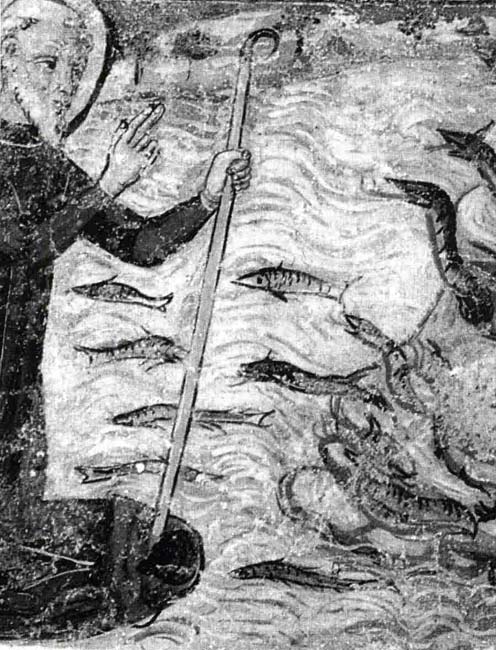
The hundredth Julius reserved for a place nobody would go: a rocky island in the lake — the Byzantine notice calls the water Mukoros, the Latin knows it as Lake Orta — reputed to be so infested with serpents and dragons that no boat would put in there. Finding no boatman willing to carry him, Julius (so the story runs) spread his cloak upon the water, set his staff for a mast, and sailed across; and standing on the rock he commanded the serpents in the name of Christ to depart, and they went out of the island into the deep. On the cleared ground he built his last church — dedicated, the Byzantine account says, to the Twelve Apostles, and in the Latin record to the Apostles Peter and Paul. The Isola San Giulio in Lake Orta, with its basilica and the crypt (the scurolo) that holds his relics, is the direct continuation of that foundation and remains one of the oldest continuously venerated Christian sites of Piedmont.
The feigned death
One episode is transmitted in both traditions and is worth recording because it is so unlike the usual matter of a builder's life. Some travellers, meeting the brothers on the road and fearing to be pressed into the labour of the building, agreed among themselves to say that one of their number was dead and that they were carrying him to burial; and one lay down and played the corpse. Asked what they were about, they answered that they were burying a dead man. Julian said that their word would stand — and when they went to raise their companion, he was dead in earnest. The tale is told to teach the peril of a lie made in the presence of a servant of God, and it is the one anecdote the Slavonic synaxarion keeps in full.
Repose and relics
Julian died first and was buried in the crypt beside his church of St Laurence at Gozzano; Julius was buried on his island. Neither brother was martyred: they are commemorated as venerable, holy ascetics and labourers who reposed in peace. Their graves became the two poles of a strong local cultus in the diocese of Novara, and the relics of both survive — a point of some weight, since excavation at Gozzano in the modern period recovered a burial answering to the tradition, and confirmed that the two were distinct persons and not, as had once been proposed, a single saint doubled by his own legend.
Feast and commemoration
June 21 (church date; New Calendar civil June 21, Old Calendar civil July 4) in the Byzantine calendar, where the two are kept together as Ἰουλίου πρεσβυτέρου καὶ Ἰουλιανοῦ διακόνου and the Slavonic books style them преподобные — venerable. Latin usage differs entirely: Julius is kept at Novara on January 31, and Julian at Gozzano; the Orthodox commemoration of Julius on May 19 is also met with in some Greek lists. The day carries the service of Julian of Tarsus, and the brothers are commemorated at the synaxarion reading. As pre-schism Western saints of Greek birth they are kept without controversy on both sides of the later division, and their island church is a place of Orthodox as well as Latin pilgrimage.
Hymns
Apolytikion — Tone 8 (common of venerable monastics)
In you, O Fathers, was the image of God preserved unimpaired; for taking up the Cross you followed Christ, and by your deeds you taught us to despise the flesh, which passes away, but to care for the soul, a thing immortal. Wherefore, O venerable Julius and Julian, your spirits rejoice with the angels.
Iconography
Julius is shown as a priest, in phelonion and epitrachelion, bearded, blessing or holding a Gospel-book, and very often with the sign proper to him: the island with its church, or the cloak spread upon the water carrying him across the lake, or the serpents and the dragon fleeing into the deep before his staff. Julian stands beside him as a deacon, in the sticharion with the orarion over the shoulder and a censer or a small casket in his hand, younger and often beardless. In the Piedmontese churches the pair are painted together, sometimes with the model of a church between them, for the hundred foundations.
The stored image is an Italian wall-painting of Julius at the moment of the miracle: the haloed priest, tonsured and in a dark habit, blessing with the right hand and grasping the long crook-headed staff with the left, standing above a lake full of fish out of which a serpentine dragon twists away from him. The identification is secure from the attributes; the photograph is an old monochrome reproduction taken from a devotional archive, and the date of the underlying fresco is not recorded on the source file record — it is stored here as a pre-modern work on the evidence of its manifest style and condition, and the gap in its documentation is noted rather than papered over.
Disputed questions
- Which Theodosius? The Latin passio and the Western scholarship put the brothers under Theodosius I (379–395), with Julius dying about 401; the Byzantine and Slavonic notices name Theodosius the Younger (408–450) and place their repose after the middle of the fifth century. The difference is of about two generations. The Western date fits the legal history better — it is Theodosius I whose edicts of 391–392 ended public sacrifice and licensed the destruction of temples — while the Eastern date may reflect the later composition of the Greek notice. The earliest surviving Life is no older than the eighth century, so neither date rests on a contemporary record. This entry records both and assigns the century as 5 with that caveat.
- One saint or two? It was formerly argued that "Julius" and "Julian" were a single founder split in two by the two church-sites, the names being variants of one another. The archaeological recovery of the Gozzano burial, and the independence of the two cults in the earliest Novarese records, have told against this; the brothers are treated as two.
- Not to be confused with the many other saints named Julian in the Byzantine calendar — above all with Julian of Tarsus (of Anazarbus), the Cilician martyr commemorated on this same day, June 21, with whom the deacon Julian is most easily confounded; and further with Julian of Emesa the physician (February 6), Julian and Basilissa of Antinoe, Julian of Mesopotamia, Julian and Caesarius of Terracina, and Julian of Galatia and his forty companions. The deacon of Novara is the only one of them who is not a martyr.