
Julian of Emesa
The Holy Martyr Julian of Emesa, the Physician
Martyr · d. c. 284 (some sources c. 312), at Emesa
Commemorated 6 February — Martyrdom at Emesa, within the afterfeast of the Meeting
Julian (†c. 284) was a young Christian physician of Emesa in Syria (modern Homs), martyred for the faith in the persecutions of the late third century. The tradition remembers him as a healer of both body and soul, who used his art as an open door for the Gospel, secretly tending the Christians imprisoned for Christ and bringing many of the sick and the pagan to baptism. Seized for his confession and refusing to sacrifice, he was put to death by a cruel torture — nails driven into his head, hands, and feet — and so received the martyr's crown. His memory was cherished at Emesa, where a church of Saint Elian rose over the place of his death and still guards his tomb; he is honoured as a patron of physicians and of the sick. He is commemorated on February 6, within the afterfeast of the Meeting.
.jpeg)
The physician of Emesa
Emesa — the city of the Orontes valley in Syria, of old famous for its great temple of the sun and by the third century a flourishing Christian centre, and one of the ancient sees of the Patriarchate of Antioch — is the home of this martyr. Julian was a physician of the city, young and of Christian faith, and the tradition dwells on the way he joined his calling to his confession: he healed the body that he might reach the soul, giving his art freely and using the trust it won him to speak of Christ, so that many whom he cured, and many pagans besides, were brought to baptism through his hands. In the manner of the holy physicians, he made medicine a ministry of the Gospel.
His charity reached above all to the confessors in prison. When the persecution fell upon Emesa and its bishop and clergy were seized, Julian is said to have come secretly to the prison to tend and encourage those held for the faith — a service that in some tellings binds his memory to the martyr-bishop Silvanus of Emesa and his companions, put to death in the same city in the same persecution. Whether he ministered to those very martyrs or to others of their number, the picture is constant: the young doctor moving among the imprisoned Christians, healing and consoling, until his own turn came.
Martyrdom
Denounced as a Christian and brought before the persecutors, Julian confessed Christ and refused to sacrifice to the gods. He was condemned to a death of peculiar cruelty: the tradition says that iron nails were driven into his head, his hands, and his feet, and so, in torment, he gave up his soul to God and was numbered with the martyrs. His body was gathered and honoured by the Christians of Emesa.
Veneration and relics
Julian's cult was firmly rooted at Emesa. A church of Saint Elian — Elian being the Syriac form of his name — was built, the tradition says as early as the year 432, over the site of his martyrdom, and his relics were laid in a sarcophagus in a chapel by the crypt; the shrine survives to this day at Homs, and a monastery bears his name in the Syrian desert nearby. Among the Arabic-speaking Christians of Syria, Mar Elian of Homs is a beloved and living patron, and his memory is kept with especial warmth in the Church of Antioch to which Emesa belongs. He is invoked, as befits his calling, for the healing of the sick and as a patron of physicians.
Feast and commemoration
Julian is commemorated on February 6 (church date; Old Calendar civil February 19), within the afterfeast of the Meeting of the Lord, his office sung with the hymns of the Meeting. The Greek, Slavic, and Antiochian calendars keep him on this day; the Oriental Orthodox and some Western calendars observe him on February 7. He is honoured with the common hymns of a martyr.
Hymns
Troparion — Tone 4
Thy martyr Julian, O Lord, in his contest received the crown incorruptible from thee our God; for, possessed of thy might, he cast down the tyrants and shattered the powerless boldness of the demons. By his intercessions save our souls, O Christ our God.
Original translation from the Greek
Iconography
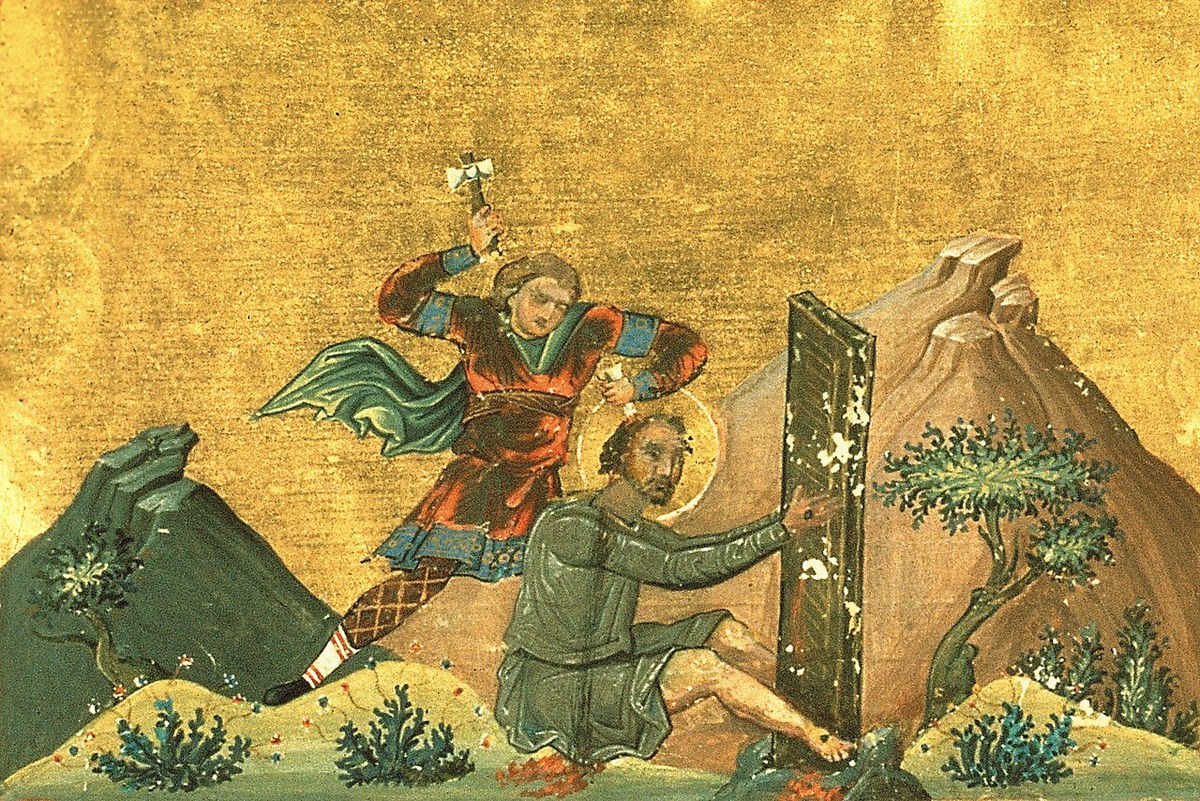
Julian is shown in the type of the young lay martyr: a beardless or lightly bearded youth in the tunic and cloak, holding the small cross of martyrdom; where his calling is marked, the physician's box or lancet identifies him, as with the holy unmercenaries. His narrative image is the martyrdom — the young man struck down and put to death by his executioner.
The stored image is the miniature for February 6 from the Menologion of Basil II (Constantinople, c. 985; Vatican, Vat. gr. 1613), showing the martyrdom of Julian: the saint, haloed, brought to the ground before a rocky landscape while his executioner raises the instrument of death above him (source, public domain, pd-old-work).
Disputed questions
- The date, and the persecution. The classical Greek synaxarion places Julian's martyrdom under the emperor Numerian, about the year 284; several jurisdictional calendars (the OCA and the Slavic tradition) instead assign it to the Great Persecution, about 312, under Maximian/Maximinus. The difference of some thirty years turns on which persecution the tradition of Emesa attached to him, and it is bound up with the further question of his link to Silvanus of Emesa (†c. 312, kept January 29): if Julian tended those very martyrs, the later date would follow. The sources are recorded here as they stand; the earlier, Numerianic dating is given as primary, with the c. 312 tradition noted.
- Not to be confused with the several other martyrs named Julian in the calendars — among them Julian of Anazarbus, Julian of Cilicia, Julian and Basilissa of Antinoë, and Julian of Mesopotamia. This Julian is the physician of Emesa, distinguished by his city and his art.