
Juliana of Olshansk
The Holy and Righteous Virgin Juliana, Princess of Olshansk
Righteous · Virgin · Princess · d. c. 1540
Commemorated 6 July — Uncovering of the incorrupt relics at the Kiev Caves Lavra, 28 September — Synaxis of the venerable fathers of the Kiev Caves whose relics repose in the Near Caves
Juliana was the daughter of Prince Yuri Dubrovitsky-Olshansky, a Lithuanian-Rus' magnate of the early sixteenth century and a benefactor of the Kiev Caves Lavra. She died a virgin at the age of sixteen, and was buried near the Great Church of the Dormition. Long afterwards, monks digging a grave beside the church struck an unrecorded coffin and found her body incorrupt, lying as if asleep in a white dress sewn with gold and adorned with her ornaments, with an inscribed plate naming her. Healings followed at her shrine; a thief who stripped a jewel from the relics fell dead at the gate; and Metropolitan Peter Mogila, after a vision in which the saint reproached him for the little honour paid her, enshrined her with a solemn inscription. What survived the Lavra fire of 1718 was laid in the Near Caves, where it remains. Her feast is kept as the uncovering of her relics, on July 6.

The house of Olshansk
The Olshansky (Holshansky) princes were a Lithuanian-Rus' family of the first rank, whose lands lay in the Kiev region under the rule of the Grand Duchy of Lithuania — Kiev having passed out of direct Rus' rule after the Mongol destruction, so that the Orthodox of the city lived from the fourteenth century onwards under Catholic sovereigns while their monasteries retained a precarious independence. Juliana's father, Prince Yuri (George) Dubrovitsky-Olshansky, was a benefactor of the Kiev Caves Lavra, the great house of Rus' monasticism founded by Anthony and Theodosius, and it was as a family of donors that the Olshanskys had a burial claim close to the Lavra's principal church.
Of Juliana's own life the tradition records almost nothing but its brevity and its purity. She reposed a virgin at sixteen, unmarried and unbetrothed — the record does not preserve the cause — and her father buried her beside the Great Church of the Dormition within the Lavra enclosure. No cult attached to her at the time; she was, so far as her contemporaries were concerned, a young noblewoman who had died and been laid in a good grave. The received date is about 1540.
The uncovering of the relics
Some generations later — the interval is the chief uncertainty in her history — brethren of the Lavra digging a new grave near the Great Church broke into a coffin whose occupant nobody had recorded. Opened, it disclosed a body entire and undecayed: a young woman lying, in the phrase of the account, as if alive, in a white dress sewn with gold and wearing rich ornaments, and with a plate on the coffin bearing an inscription that identified her as Juliana, daughter of Prince Yuri Olshansky. The relics were carried into the Great Church and set there for veneration, and the archimandrite of the day — the sources name Elisha Pletenetsky — established her commemoration.
Miracles, and the vision of Peter Mogila
Healings were reported at the shrine from the beginning. Two traditions in particular fixed themselves to it.
The first is the theft. A man came to venerate the relics and, seeing the gold and the jewels still upon the body, stripped a ring (in some tellings a precious ornament) from the saint's hand and concealed it. He got as far as the gate of the monastery and fell dead; the stolen thing was found on him, and was restored.
The second is the vision of Peter Mogila. Mogila, Metropolitan of Kiev from 1633 to 1646 and the reformer of Orthodox learning in the Ukrainian lands, is said to have seen the saint in a dream, wherein she reproached him that so little honour was given her among the saints of the Lavra. He answered the reproach by having her relics placed in a new and richly ornamented shrine, over which he set an inscription in verse declaring her a virgin of the princely house of Olshansk and a bride of Christ. From that time her veneration was formally established at Kiev.
The fire of 1718 and the Near Caves
On the twenty-second of April 1718 a great fire swept the Lavra and burned out the Great Church of the Dormition with its treasures. The saint's shrine was among the losses; what could be recovered of the relics was gathered, placed in a new reliquary, and taken down into the Near (Antonian) Caves, where they rest among the fathers of the Lavra. She is accordingly numbered in the Synaxis of the Fathers of the Near Caves on September 28, and is honoured as one of the "saints of Kiev" in the Ukrainian and Russian calendars.
Feast and commemoration
July 6 (church date; Old Calendar civil July 19), kept as the uncovering of the relics — the Russian and Ukrainian calendars, and the OCA, all place her here; the Greek and Antiochian books do not carry her, since her cultus is local to Kiev. She is commemorated again on September 28 with the fathers whose relics lie in the Near Caves, and on the second Sunday of Great Lent with the whole company of the saints of the Kiev Caves, a movable commemoration recorded under that rule rather than here. Her shrine in the Near Caves is a station on the pilgrim's round of the Lavra.
Hymns
Apolytikion — Tone 4 (common of a holy virgin)
Thou wast betrothed to the Bridegroom Christ from thy youth, and having kept thy virginity undefiled thou didst pass over early to the bridal chamber of heaven; wherefore God glorified thy body with incorruption, O righteous Juliana. Entreat Him that our souls may be saved.
Iconography
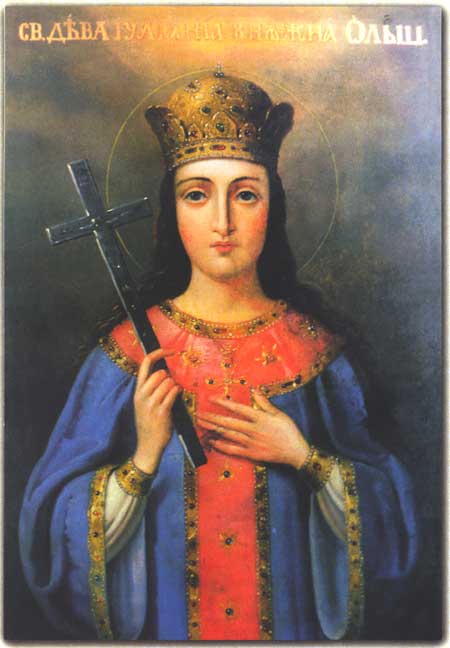
Juliana is painted as a young girl of the princely rank: a crown or coronet on loose or lightly bound hair, a red or crimson gown under a blue-green mantle, both stiff with gold embroidery and jewels in the manner of sixteenth-century Rus' court dress, with the cross of the confessor of Christ held upright in one hand and the other laid on the breast. She is never given the martyr's palm; the crown is that of her birth and of her virginity, not of martyrdom. The Lavra tradition sometimes shows her in the white gold-sewn dress in which the relics were found. Narrative scenes are rare: where they occur they show the monks opening the coffin, or Peter Mogila kneeling before the vision.
The stored image is a late nineteenth-century Lavra icon inscribed in Church Slavonic СВ. ДѢВА ІУЛІАНІА КНЯЖНА ОЛЬШ[АНСКАЯ] — "Holy Virgin Juliana, Princess of Olshansk" — painted in the naturalistic academic manner of the Kievan workshops of that period: the crowned girl half-length, in blue mantle over a jewelled red gown, holding a black cross.
Disputed questions
- When were the relics uncovered? This is a real difficulty. The date given in most calendars, and the date the feast commemorates, is July 6, 1540; but the archimandrite credited with enshrining the relics, Elisha Pletenetsky, ruled the Lavra from 1599 to 1624, and Peter Mogila's involvement belongs to the 1630s. The two cannot both be right. The likeliest reconstruction is that 1540 is the approximate year of her death, and that the uncovering belongs to the early seventeenth century under Pletenetsky, the received date having drifted onto the wrong event. Some Ukrainian scholarship places her death rather in the 1550s. The repository records the traditional July 6 as the feast without resolving the chronology.
- Her age and status. All accounts agree she was sixteen and a virgin; the epithet princess is by birth, not by rule, and she is classified accordingly.
- Not to be confused with the other Julianas of the Russian calendar, in particular Juliana of Vyazma (†1406, a princess-martyr of Torzhok, December 21), Juliana of Lazarevo (†1604, the righteous laywoman of Murom, January 2), and the ancient great-martyr Juliana of Nicomedia (December 21). Juliana of Vyazma is the one most easily confounded with her: both are Russian princesses of the late medieval period, and both are virgins. They are distinct in date, in place and in manner of death — Juliana of Vyazma was killed resisting an assault on her chastity and is a passion-bearer; Juliana of Olshansk died of natural causes and is venerated for the incorruption of her body.