
Juliana of Vyazma
The Holy and Right-believing Princess Juliana of Vyazma and Novy Torg, the Passion-bearer
Passion Bearer · Princess · d. 21 December 1406, at Torzhok
Commemorated 2 June — Uncovering of her relics and glorification at Torzhok (1819), 21 December — Her death at Torzhok
Juliana (†21 December 1406) was the wife of Prince Simeon Mstislavich of Vyazma, and died at Torzhok defending her marriage and her chastity against Yuri Svyatoslavich, the dispossessed Prince of Smolensk. Sheltering in the same town as his exiled kinsmen, Yuri conceived a passion for her; when she refused him he killed her husband at table and turned on her, and when she wounded him with a knife he cut off her hands and feet with his sword and had her body thrown into the frozen Tvertsa. In the spring her body was found — the tradition says floating against the current — and was buried at the Transfiguration Cathedral of Torzhok, where healings were reported at her tomb through four centuries until the Church uncovered her relics and glorified her on 2 June 1819. She is honoured among the Wonderworkers of Novy Torg and is one of the Russian Church's patrons of the sanctity of marriage.

Origins and marriage
Juliana was the daughter of a boyar named Maxim Danilovich — a family of no great prominence, of which the chronicles record little more than the name. She was married to Prince Simeon Mstislavich of Vyazma, a minor prince of the Smolensk line, and the sources describe her simply as a woman of exceptional beauty and of a strict and devout life, exact in the Church's fasts and prayers and in the duties of her household.
Her life falls at a bad moment in the history of her husband's country. In 1404 the Grand Duke Vitovt of Lithuania took Smolensk, and the princes of that line lost their patrimony. Yuri Svyatoslavich, the last independent Prince of Smolensk, fled to Moscow, and with him her husband Simeon of Vyazma; the Grand Prince Vasily I of Moscow received them and gave them Torzhok (Novy Torg, in the Tver land) to hold as a kormlenie. So the household of Simeon and Juliana came to live in the same town as the dispossessed prince of Smolensk, and under his authority.
Martyrdom or repose
At Torzhok Yuri, himself a married man, became inflamed with desire for Juliana. He courted her, then pressed her, then threatened; she refused him steadily, reminding him of her marriage and of the judgement of God, and — the chronicle account insists on this — never sought to escape the town or to shame him publicly, but resisted him where she stood.
At length, on 21 December 1406, Yuri resolved to take by violence what he could not obtain. At a feast in his own house he murdered her husband, Prince Simeon, and then seized Juliana. She fought him: she struck him with a knife from the table and wounded him. Enraged and bleeding, he cut off her hands and her feet with his sword, and had the body carried out and thrown into the river Tvertsa through the ice.
The Illustrated Chronicle of the sixteenth century paints the whole scene in two registers — Yuri pressing his suit and Juliana striking him with the knife; and the murder of Simeon Mstislavich at the feast — and the incident was remembered in Russia as a byword for the sacrilege of a prince against a guest and a wife.
Relics and translations
Her body lay in the river through the winter. In the spring of 1407 it was seen in the water and — this is the wonder the tradition dwells on — was moving upstream, against the current, and was found undecayed. An account preserved at Torzhok tells of a sick peasant who heard a voice bidding him go and tell the clergy to take up the body of the princess Juliana; he obeyed, was healed, and the clergy came out in procession.
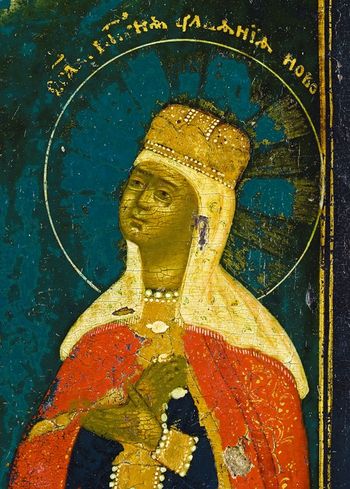
She was buried at the Cathedral of the Transfiguration at Torzhok, at the south doors on the right-hand side, and a tomb was raised over the grave. Healings were reported there steadily, and she came to be counted, with the earlier Ephraim and Arcadius of Novy Torg, among the Novotorzhskie chudotvortsy — the Wonderworkers of Torzhok — whose collective icon (the source of the image stored here) hung in the cathedral.
The formal recognition came at the beginning of the nineteenth century. The tomb was opened and examined in 1815; the uncovering of the relics and the glorification followed, and are kept on 2 June 1819, in connexion with which a chapel dedicated to Saint Juliana was built on the right-hand side of the cathedral. In 1906 the chapel over her grave was replaced by a proper church dedicated to her within the cathedral complex.
The Soviet period broke the shrine. An official opening of the reliquary in 1919 — one of the anti-religious vskrytiya moshchei of those years — reported bones of the hands present and entire, which the authorities published as a contradiction of the account of her mutilation. When the Transfiguration Cathedral was closed in 1918 the relics were moved to the church of the Archangel Michael at Torzhok, where they remained until about 1930; after that their fate is unknown, and no part of them has been publicly identified since. Her veneration at Torzhok has revived, but the relics themselves are reckoned lost.
Veneration and later cultus
Juliana's cultus was for four hundred years a purely local one — the tomb at Torzhok, the Novotorzhok company of saints, the pilgrims of the Tver land — and it was the nineteenth century that gave her a place in the general Russian calendar. She is invoked as a patron of marriage and of conjugal fidelity, and by women in danger of violence; the Russian Church has often paired her with the earlier Juliana of Lazarevo, the Murom noblewoman of the sixteenth century, as the two lay women of the Russian calendar honoured for sanctity in the married state — though the two are unrelated and quite different in their manner of life and death.
Feast and commemoration
Juliana is commemorated on two days. Her principal feast is December 21 (church date; Old Calendar civil January 3), the day of her death at Torzhok — a day she shares with the great virgin-martyr Juliana of Nicomedia, with whom the Russian books are careful to distinguish her. June 2 (church date; Old Calendar civil June 15) keeps the uncovering of her relics and her glorification at Torzhok in 1819, and it is on this June day that she appears on the general Russian calendar and in the OCA listings for the day. She is kept besides with Ephraim and Arcadius of Novy Torg in the local synaxis of the Wonderworkers of Torzhok, and among the saints of the Tver land. The commemoration is Russian; it is not in the Greek or Antiochian books.
Hymns
Troparion — Tone 4
Thou didst love thy husband and thy God more than thine own life, O right-believing Juliana, and wouldst not yield thy purity to a prince's violence; wherefore, mutilated by the sword and cast into the waters, thou wast borne up by God against the stream, and thy grave at Novy Torg became a fountain of healings. O passion-bearer, guard the marriages of the faithful, and pray that our souls may be saved.
Original translation from the Slavonic
Iconography
Juliana is painted as a princess: a mature woman, robed to the feet, crowned or wearing the princely kokoshnik with a veil over it, her hands raised in prayer or holding a scroll or a small cross. Where her passion is shown she may hold or be accompanied by the knife with which she defended herself, and in narrative panels the scenes are the murder of her husband at the feast, her resistance, her body in the river Tvertsa, and its finding by the clergy. She appears most often not alone but in the composite icon of the Wonderworkers of Novy Torg, standing with the venerable Ephraim and Arcadius of Torzhok above a view of the Transfiguration Cathedral. The sixteenth-century Illustrated Chronicle of Ivan IV contains, besides, two miniatures of the events of 1406, which are the earliest images connected with her.
The stored image is a detail of the 1797 icon of the Wonderworkers of Novy Torg: the princess crowned and haloed, in a red mantle over a gold-figured robe strung with pearls, her hands crossed at the breast, with the Slavonic inscription "the right-believing princess Juliana of Novotorzhok" across the ground beside her head. The photograph on Wikimedia Commons carries a CC BY-SA tag applied by its uploader; that tag governs only the photograph, while the eighteenth-century panel beneath it is public domain by age, and the shot is a faithful flat reproduction of it.
Disputed questions
- Her title in the calendars. Russian usage styles her blagovernaya knyaginya, "right-believing princess." The OCA calendar heads her entry Venerable Juliana, though she was never a monastic; other calendars call her martyr, since she died defending chastity. This entry classes her as a passion-bearer and princess, which best fits a death accepted in Christ-like meekness at the hands of a Christian prince rather than in a persecution of the faith.
- Not to be confused with Juliana of Olshansk (†c. 1540, July 6), the other Juliana of the Russian calendar who was a princess and a virgin: a daughter of the Lithuanian-Rus' house of Olshansk who died a natural death at sixteen and whose body was found incorrupt at the Kiev Caves Lavra. The two are easily confounded — both late-medieval princesses, both virgins — but differ in date, in place, and in the manner of their glorification.
- The mutilation. The hagiographic account has Yuri cut off her hands and feet; the Soviet examination of 1919 reported the bones of the hands present and entire. The two cannot both stand as they are stated. The tradition is recorded here as it was received, with the 1919 report noted; the deliberately hostile purpose of those examinations, and the four centuries of translations and repairs of the shrine between 1407 and 1919, both bear on how much weight the report will carry.
- The end of Yuri Svyatoslavich. The chronicles have him flee Torzhok after the murder, wander to the Horde and then to a monastery in penitence, and die in 1407, within the year — the Russian sources treating his ruin as the judgement Juliana had warned him of. The details of his penance vary between the chronicle recensions.
- Not to be confused with Juliana of Nicomedia (December 21 — the same church date, which is the confusion most likely to occur), nor with Juliana of Lazarevo (January 2), nor with Cyrenia and Juliana.