
Justin the Philosopher
The Holy Martyr Justin the Philosopher and Apologist
Martyr · b. c. 100, Flavia Neapolis in Samaria — d. c. 165, Rome
Commemorated 1 June — Martyrdom at Rome under the prefect Rusticus
Justin the Philosopher (c. 100 – c. 165) is the first great apologist of the Church and the earliest Christian writer whose substantial works survive entire. Born of pagan Greek parents at Flavia Neapolis in Samaria — the ancient Shechem — he passed through Stoicism, the Peripatetics, Pythagoreanism and Platonism before an unnamed old man met by the sea turned him from the philosophers to the prophets and to Christ. Wearing still the philosopher's cloak, he taught Christianity as the one true philosophy, opened a school at Rome, and addressed to the emperors and Senate the two Apologies and to a learned Jew the Dialogue with Trypho. Denounced by the Cynic Crescens, he was scourged and beheaded with six companions under the urban prefect Rusticus, and the authentic Acts of that trial survive. His description of baptism, of the Sunday assembly and of the Eucharist is the earliest detailed account of Christian worship in existence.

Origins at Flavia Neapolis
Justin was born about the year 100 at Flavia Neapolis in the province of Syria Palaestina — the Roman colony planted by Vespasian beside the ancient Samaritan city of Shechem, at the foot of Mount Gerizim, the place of Jacob's well (the modern Nablus). He names himself in the opening of the First Apology as "Justin, son of Priscus, son of Bacchius, of Flavia Neapolis in Syria Palaestina." The names are telling: a Latin father, a Greek grandfather, a colonial family of settlers rather than of native Samaritans. He tells Trypho plainly that he was uncircumcised and reared without the Law, and his knowledge of Hebrew was slight; the synaxaria, following him, call his parents pagan Greeks. He grew up, then, a Gentile of the Hellenistic east, in a town where the Samaritan religion, the Jewish diaspora, and the whole apparatus of Graeco-Roman cult stood side by side — an upbringing that left him permanently interested in how the God of Israel and the reasonings of the Greeks could be one truth.
The search through the philosophies
The Dialogue with Trypho opens with the most famous intellectual autobiography of the second century, and everything later told of Justin's conversion depends on it. Seeking God, he went first to a Stoic, who had nothing to teach him about the divine nature and thought the question unnecessary. He went next to a Peripatetic, who began by settling his fee, and whom Justin left in disgust as no philosopher at all. A Pythagorean of reputation refused to admit him until he should first have mastered music, astronomy and geometry, as the disciplines that detach the soul from the senses; Justin, having no such training and no time to acquire it, went away discouraged. At last he attached himself to the Platonists, and there for a time he rested: the contemplation of the incorporeal, the doctrine of the Ideas, the ascent of the mind toward the Good, seemed to him the very wings of the soul. He expected "straightway to look upon God."
The old man by the sea
Withdrawing to a quiet place near the sea to think undisturbed, Justin was followed and accosted by an aged man, grave and gentle, whose name the Dialogue never gives and who is usually taken for a Christian of Syria or Palestine. Their conversation is the hinge of his life. The old man drew him out on the Platonic doctrine of the soul — that it is by nature immortal, kindred to God, and able of itself to see Him — and then dismantled it: if the soul lives, it lives not by its own nature but because God wills it to live; if it sees God, it does so not by kinship but by gift. Philosophy at its best had defined the search and could not satisfy it.
Then he told Justin of others: that long before all those reckoned philosophers there had been men more ancient, blessed and righteous and beloved of God, who spoke by the Holy Spirit and foretold things now come to pass — the prophets. They did not argue, for they were witnesses to the truth beyond argument; they glorified the Maker of all and proclaimed His Christ. "Pray," the old man said, "that the gates of light may be opened to thee, for these things are not to be seen or understood by any unless God and His Christ grant understanding." Then he departed, and Justin never saw him again. A fire, he says, was kindled in his soul; a love seized him for the prophets and for those who are the friends of Christ; and as he turned their words over he found this alone to be the philosophy that is safe and profitable. He was baptised — the Slavic tradition places it in his thirtieth year, about 133–137 — and thereafter, still wearing the philosopher's cloak, he professed Christianity itself as the true philosophy, the only one that both proves its case and saves.
Teacher at Ephesus and Rome
Justin travelled and taught. The Dialogue is set at Ephesus in the aftermath of the Bar Kokhba war (132–135), where he met a learned and courteous Jew, Trypho, a refugee of that war, and disputed with him for two days in the colonnade of a gymnasium. Later he came to Rome in the reign of Antoninus Pius (138–161) and there opened a school of Christian philosophy; he taught, the Acts of his martyrdom say, in lodgings above the baths of Myrtinus (or Martinus), and received all who would come. Tatian the Syrian was his most famous pupil — and, after his master's death, the founder of a rigorist sect of his own.
Justin's method is what makes him a father of theology and not merely a defender of the Church. He held that the Word (Logos) who was made flesh in Christ is the same Word by whom all men reason, and that a seed of the Word (logos spermatikos) is sown in every mind; therefore whatever any man has rightly said belongs to Christians, and Socrates, Heraclitus and the best of the Greeks lived, in their measure, by Christ. The philosophers had fragments; the Church has the whole. It is a generous doctrine, and it has been the charter of every Christian engagement with pagan learning since.
The Apologies and the Dialogue
Three works of Justin survive, transmitted — a fact worth pausing over — in one single imperfect Greek manuscript, Parisinus graecus 450, copied in 1364:
- The First Apology, addressed to the emperor Antoninus Pius, his sons, and the Roman Senate, and generally dated about 153–155. Justin asks not favour but justice: that Christians be tried for crimes proved, not condemned for the name; he answers the standing charges of atheism, incest and cannibalism; he argues from the prophets that Jesus is the Christ; and — chapters 61 and 65–67 — he describes, for the benefit of a pagan emperor, exactly what Christians do when they meet. This is the earliest full account of Christian worship anywhere (see below).
- The Second Apology, a shorter piece to the Roman Senate, provoked by a particular scandal of justice: a woman's conversion, her husband's denunciation of her teacher Ptolemaeus, and the execution of Ptolemaeus and of a bystander, Lucius, who protested the sentence, by the prefect Urbicus. Justin's point is that Christians are killed for nothing but the name, and that the demons stand behind the whole business.
- The Dialogue with Trypho, his longest work, written after the Apologies and before 161: that the Law was given for a time and to one people; that the new and everlasting covenant in Christ is for all; that the Scriptures of Israel testify to Him; and — with a courtesy rare in the genre — that the Jews are addressed as brethren whom he desires to persuade, not as enemies.
Eusebius knew and lists a number of further works now lost: Against Marcion, a Refutation of All Heresies, On the Resurrection, an address To the Greeks, On the Sovereignty of God, a treatise called The Psalmist, and one On the Soul. Several late writings circulated under his name in the manuscripts and are not his.
The earliest witness to the Eucharist and to Sunday
The value of Justin to the Church is not exhausted by his arguments. Because he set out to explain Christian practice to outsiders, he recorded in the First Apology what insiders had no reason to write down, and his account is the earliest detailed description of the Church's worship that exists — earlier than any liturgical text, and a full century before the Syrian orders.
He describes baptism (ch. 61): instruction, fasting and prayer, with the congregation praying and fasting alongside; then the washing in water "in the name of the Father and Lord of all, and of our Saviour Jesus Christ, and of the Holy Spirit," which he calls illumination, because the mind of the one baptised is enlightened. The newly baptised is then led to the assembly, where the brethren pray with him for the first time and he receives the gifts.
He describes the Eucharist (chs. 65–66): the common prayers; the kiss of peace; bread and a cup of wine mixed with water brought to "the president of the brethren"; the long prayer of thanksgiving over them, to which the whole people answers Amen (he explains the Hebrew word for his Greek readers); the distribution by the deacons, who also carry the gifts to those absent. And then the sentence for which every later theology of the sacrament has had to account: this food is called among Christians Eucharist, and it is received "not as common bread and common drink"; as the Word was made flesh for our salvation, so the food over which the thanksgiving has been made is the flesh and blood of that same incarnate Jesus. He adds that none may share in it but the baptised who believe the Church's teaching and live according to Christ's commandments.
And he describes the Sunday assembly (ch. 67), the earliest such description we have: on the day called Sunday all who live in town or country gather in one place; the memoirs of the apostles and the writings of the prophets are read as long as time allows; the president then instructs and exhorts; all stand and pray; the bread, wine and water are brought and the Eucharist is celebrated; the deacons carry portions to the absent; and those who are able and willing give what they wish, the collection being kept by the president for orphans and widows, the sick, prisoners, strangers, and all in need. Sunday is kept, he explains, because it is the first day, on which God made light out of darkness, and because it is the day on which Jesus Christ our Saviour rose from the dead. For the Orthodox reader this is the second century's own testimony to the Divine Liturgy: Scripture, homily, intercession, offering, anaphora, communion, and the care of the poor, in that order, on the Lord's Day.
The dispute with Crescens and the martyrdom
At Rome Justin disputed publicly with a Cynic philosopher named Crescens (the Slavic lives call him Crescentius), and worsted him. In the Second Apology Justin says outright that he expects to be "plotted against and put in the stocks" by Crescens, a man who loves not wisdom but the applause of the crowd and who denounces Christians as atheists without having troubled to learn what they teach. Tatian, who was there, states flatly that Crescens contrived his master's death. Whatever the immediate mechanism, the accusation came; and under Marcus Aurelius, about the year 165, Justin was brought with a group of his hearers before the prefect of the city, Q. Junius Rusticus (in office c. 162–168).
The record of that trial survives — the Acts of Justin and his Companions, in three Greek recensions, and one of the small handful of genuinely early martyr-acts that read like court minutes rather than legend. Rusticus asks Justin what doctrines he professes; Justin answers that he has tried to make himself acquainted with every system and has rested at last in the true teaching of the Christians, however that may displease those who hold error. Asked where the Christians meet, he replies that God is not confined to a place, that Christians are scattered, and that he himself lodges above the bath of Myrtinus, where he has taught all who came to him. Asked whether he is a Christian, he says: "Yes, I am a Christian." Six companions are questioned in turn and each confesses. Rusticus presses Justin on whether he supposes that after being scourged and beheaded he will ascend into heaven and receive a reward; Justin answers that he does not merely suppose but is persuaded of it, and that to all who so live the favour of God abides until the ending of the world. When at last the prefect commands them to sacrifice to the gods, the martyrs answer together: "Do what you will, for we are Christians, and we do not sacrifice to idols." Sentence is pronounced in the dry formula of Roman law — that those who have refused to sacrifice to the gods and to obey the emperor's edict be scourged and led away to be beheaded according to the laws. So they were, glorifying God; and the faithful took up their bodies secretly and laid them in a fitting place.
Veneration and later cultus
Justin's fame in the East rests on his writings as much as on his passion: he is the Philosopher among the martyrs, cited by Irenaeus, quarried by Eusebius, and named with honour in the councils of the Church as an ancient witness to the faith of the second century. The Byzantine synaxaria keep him on June 1 with the companions who suffered with him. In the West his feast stood on April 14 from 1882 until 1969, when it was moved to June 1 to agree with the Eastern date. He is invoked as a patron of philosophers, and by extension of Christian apologetics — the discipline he may fairly be said to have founded.
Feast and commemoration
Justin is commemorated on June 1 (church date; New Calendar civil June 1, Old Calendar civil June 14) throughout the Orthodox world — the Antiochian, Greek, Slavic and Georgian books agree — usually under the title "the Philosopher and Martyr" and usually with those who suffered with him at Rome. In most years his feast falls within the fifty days of Paschaltide or in the weeks after Pentecost, and it therefore competes for liturgical attention with the movable cycle; his service in the Menaion is of simple rank, but he is one of the very few second-century figures whom the Church commemorates both as a martyr and as a teacher, and Orthodox theological schools keep his day with particular honour. Since 1969 the Roman calendar has kept him on the same day, having previously assigned him April 14; the Serbian Church keeps the modern Archimandrite Justin Popović on June 1 as well, deliberately joining the disciple to his namesake.
Hymns
Troparion — Tone 4 (common of a martyr)
Thy martyr Justin, O Lord, in his contest received an incorruptible crown from Thee, our God; for possessing Thy strength, he cast down the tyrants and shattered the feeble insolence of the demons. By his intercessions save our souls.
Original translation from the Greek
Kontakion — Tone 2
Having sought out the wisdom of the Greeks and found it wanting, thou didst learn from the prophets the philosophy that saveth, O Justin; and having taught the emperors of the earth to reverence Christ, thou didst seal thy words with thy blood. Wherefore entreat Him without ceasing for us who honour thee.
Original translation from the Greek
Iconography
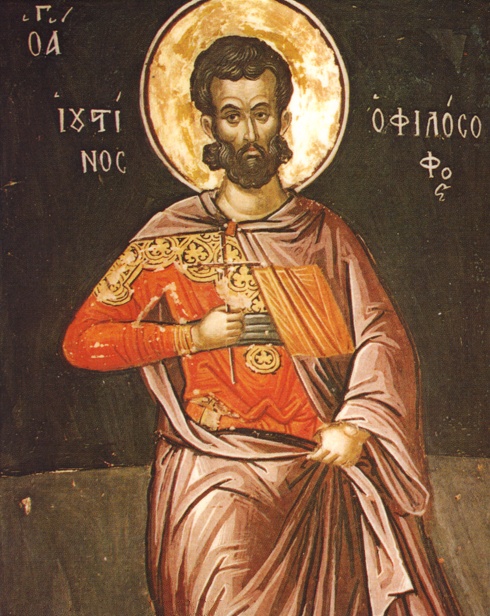
Justin is painted, alone among the martyrs of his century, as a philosopher and not as a soldier, youth or courtier: a man of middle years with dark hair and a full pointed beard, bare-headed, in a tunic and a mantle draped over one shoulder in the manner of the ancient sages — the same dress in which the Church paints the Old Testament sages and the "Hellenic philosophers" of the narthex programmes. His attribute is the scroll or codex, held open or closed, standing for the Apologies; sometimes he holds the martyr's cross as well, and where his passion is shown in narrative he is depicted scourged and beheaded with his companions before a seated Roman magistrate. In the Slavic menaion-icons for June he stands first in the row of the day. He is never given episcopal vesture, since he was a layman.
The stored image is the fresco of Justin from the katholikon of Stavronikita Monastery on Mount Athos, painted by Theophanes the Cretan in 1545–1546 — the greatest of the Cretan-school wall-painters — and inscribed Ο ΑΓ(ΙΟΣ) ΙΟΥΣΤΙΝΟΣ Ο ΦΙΛΟΣΟΦΟΣ, "Saint Justin the Philosopher." He is shown half-length in a red tunic with a gold-embroidered band and a grey-violet mantle, holding a closed book against his breast: the philosopher's portrait type, exactly as the tradition understands him.
Disputed questions
- A second Justin on the same day. The Greek Menaion and the Prologue of Ohrid give June 1 two entries: Justin the Philosopher, and "the other Justin" with his companions — Chariton, Charito the virgin, Euelpistus, Hierax, Paeon and Liberian (in the Slavic lists a Justus appears as well, and Liberian becomes Valerian). But the authentic Acts know only one Justin: the philosopher himself, tried with exactly those six companions before Rusticus. The near-certain explanation is that the synaxarist, working from two notices of the same event, took the "Justin" of the companions' passion for a different man and duplicated him — and that the Slavic Justus is a doubling of Justin in transmission. The two commemorations are therefore kept, out of respect for the liturgical books, as Justin the Philosopher and Justus, Justin and their Companions, with the identity question stated in both places; the reader should understand that the second "Justin" is almost certainly the first.
- The year of his birth. Justin himself gives no date. The internal evidence of the Dialogue (set soon after 135, when he was already a mature teacher) suggests a birth about 100, which is the usual modern estimate; the Slavic and OCA lives give c. 114, working back from a baptism "in his thirtieth year" to the mid-130s. Neither can be proved, and the difference does not affect the narrative.
- The year of death. The prefecture of Rusticus (c. 162–168) fixes the outer limits. 165 is the conventional date; some lives say 166, and the Acts themselves give no year.
- Whether Justin was a Samaritan. He was born in a Samaritan city and once seems to reckon himself among his townsfolk of Samaria, which has led some to make him a Samaritan by descent. Against that stand his own statements that he was of the uncircumcised and untaught in the Law, and the Latin and Greek names of his father and grandfather. The safe conclusion, and the one the synaxaria draw, is that he was a Gentile Greek of the Roman colony at Shechem.
- Not to be confused with Justinian the Emperor (Justinian and Theodora, November 14), nor with the twentieth-century Serbian father Justin Popović of Ćelije (†1979), who is also commemorated on June 1 precisely because he bore the Philosopher's name; nor with the Roman Justus of other days.