
Luke of Simferopol
Our Father among the Saints Luke the Confessor, Archbishop of Simferopol and Crimea
Confessor · Bishop · Wonderworker · b. 27 April 1877, at Kerch in the Crimea — d. 11 June 1961 (church date 29 May), at Simferopol
Commemorated 5 March — Uncovering of the relics at Simferopol (1996), 29 May — Repose of the confessor-surgeon of Simferopol (Russian church date; civil June 11), 11 June — Greek New-Calendar usage, which keeps the civil June 11 of his repose as the church date
Luke of Simferopol — in the world Valentin Felixovich Voino-Yasenetsky (1877–1961) — was one of the foremost surgeons of the Russian twentieth century and, at the same time, a bishop who spent eleven years in Soviet prisons and exile for refusing to be silent. He pioneered regional anaesthesia, wrote the Essays on the Surgery of Purulent Infections that trained generations of Russian surgeons, operated in a cassock with an icon in the theatre, was tonsured and consecrated in secret in 1923, was arrested three times, ran the military hospitals of Krasnoyarsk as an exile through the Second World War, was given the Stalin Prize in 1946 and gave most of it away, governed the see of Simferopol and Crimea from 1946, went blind in his last years and went on preaching, and died on 29 May (civil 11 June) 1961. His relics were uncovered in 1996 and he is venerated with extraordinary warmth in Russia, Ukraine and above all in Greece, where he is invoked before surgery as the physician-hierarch of the modern world.

Painter, then physician
He was born at Kerch in the Crimea on 27 April 1877, into a family of impoverished Polish nobility: his father a Roman Catholic pharmacist, his mother Russian Orthodox, and the household one in which religion was little spoken of. The family moved to Kiev, and there the boy's gift was drawing. He finished the Kiev art school and went to Munich intending to be a painter — and turned back, judging that he had no right to spend his life on what pleased him while the Russian peasantry died of untreated illness. He read the New Testament in these years and was seized in particular by the verse about the harvest and the labourers; the decision to become a "peasants' doctor" was, in his own telling, a religious one.
He accordingly entered the medical faculty of Kiev University, graduating in 1903, and — to the astonishment of his teachers, who saw a scientist — went straight into rural practice. In the Russo-Japanese war of 1904 he served in a Red Cross field hospital at Chita, where at twenty-seven he was already operating on the great cavities of the body, and where he married the nurse Anna Vasilievna Lanskaya, whom the wounded called "the holy sister." Four children were born to them.
The surgeon
There followed years in the zemstvo hospitals of Simbirsk, Kursk, Saratov and Vladimir provinces, in which he did an enormous volume of general surgery under primitive conditions and began the work that made his name. Appalled at the deaths caused by general anaesthesia in inexperienced hands, he devoted himself to regional and local anaesthesia — nerve-block techniques, and in particular the injection of the branches of the trigeminal and sciatic nerves — and in 1916 defended a doctoral dissertation on the subject which was at once recognised as a work of the first rank. He also began collecting the material of his life's book: the surgery of purulent infection, the field in which, before antibiotics, most surgical death occurred.
In 1917 he moved to Tashkent as chief surgeon of the city hospital, and afterwards professor in the new Turkestan university. In 1919 his wife died of tuberculosis; he read the Psalter over her for three nights, and afterwards raised the four children with the help of a devout theatre nurse to whom he entrusted them.
Priest and bishop
The Tashkent years turned him into a churchman. He spoke at diocesan assemblies, and after one such intervention Bishop Innocent of Tashkent said to him simply: "Doctor, you must be a priest." He was ordained deacon and then priest in 1921, and thereafter operated and lectured in a cassock, with a pectoral cross, and with an icon of the Mother of God hung in the operating theatre — refusing to remove it when ordered, and staying away until it was restored. He signed his medical papers with his priestly name.
In 1923, in the crisis of the Renovationist schism, he was secretly tonsured a monk with the name Luke — after the Evangelist who was a physician and a painter, the two vocations of his own life — and secretly consecrated bishop. He was arrested within days. There followed the pattern of the rest of his life:
- 1923–1926, prison and exile to Siberia — Yeniseisk, and then the far north at Turukhansk, where he operated in a village hospital with a penknife and a pair of pliers, and where he was for a time banished to a fishing settlement inside the Arctic Circle;
- 1930–1933, arrest at Tashkent and exile to Arkhangelsk;
- 1937–1943, arrest in the Great Terror, thirteen days of the "conveyor" interrogation without sleep, and exile to Bolshaya Murta in the Krasnoyarsk region.
He was never broken and never renounced either of his offices. In prison he went on writing the Essays on Purulent Surgery, and one of his manuscripts was confiscated and lost.
The war, the Stalin Prize, and Simferopol
When the German invasion came in 1941, the state needed him. Still a convicted exile, he was made consultant-surgeon to all the military hospitals of the Krasnoyarsk region and chief surgeon of the great evacuation hospital there, treating the most desperate infected wounds of the Eastern front; and while doing it he was, from 1942, Archbishop of Krasnoyarsk. He was translated to Tambov in 1944 and to Simferopol and Crimea in 1946.
In that same year the Soviet state gave him the Stalin Prize, First Class, for the Essays on the Surgery of Purulent Infections together with his monograph on the late resection of infected gunshot wounds of the joints. He accepted it, gave the greater part of the money to orphans of the war, and continued to receive the poor of Simferopol in his own house without payment. He was the only Soviet citizen to hold that prize and a bishop's mitre at once.
He governed Crimea for fifteen years, in the hardest conditions of the post-war Church: churches closing, clergy few, surveillance constant. He preached at length and continually — the corpus of his sermons is very large — and wrote the treatise Spirit, Soul and Body, an argument against materialist psychology from the standpoint of a working anatomist. He lost the sight of one eye in 1955 and became wholly blind about 1958, and thereafter served the Liturgy and preached from memory, dictating.
Repose, relics and veneration
He died at Simferopol on 11 June 1961, which in that year was the Sunday of All Saints of Russia; the church date is 29 May. The authorities tried to prevent a public funeral and failed: the crowd carried him to the All Saints cemetery and the procession filled the streets.
His relics were uncovered in March 1996 and translated to the Holy Trinity cathedral of the convent at Simferopol, where they lie. He was glorified as a locally venerated saint of the Crimea in 1995 by the Ukrainian Orthodox Church, and afterwards numbered among the New Martyrs and Confessors of Russia in the general glorification of the Russian Church. His cultus spread with remarkable speed beyond the former Soviet Union: in Greece and Cyprus he is among the most popular of all modern saints, with churches, relic-portions and a very large literature of reported healings, and he is invoked as a matter of course by the sick before operations. He is the patron of surgeons and of medical students.
Feast and commemoration
May 29 (church date; New Calendar civil May 29, Old Calendar civil June 11) — his repose, kept in the Russian and Ukrainian Churches on Old-Calendar May 29, that is civil June 11, and by the New-Calendar Churches, most conspicuously the Greek, on June 11 as their church date. This is an instance where the two reckonings meet on the same civil day and diverge on the church date; this collection keeps him under the church date 05-29 of the calendar in which he was glorified.
A second commemoration, the uncovering of his relics at Simferopol in 1996, is kept on March 5 (civil March 18), and he is also commemorated in the synaxis of the New Martyrs and Confessors of Russia and among the saints of Crimea.
Because Orthodox Pascha falls between April 4 and May 8, the fixed day May 29 always stands within the Pentecostarion, and whatever belongs to the movable cycle in a given year takes precedence over the fixed commemorations.
Hymns
Apolytikion — Tone 4 (common of a hierarch)
The truth of things hath shown thee to thy flock as a rule of faith, an image of meekness and a teacher of temperance; therefore thou hast attained the heights by humility and riches by poverty. O father and hierarch Luke, intercede with Christ God that our souls may be saved.
Kontakion — Tone 2
Thou didst take the knife to heal and the cross to preach, and neither prison nor the northern ice could part thee from either; blind at the last, thou didst see more than thy persecutors. O holy hierarch and physician Luke, stretch out thy hand over those who lie under the surgeon's knife, and pray for our souls.
Original translation from the Slavonic
Iconography
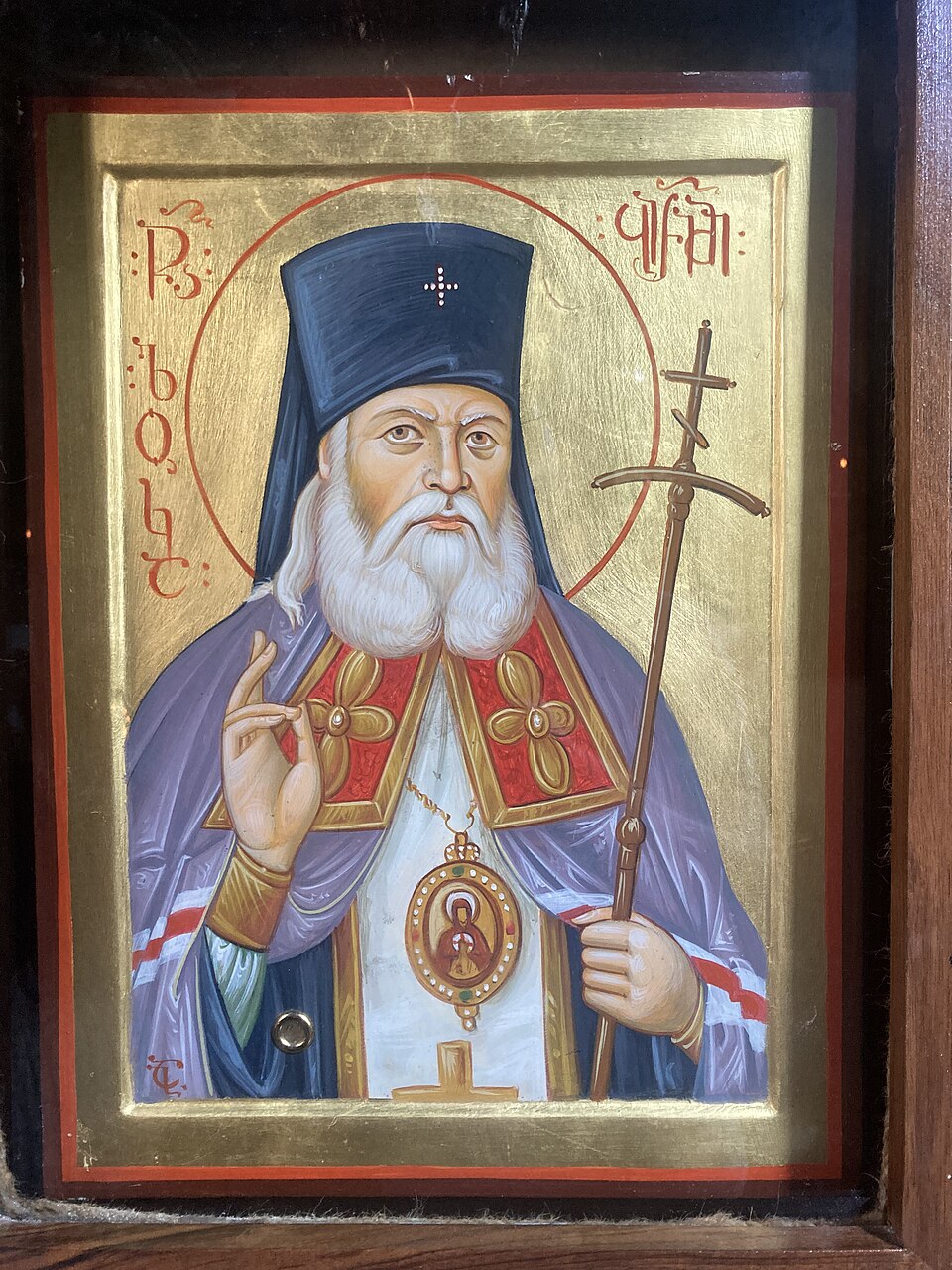
Luke is painted as a hierarch: in phelonion, omophorion and mitre, or in the mandyas and klobuk, blessing with the right hand and holding the Gospel; but the iconography of him is unmistakable for two features. The first is the face, which is a portrait — the icons follow the photographs closely, with the broad forehead, the round spectacles of his working years, and the wide grey-white beard, so that he is one of the most immediately recognisable of the modern saints. The second is the instruments: he is very often shown holding, instead of or beside the Gospel, a surgical instrument case, a scalpel, or a book inscribed with the title of the Essays on Purulent Surgery, and Greek icons frequently place him in the operating theatre, or show his hands over a patient, with the Mother of God's icon on the wall behind — the icon he refused to take down. Border scenes show the interrogation, the Siberian exile, the field hospital, and his blindness. In Greek churches he commonly appears beside Cosmas and Damian and the other unmercenary physicians.
No image is stored for this saint. Every icon of him is a modern work by a living or recent iconographer, and the photographic portraits on which they depend are themselves within copyright; nothing free-licensed and identifiable was available, and the project's constitution forbids storing copyrighted modern icons. He is therefore entered in the the list of icons still being sought index with this reason.
Disputed questions
- The date of his glorification. He was canonised as a local saint of Crimea by the Ukrainian Orthodox Church in 1995 (some notices give 1996, the year of the uncovering of the relics and of the synodal act), and included in the general commemoration of the New Martyrs and Confessors of the Russian Church at the Jubilee Council of 2000. The variants in the published accounts reflect these successive acts rather than a disagreement of fact.
- "Confessor," not "martyr." He died in his bed and is not a new-martyr; his title in the Russian books is исповедник, confessor, for the eleven years of imprisonment and exile. Greek usage sometimes styles him ἰατρός, "the physician," or ὁ ἰαματικός, and occasionally ἀνάργυρος, "unmercenary," by analogy with Cosmas and Damian — an affectionate description rather than a formal classification, and this entry does not carry unmercenary in its types.
- The secret consecration of 1923 is variously reported as to place, date and consecrators, the secrecy being the point; the accounts agree that it was performed by bishops of the canonical (non-Renovationist) hierarchy in Turkestan and that he was appointed to Barnaul or to Penjikent before being sent to Tashkent.
- Not to be confused with Luke the Evangelist (October 18), whose name he took and whose double calling as physician and painter he shared; nor with Luke of Steiris (†953), Luke of Taormina, or Luke the New Stylite.