
Luke the New Stylite
Our Venerable Father Luke the New Stylite of Chalcedon
Venerable · b. c. 879 — d. 979
Commemorated 11 December — Repose; falls within the Nativity Fast
Luke the New Stylite (c. 879–979) was a soldier of the Byzantine army who became the last of the great pillar-saints of the East. Having survived unhurt the catastrophic defeat of the imperial forces by the Bulgarians at Anchialos in 917, he laid down his arms for the monastic life, was ordained priest, and took up the ascesis of the stylites. After brief pillars in Anatolia and near the capital he settled at Chalcedon, on the Asian shore opposite Constantinople, where he stood upon a column for forty-five years and was renowned for the gift of wonderworking, until his repose about the year 979 at a very great age. He is commemorated on December 11, the same day as the elder pillar-saint Daniel the Stylite, within the Nativity Fast.

Origins and soldiering
Luke was born about 879 in the province of Anatolia, of the Byzantine heartland of Asia Minor, and entered the imperial army in the reign of the emperor Constantine VII Porphyrogenitus (912–959). He took part in the great war against the Bulgarians of Tsar Symeon, and in the disastrous Byzantine defeat at Anchialos on the Black Sea in 917 — one of the worst reverses in the empire's history — he passed through the slaughter unharmed, which he received as a token of the providence of God calling him to another warfare.
Monk, priest, and stylite
Leaving the world, Luke became a monk and, advancing in the ascetic life, was ordained presbyter. Reaching for a yet higher degree of self-denial, he loaded himself with iron chains and mounted a pillar. After three years upon this first column he was moved, by divine prompting, to travel: he went first to the holy Mount Olympus of Bithynia, thronged with ascetics, then to Constantinople, and at last across the strait to Chalcedon. There, at the promontory of Eutropius on the Asian shore, he set up the pillar on which he would remain for the rest of his life — forty-five years — persevering through heat and cold in unceasing prayer, and manifesting the gift of wonderworking, healing and foretelling for the many who came to him.
Repose
Luke reposed upon his pillar at Chalcedon about the year 979 (some notices give 980), having reached, by the received reckoning, close to a hundred years of age. He is counted the last of the celebrated stylites of the Byzantine East, closing the long line that Symeon the Stylite had opened five centuries before.
Feast and commemoration
December 11 (church date; Old Calendar civil December 24), his repose, kept in the Byzantine rite within the Nativity Fast. The day's proper service in the Menaion belongs to the earlier and greater Daniel the Stylite; Luke is commemorated alongside him, the two pillar-saints of the day being joined in the synaxarion, which gives Luke a couplet of verses but no proper office.
Hymns
Troparion — Tone 1
Thou didst become a pillar of patience, O venerable one, rivalling the forefathers: Job in his sufferings, Joseph in his temptations, and the life of the bodiless powers while yet in the body. O Luke our father, entreat Christ God that our souls may be saved.
Original translation from the Greek
Synaxarion
The pillar raised Luke on high; and Luke raised his mind to God, toward whom he runs.
Iconography
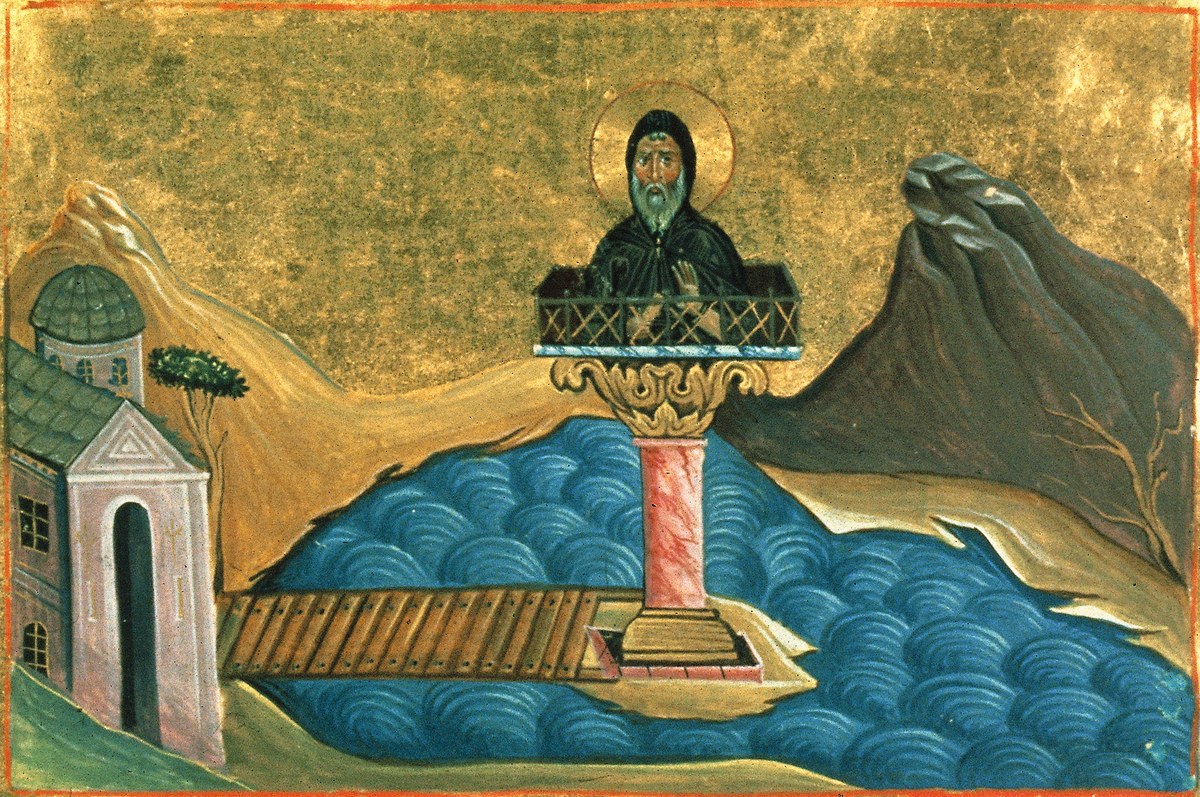
Luke is depicted after the common type of the stylites: an aged monk-priest rising from the capital of a tall column, blessing or with hands lifted in prayer, sometimes with the chains he wore shown about him and the sea of the Bosphorus and Chalcedon below. The stored image is the miniature of the Menologion of Basil II (Constantinople, 985): the stylite at prayer on his latticed column between the church and the mountain — the unmistakable type of his ascesis.
Disputed questions
- Year of repose. The synaxaria and the OCA give his death "about 980"; the received chronology of his Life places it in 979. The difference is of a single year and turns on the reckoning of his forty-five years at Chalcedon.
- Not to be confused with Luke the Evangelist (October 18) or with the tenth-century abbot Luke of Steiris (Luke the Younger of Hellas, the wonderworker of Hosios Loukas, commemorated February 7), with whom name and century invite confusion; Luke the New Stylite is distinct from both — a Bithynian and Chalcedonian pillar-saint, soldier turned ascetic.