
Lucian of Antioch
The Holy Hieromartyr Lucian, Presbyter of Antioch the Great
Hieromartyr · Priest · b. c. 240 — d. 312
Commemorated 15 October — Principal Byzantine commemoration (transferred from January 7, the day of his death)
Lucian (c. 240–312) was a presbyter of Antioch, founder of the Antiochene school of biblical study and author of a critical recension of the Greek Bible whose text, through the church of Constantinople, underlies the Scriptures the Byzantine world has read ever since. Teacher of a generation of eastern bishops — among them Arius and the "Collucianists," a connection the tradition has weighed honestly against his sanctity — he was arrested in the last great persecution, made a celebrated defence of the faith before his judge at Nicomedia, celebrated the Eucharist on his own breast in prison, and died there of starvation on January 7, 312, answering every question with the words "I am a Christian." His body, cast into the sea, was borne ashore at Drepanum — the later Helenopolis — and John Chrysostom preached his festal encomium at Antioch. The Byzantine calendar keeps him on October 15.
.jpg)
Origins and early life
Lucian was born about the year 240 at Samosata on the Euphrates, the chief city of Commagene in the Roman province of Syria — the city that had earlier produced the pagan satirist Lucian (a wholly different man) and, in the saint's own generation, the controversial bishop Paul of Samosata. The hagiographic tradition gives him devout parents who died when he was twelve; the boy distributed his inheritance to the poor and went to Edessa, the Syriac-speaking centre of Mesopotamian Christianity, where he studied the Scriptures under a confessor named Macarius and embraced a life of strict asceticism. His formation thus joined the two things that marked him for life: the discipline of the desert and the discipline of the text. From Edessa he came to Antioch the Great, the capital of the Roman East, where he was ordained presbyter; the sources associate his early studies also with the presbyter Malchion, head of the rhetorical school at Antioch and the man who had unmasked Paul of Samosata's teaching at the synod of 268.
The school of Antioch
At Antioch Lucian opened a didaskaleion — a school of biblical study — which posterity has reckoned the foundation of the Antiochene exegetical school. Its method was the one that would distinguish Antioch from Alexandria for the next two centuries: attention to the letter of Scripture — grammar, history, the plain and intended sense of the sacred writers — against the thoroughgoing allegorism of the Alexandrian masters, for whom the text was chiefly a veil of higher meanings. Lucian did not invent literal exegesis, and the great Antiochenes of the following century — Diodore of Tarsus, Theodore of Mopsuestia, John Chrysostom, Theodoret — were not his pupils in any direct line; but the tradition, ancient and modern alike, has seen in his school the seedbed of that whole exegetical culture, and Antioch remembered him as its teacher. Eusebius of Caesarea, his contemporary, calls him "a man most excellent in every way, of temperate life and steeped in sacred learning"; Jerome lists him among the church's men of letters, "a man of great talent, so laborious in the study of the Scriptures that even now certain copies of the Scriptures go by the name of Lucianic."
The Lucianic recension of the Bible
Jerome's remark points to Lucian's most durable work: a critical revision of the Greek Bible. Finding the text of the Septuagint corrupted by generations of copyists — and, the hagiographic tradition adds, deliberately distorted by heretics in support of their teachings — Lucian undertook a recension of the Old Testament, working, the tradition says, with reference to the Hebrew, which he is said to have known; and with it a revision of the text of the Gospels and the rest of the New Testament. Jerome attests that in his own day the copies called Lucianea were current from Constantinople through Asia Minor to Antioch — the Lucianic recension had become, in effect, the Bible of the eastern imperial church. In the Old Testament, scholarship identifies the "Lucianic" or "Antiochene" text as a distinct and important textual stream (valued not least because it sometimes preserves ancient readings older than Lucian himself); in the New Testament, the text of the imperial capital that grew from the Antiochene revision stands behind the Byzantine text-type — and so behind the received text of the Orthodox Church's lectionaries and, through the first printed editions, of the Reformation Bibles. How much of this vast textual legacy is Lucian's own hand and how much his school's is a question modern scholarship leaves open; the attribution of the Byzantine text's ancestry to Lucian personally is a scholarly inference from Jerome's notices, not a documented fact. The hagiographic tradition adds that the saint's own copy of his corrected Bible, written in three columns, was hidden in a wall at the time of his arrest and brought to light in the days of Constantine.
Of Lucian's other writings almost nothing survives: a short letter from prison to the church of Antioch, quoted in the Chronicon Paschale, reporting the martyrdom of Anthimus of Nicomedia and sending the greeting of "the whole choir of martyrs"; the defence spoken before his judge (see below); and the creed transmitted under his name (see Disputed questions).
The teacher of Arius: the Collucianists
Lucian's memory carries a shadow no honest account may omit. Among the pupils of his school were the very men who, a decade after his death, set the Arian controversy alight: Arius himself, Eusebius of Nicomedia, Maris of Chalcedon, Theognis of Nicaea, Leontius the later bishop of Antioch, Asterius the Sophist. Arius, writing to Eusebius of Nicomedia at the outbreak of the controversy, greets him as a fellow disciple — syllukianista, "Collucianist" — and the name stuck to the party. Alexander of Alexandria, Arius's bishop and first opponent, went further: in his encyclical letter he made Lucian the link in a chain of error running from Paul of Samosata, and asserted that Lucian had remained outside the communion of the church of Antioch — aposynagogos — through the episcopates of three bishops, Domnus, Timaeus, and Cyril. On this showing the subordinationist strain in Arius's doctrine of the Son was his inheritance from the master's lecture-room.
Against this stands the exculpatory tradition, which the Church's calendar itself embodies. Alexander's charge is polemic written in the heat of the controversy and is unsupported by any other ancient witness; if Lucian was ever out of communion — whether under suspicion from his association with Paul of Samosata's city and circle, or otherwise — he was manifestly reconciled long before the end, for he died a presbyter of Antioch and the most honoured martyr of his church. His pupils' heresy is not proof of his own: Arius appealed to a dead teacher who could no longer be questioned, and what survives of Lucian's authentic teaching contains no Arian thesis. The creed produced under his name at Antioch in 341 — whatever its true authorship — confesses the Son "God from God, whole from whole, exact image of the Godhead and essence of the Father," language no Arian could sign in its plain sense. The Church, weighing the man's confession, his ascetic life, his learning, and his death, glorified him without reservation: Chrysostom preached his praises at Antioch, and East and West alike have kept his feast from the fourth century to this day. The entry records both streams, as the sources give them.
Persecution, defence, and martyrdom
When the Great Persecution broke out under Diocletian in 303, Lucian was among its most eminent targets in the East. The tradition followed by the Slavic books and the OCA has him arrested and taken to Nicomedia, the imperial residence, where he lay in prison for nine years, strengthening the confessors around him and urging them not to fear torture or death; the Greek historical sources concentrate on the end of that road, under Maximinus Daia, the persecution's last and bitterest architect in the East. Brought before the tribunal — Eusebius says in the presence of the ruler himself — Lucian delivered a defence (apologia) of the Christian faith, a reasoned oration which Eusebius mentions with pride and of which Rufinus transmits a Latin version: the Christians, it argues, worship no new god but the one Creator, and their manner of life refutes the slanders against them. Thereafter he was returned to prison, where hunger was made an instrument of execution: starved for days, he was offered meats sacrificed to idols, and refused them.
The most cherished scene of his passion belongs to these last days. As the feast of Theophany approached — January 6 of the year 312 — the imprisoned presbyter desired to communicate of the Holy Mysteries with his companions one final time. Bread and wine were brought in by the faithful who visited him; and Lucian, stretched on his back upon the bed of sharp potsherds on which his tormentors had laid him, his limbs bound, offered the Eucharist upon his own breast — his chest the altar of the feast — and all the Christians in the prison communicated. The following day the emperor's men came to see whether he yet lived; to every question he answered only, "I am a Christian," and with that confession, thrice repeated, he gave up his soul. He died on January 7, 312. Some strands of the tradition add that the sword was brought against him when starvation had failed, and the day's synaxarion verses remember the hunger: "By deprivation of bread Lucian held out, unwilling to be deprived of the living Bread."
Relics: the sea, the dolphin, and Helenopolis
The martyr's body was cast into the sea. The tradition — already sung in the Menaion's stichera — tells that after thirty days the deep gave it back: a dolphin bore the body ashore near Drepanum on the gulf of Nicomedia in Bithynia, as the sea-beast of old had rendered up Jonah, and the faithful buried it there with honour. The grave became a shrine of healing. The empress Helena, mother of Constantine, held the martyr in particular veneration, and when Constantine refounded Drepanum in the year 327 he named it Helenopolis in his mother's honour and endowed it around the sanctuary of the martyr Lucian — one of the first cities of the Christian empire to be built, in effect, about a martyr's tomb. The OCA life transmits a parallel notice that Helena built a church over the saint's relics at Antioch, and connects the October feast with its dedication; the Bithynian tradition of Drepanum-Helenopolis is the one the Greek sources carry. Both are recorded here (see Disputed questions).
Veneration and later cultus
Lucian's cult is as old as his death. The Syriac Martyrology compiled in 411 — drawing on a Greek calendar of the fourth century — already lists him on January 7, "Lucian, presbyter of Antioch"; the West has kept him on January 7 ever since (so the Roman Martyrology). At Antioch his feast was a high day within living memory of his death: on it John Chrysostom, then a presbyter of the same church, delivered the surviving encomium On the holy martyr Lucian, holding up the martyr of the Eucharist-in-prison to the congregation that claimed him as its own. In the Byzantine rite the commemoration was transferred to October 15, since January 7 came to be wholly occupied by the Synaxis of John the Forerunner on the day after Theophany; the transfer was accomplished by the time of the tenth-century Constantinopolitan books, where October 15 is Lucian's fixed day, as it remains in the Greek, Slavic, and Antiochian calendars today. For the church of Antioch he stands with Ignatius and Babylas among the martyrs of the see itself — the presbyter whose learning made the city a school of the Scriptures for the whole East.
Hymnographic and literary legacy
The Menaion office of October 15 is the martyr's own: three stichera at Vespers in Tone 4 (to "Ἔδωκας σημείωσιν"), singing his imprisonment, his starvation, and the sea's thirty-day custody of his body; a kathisma in Tone plagal 4; and a canon in Tone 4 by Theophanes the Branded, bearing the acrostic "I sing thy glory, all-blessed Lucian" (Σοῦ Λουκιανὲ παμμάκαρ μέλπω κλέος). The kontakion in Tone plagal 2, to the automelon "Τὴν ἐν πρεσβείαις," praises the two lamps of his life in one line: "made radiant first in ascesis, and made bright the second time in contest." Beyond the liturgy, his name is stamped on the textual history of the Greek Bible (the Lucianea of Jerome's notice), on the "Lucianic" creed of 341, and on Chrysostom's homily — while on the other side of the ledger the Arian historian Philostorgius cherished his memory for the sake of his pupils, a double afterlife that mirrors the double tradition about the man.
Feast and commemoration
October 15 (church date; Old Calendar civil October 28), the principal and universal Byzantine commemoration, transferred in the Constantinopolitan tradition from January 7 — the day of his death, still his day in the Roman Martyrology — on account of the Synaxis of John the Forerunner. The Greek Menaion appoints the day's full proper service to Lucian alone; the Slavic Menaion joins his service to that of Euthymius the New of Thessalonica, with whom he shares the day in the Slavic and OCA calendars. The OCA notes the possibility that the October date reflects the dedication of a church over his relics. On the divergent styling of the saint (hieromartyr, venerable-martyr, martyr) see Disputed questions.
Hymns
Troparion — Tone 4
By the abstinence of thy fasting and the blood of thy martyrdom thou didst obtain a crown unfading, O Hieromartyr Lucian, boast of Antioch: pray to Christ God for us who keep thy holy memory.
Original translation from the Slavonic
Kontakion
Him who first shone bright in ascesis, and the second time was made radiant in contest, let us all gloriously honour with our songs — Lucian, a lamp most brilliant — for he intercedeth unceasingly for us all.
Original translation from the Greek
Magnification
We magnify thee, O Hieromartyr Lucian, and we honour thy holy memory, for thou prayest for us to Christ our God.
Original translation from the Slavonic
Stichera
The bosom of the sea received thee, O Lucian, and after thirty days gave thee back to the dry land, as of old the beast by its ministry rendered Jonah, unto a burial honoured of God and a divine well-spring of healings, O first-fruits of the martyrs and firm foundation of the Church; wherefore we honour thee, intercessor for our souls.
Iconography
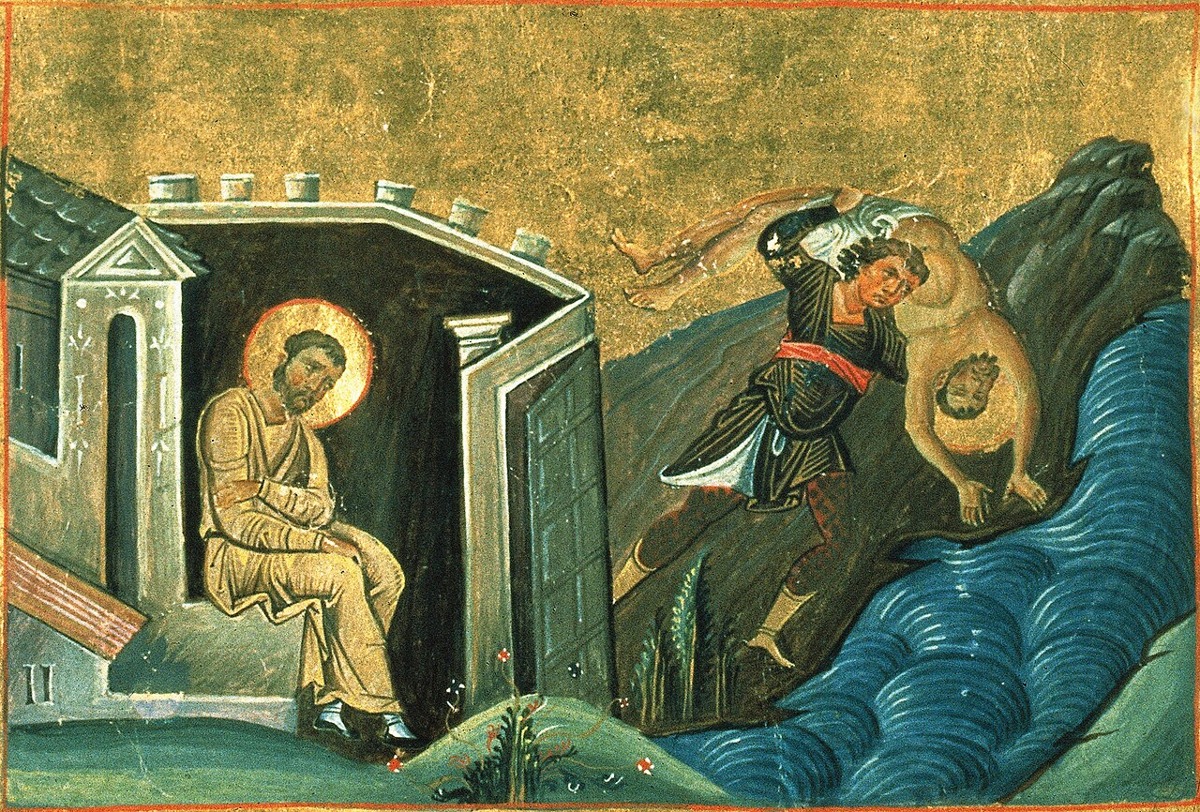
Lucian is depicted as a mature presbyter with short dark hair and a rounded beard, in the tunic and mantle of a priest — not, in the Greek tradition, in episcopal vestments, though the Russian icon-painters' manuals diverge on the point: the Stroganov guide shows him in a phelonion holding a Gospel, without the omophorion, while the Litsevoy Podlinnik directs that he be painted as a bishop, a promotion in paint that the OCA compares to the parallel case of Charalampus. Narrative images follow the passion: the stored miniature for October 15 from the Menologion of Basil II (Constantinople, c. 985; Vatican, Vat. gr. 1613) sets two scenes side by side — the haloed martyr seated in the dark doorway of his prison, and, at the right, an executioner casting his naked body from the rocks into the swirling sea that would keep it thirty days.
Disputed questions
- Hieromartyr or venerable-martyr? The classifications diverge in a way the service books themselves preserve. The Greek Menaion heads the day "the holy Hosiomartyr (venerable-martyr) Lucian" — honouring the ascetic — while the synaxarion notice within the same book styles him "Hieromartyr, presbyter of Antioch the Great"; the Slavic calendar likewise titles the day's saint a venerable-martyr while his hymns address him as hieromartyr ("священномучениче Лукиане"). The OCA heads its life simply "Martyr Lucian the Presbyter." This entry follows the synaxarion and the hymns: hieromartyr and priest, with his ascetic formation recorded in the Life.
- Lucian and Arius. Whether the teacher of the Collucianists bears any responsibility for the heresy of his pupils is the classic problem of Lucianic scholarship, ancient and modern; the evidence — Arius's syllukianista, Alexander of Alexandria's hostile notice of his years out of communion, the creed of 341, and the Church's unbroken veneration — is set out in the Life above. A minority of scholars, ancient and modern, have proposed cutting the knot by distinguishing two Lucians of Antioch, the martyr and the teacher of Arius; most accept a single man and let the tension stand. So does this entry.
- Manner of death. Starvation in prison is the dominant tradition, confirmed by the synaxarion distich; a subsidiary stream says the sword despatched him when hunger had not. Some late accounts say his body was weighted and sunk. The frontmatter records the traditional date, January 7, 312.
- Site of the relics. The Greek tradition and the church historians fix the martyr's grave at Drepanum in Bithynia, refounded as Helenopolis in his shrine's honour in 327; the OCA life carries a notice of a church of Saint Helena over his relics at Antioch, linked to the October date. The two notices are left side by side, as transmitted.
- Not to be confused with Lucian of Samosata the pagan satirist (2nd century), a namesake and fellow-townsman only; nor with Lucian of Kaphar Gamala, the priest to whom the relics of Stephen the Protomartyr were revealed in 415 (see the entry on Stephen); nor with the martyr Lucian of the company of Macrobius and Gordian (September 13); nor with the hieromartyr Lucian of the Kiev Caves (†c. 1243), who shares this feast day precisely because he bears this Lucian's name; nor with the hieromartyr Lucian of Beauvais, first bishop of that Gallo-Belgic city and a saint of the Slavonic and OCA calendars on June 3, where he stands beside the similarly named Lucillian of Byzantium.