
Marcellinus of Rome
The Holy Hieromartyr Marcellinus, Pope of Rome, and the Holy Martyrs Claudius, Cyrinus and Antoninus
Hieromartyr · Bishop · Martyr · b. 3rd century, at Rome — d. 304, at Rome
Commemorated 7 June — Martyrdom at Rome with Claudius, Cyrinus and Antoninus
Marcellinus was bishop of Rome from 296 to 304, and his pontificate ended inside the Great Persecution of Diocletian. The Byzantine synaxarion honours him as a hieromartyr and tells his story as a fall and a recovery: worn down by torture he offered incense to the idols, was rewarded by the emperor with honours and friendship, and then, undone by his conscience, confessed his apostasy before a synod of bishops at Sinuessa in Campania in sackcloth and ashes, judged himself unworthy of the priesthood and asked that his body be left unburied. The bishops refused to condemn him, reminding him that Peter also had denied Christ and had wept and been forgiven; and Marcellinus returned to Rome, renounced his compliance to the emperor's face, and was tortured and beheaded with three companions, Claudius, Cyrinus and Antoninus. His body lay unburied thirty-six days until the Apostle Peter appeared to his successor Marcellus and bade him bury it, and it was laid in the cemetery of Priscilla on the Via Salaria. His feast is June 7 in the Byzantine calendars and April 26 in the Latin.

The bishop of Rome under Diocletian
The historical outline is secure and very brief. Marcellinus was elected bishop of Rome in the summer of 296, following Caius, and the fourth-century Roman lists give him a pontificate of a little over eight years, ending in 304. The whole of the second half of that period lies under the edicts of Diocletian — the demolition of churches, the surrender and burning of the Scriptures, the imprisonment of the clergy, and finally the general order to sacrifice. Rome lost its bishop and then went for some years, on any reckoning, effectively without one: the see was vacant or contested until Marcellus was established about 308, and the Roman church was afterwards torn for a generation over what to do with those who had complied. Marcellinus stands exactly at that fracture, and everything told about him is coloured by it.
The most reliable single datum about him is where he was buried. The Chronography of 354, in the list of the depositions of the Roman bishops, records Marcellinus's burial in the cemetery of Priscilla on the Via Salaria, on the 26th of April — which is why the Latin calendars keep him on that day, and why the detail of the burial in Priscilla's crypt, which the legend supplies with a vision to explain it, is in fact the one part of the narrative independently attested.
The charge of apostasy
That Marcellinus lapsed was asserted in his own century — by the Donatists of Africa, who used the story polemically to argue that the Roman succession itself was polluted by traditio, the handing over of the sacred books. Augustine answered them directly, and treated the accusation as a slander: he lists it among the fabrications of his opponents and denies that any such thing is on record against Marcellinus or against his archdeacon. The Donatist charge and Augustine's denial are the earliest form in which the question appears, and neither side is a disinterested witness.
Whatever the truth of the accusation, it was too good a story to lose, and in the early sixth century it was rewritten from the other end. During the Roman schism of Symmachus and Laurentius, partisans of Symmachus forged a small library of documents to establish that the bishop of Rome cannot be tried by anyone — prima sedes a nemine iudicatur — and among them was an alleged Council of Sinuessa, at which a great assembly of bishops and presbyters heard Marcellinus confess that he had sacrificed and refused to pass sentence on him, saying that the first see is judged by none and that he must judge himself. This document, the Gesta de Marcellino, is by universal consent a forgery of about 500, and it is the direct ancestor of the story the Byzantine synaxarion tells: the sackcloth and ashes, the assembly of bishops (the Greek notice numbers them one hundred and eighty), the self-judgement, the request to be left unburied.
The synaxarion's account
The Byzantine notice, which is what the Orthodox books actually commemorate, runs as follows. In the persecution under Diocletian and Maximian Marcellinus was arrested and tortured, and at length burned incense before the idols; the emperor, delighted, clothed him in rich garments and treated him as a friend. Conscience gave him no rest. He went into Campania and laid his sin before a synod of one hundred and eighty bishops and presbyters at Sinuessa, coming before them in sackcloth with ashes on his head and confessing openly; and when they put it to him to judge himself, he pronounced himself unworthy of the priesthood and asked that when he died his body should be thrown out unburied. The fathers would not have it. They answered him with the case of Peter, who denied his Master out of fear and wept bitterly and was forgiven, and they left him in his office.
He came back to Rome and went to the emperor and took back what he had done — declaring before him that he had denied Christ in weakness and now confessed Him. Diocletian, enraged at being made a fool of, had him tortured again and then beheaded with the sword, and with him three men who had confessed with him, Claudius, Cyrinus (Quirinus) and Antoninus. Marcellinus went to his death praying to the Christ who receives repentant sinners.
The last movement of the story concerns his burial, which he had forbidden. His body was left thirty-six days in the open. Then the Apostle Peter appeared to Marcellus, the new bishop — the man who had most reason to think the sentence just — and asked him how long he meant to leave his predecessor unburied; and when Marcellus objected that the dead man had condemned himself, Peter answered that Marcellinus had repented, and that the words of a penitent were not to be used against him. So Marcellus took up the body and buried it honourably in the crypt which Priscilla had made for the burial of martyrs on the Via Salaria.
The reason the Church kept the story
Nothing in the Orthodox calendar suppresses the fall; the commemoration is of the fall and the return. That is unusual and deliberate. The Church has never had many saints whose notice begins with an apostasy, and the notice of Marcellinus is constructed so that the weight falls on two sentences: the bishops' reminder that Peter denied and was restored, and the Apostle's ruling that a penitent's self-condemnation may not be held against him. Read that way the day is not about the papacy or about the Donatist quarrel at all, but about the measure of repentance — and about the pastoral principle, argued in Rome for a century after Diocletian and settled in the canons, that the lapsi who return are received.
Feast and commemoration
June 7 (church date; New Calendar civil June 7; Old Calendar civil June 20) in the Byzantine calendars, where the notice is "the holy martyr Marcellinus, pope of Rome, and Claudius, Cyrinus and Antoninus." He shares the day with the martyr Theodotus of Ancyra, with Daniel of Sketis, and with his successor Marcellus of Rome and that pope's large company of Roman martyrs, so that June 7 is in effect the Byzantine calendar's Roman martyrs' day.
In the Latin books he is kept on April 26, the day of his deposition recorded in the Chronography of 354, and was for centuries joined there with Pope Cletus. The divergence is not a disagreement about the man but the ordinary difference between a Roman calendar built on the depositio dates of the city's cemeteries and a Byzantine calendar which received the Western saints later and placed them where its own synaxarion had room.
Hymns
Apolytikion — Tone 4 (common of a hieromartyr)
Sharing the manner of life of the Apostles and succeeding to their thrones, thou didst find in the practice of virtue the way of ascent to the things of God, O inspired one; therefore, rightly dividing the word of truth, thou didst contend for the faith even unto blood, O hieromartyr Marcellinus: intercede with Christ God that our souls may be saved.
Kontakion — Tone 2
Broken for an hour by the torments, thou didst offer the incense of denial; but rising up with the tears of Peter thou didst confess Christ before the tyrant, and didst wash thy word away in thy blood, O shepherd Marcellinus: and the Church, taught by thee that repentance is received, will not leave thy memory unhonoured.
Original translation from the Greek
Iconography
In Byzantine painting Marcellinus would be shown by the ordinary formula for a Western hierarch-martyr: an elderly bishop in phelonion and omophorion, blessing and holding the Gospel, with the small cross of the martyrs in his right hand where the martyrdom is signalled — the same type as any pope of Rome in an Orthodox menologion, with nothing individual but the inscription. He has no attested proper attribute, and his cult in the East has never been figural.
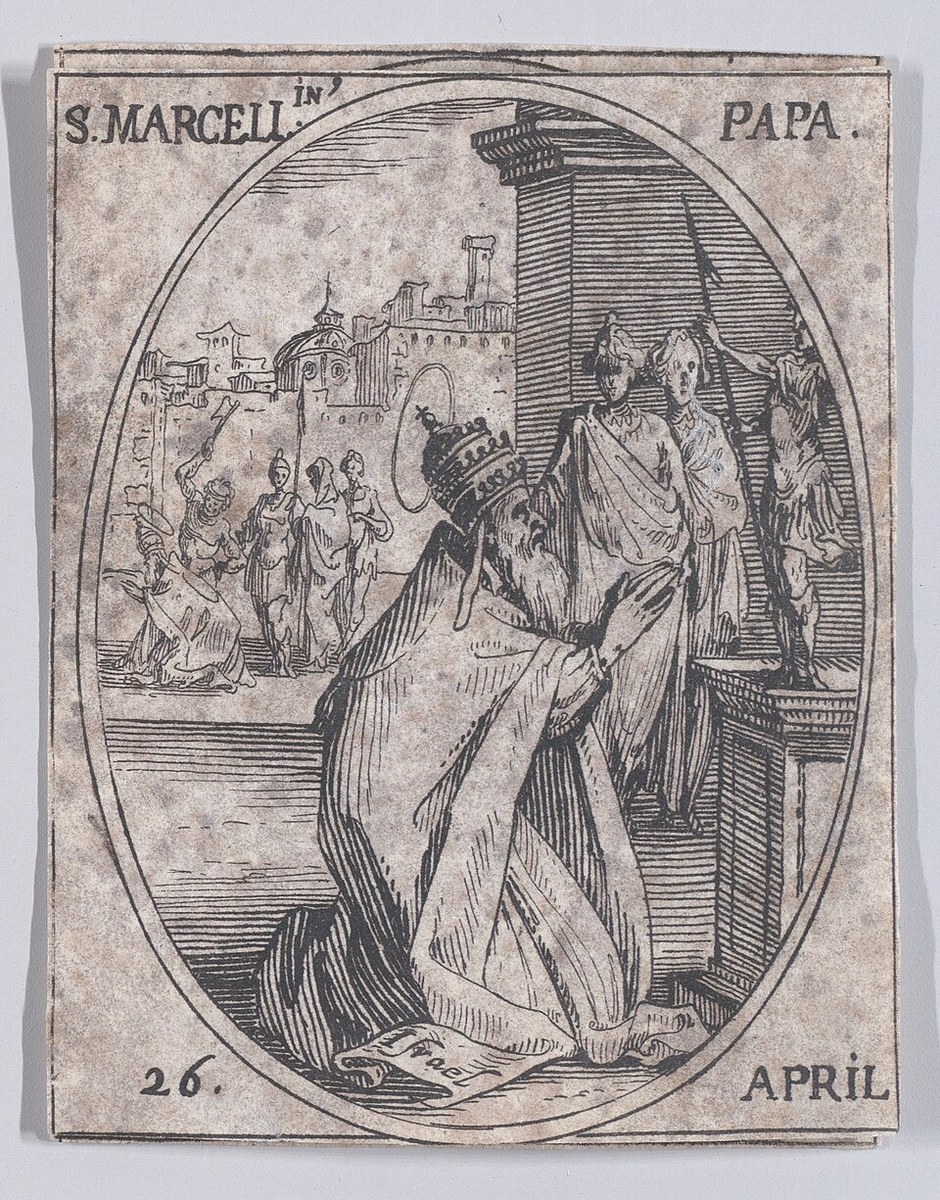
The Latin tradition, by contrast, gave him a narrative image, and it is a striking one, because it chose to paint the fall rather than the crown. The stored image is the small etching of 1636 by Jacques Callot, from his series Les Images de tous les Saincts et Saintes de l'Année, one plate for each day of the year: it is lettered "S. MARCELLIN. PAPA." above and "26. APRIL" below — the Latin feast — and shows the pope in the triple tiara and cope kneeling on the steps before a draped standing image raised on a pedestal, with an altar or tripod beside it; behind, in the middle distance, soldiers with spears and a figure kneeling under the sword complete the story in Callot's usual compressed manner. It should be read for what it is: a Western devotional print, not an Orthodox icon, of a saint whose iconography in the East is purely conventional. It is stored because it is identity-secure — the sheet names him and dates him — and because it records how the tradition that produced it understood him.
Disputed questions
- Did Marcellinus apostatise? The record is irrecoverable. The charge is first heard from the Donatists, who had a controversial motive; Augustine rejected it, and modern historians of the Roman church generally follow him and treat the story as legend grown from polemic. The elaborated version, the Gesta of the Council of Sinuessa, is a demonstrable forgery of about the year 500 made in the interest of the Symmachan party, and cannot be evidence for anything in 303. The Orthodox commemoration nonetheless transmits the developed narrative, and this entry gives it as the tradition gives it while recording that it is not history.
- Was he a martyr at all? The Roman lists record his death in 304 and his burial in the cemetery of Priscilla, but not a martyrdom; the Depositio episcoporum enters him among the bishops, not among the martyrs. Both the Byzantine and the Latin traditions came to honour him as a martyr, and the Byzantine style is hieromartyr. It is at least possible that he died in prison or in peace in the middle of the persecution.
- Marcellinus and Marcellus. The two names, the two adjacent pontificates and two badly copied catalogues have produced a long confusion; the Liber Pontificalis and the Liberian catalogue disagree about the length of each reign, and at least one ancient list drops one of them altogether, so that the older scholarship sometimes proposed that "Marcellinus" and "Marcellus" were one man twice recorded. They are two, and the Byzantine calendar keeps them on the same day, June 7 — see Marcellus of Rome, with whose companions Marcellinus also appears in the second of the day's two Roman notices, given here under Sisinius, Cyriacus and the Martyrs of Rome.
- Not to be confused with the two Roman brothers Marcellinus and Mark, deacons, martyred under Diocletian and commemorated on June 18, whose passion belongs to the cycle of Sebastian of Rome; nor with the Marcellinus of the company of Meletius Stratelates; nor with the tribune Marcellinus of Carthage, Augustine's correspondent, who is not a saint of this calendar.
- The three companions. Claudius, Cyrinus and Antoninus are known only from this notice. Their names are common Roman ones and no independent cult of them is traceable at Rome; they are commemorated with Marcellinus and have no separate day.