
Michael Maleinos
Our Venerable Father Michael Maleinos, founder of the Lavra of Kyminas
Venerable · b. c. 894, in Cappadocia (the theme of Charsianon) — d. 12 July 961, at Mount Kyminas in Bithynia
Commemorated 12 July — Repose at the Lavra of Kyminas
Michael Maleinos (c. 894 – 12 July 961) was a Byzantine aristocrat of the great Cappadocian house of the Maleinoi who left the court in his youth for Mount Kyminas in Bithynia, where he became the outstanding monastic founder of his generation. He filled the mountain with communities, governed the Lavra of Kyminas for some forty years, and there tonsured and formed Athanasius of Athos, the founder of the Great Lavra. Through his sister's marriage into the Phocas family he was the uncle of the emperor Nicephorus II Phocas, whom he counselled and whose patronage of Athos flowed from that connection. Russia keeps him with special honour as the patron saint of Tsar Michael Romanov.

Origins and the court
He was born about 894 in Cappadocia, in the theme of Charsianon, and baptised Manuel. His family, the Maleinoi, were among the greatest of the Anatolian military aristocracy — vast estates, a long line of generals, and marriage alliances with the imperial house. His father Eudokimos held the rank of patrikios; his mother Anastaso was connected to the family of the emperor Romanus I Lecapenus; his paternal grandfather Eustathios was likewise a patrician and his maternal grandfather Adralestos had been General of the East. His brother Constantine Maleinos commanded in Cappadocia; his sister married Bardas Phocas the Elder, and so became the mother of the future emperor Nicephorus II Phocas and of the kouropalates Leo.
Manuel was placed at the imperial court as a young man and was marked out for the career his birth prescribed. He did not want it. The life of him written by Theophanes, a monk of his own lavra and the primary source for everything told here, describes an adolescence already turned to the ascetic ideal, and a decisive break at about the age of eighteen — roughly 912–915 — when he left the palace and the world together.
Mount Kyminas
He went to Mount Kyminas in Bithynia, then filling up with hermits, and put himself under an elder named John Elladites. Three years of probation followed before the tonsure, which gave him the name Michael; he was later ordained to the priesthood. What he built afterwards changed the mountain. Around his own cell he gathered a coenobium, the Lavra of Kyminas, on a strict rule of common life, obedience and manual work, with a scriptorium that made it a centre for the copying of the ascetic fathers; and as disciples came he founded further houses across the mountain, so that Kyminas became — in the phrase of his biographer — covered with monasteries. He governed for about four decades, and was famous in his lifetime beyond Bithynia for discernment and for a personal austerity that no amount of superiorship softened.
Athanasius of Athos
About 952–958 there came to Kyminas from Constantinople a celebrated young teacher named Abraham, who had been directed to Michael by his friends among the Maleinoi and Phocades. Michael tonsured him and gave him the name Athanasius, put him through the ordinary obediences, and — recognising the calibre of the man — allowed him a severity of rule beyond the community's, and began to speak of him as the one who would come after him. It was at Kyminas, in Michael's own guest-house, that Athanasius first met Nicephorus Phocas. When Athanasius, fearing to be made abbot, fled from Kyminas to Athos, and when Nicephorus later sent the money from the Cretan campaign that founded the Great Lavra in 963, both strands ran back to Michael's monastery: the Athonite Lavra was in its constitution a daughter of the Lavra of Kyminas, and the elder's rule and his liturgical order went with his disciple to the Holy Mountain.
Nicephorus Phocas
Michael's nephew Nicephorus Phocas, the greatest soldier of the age and emperor from 963 to 969, was deeply attached to him and visited him at Kyminas. Nicephorus wished to take the habit himself; his uncle judged that the empire had more need of him than the mountain did, and sent him back to his command — a judgement that Byzantine writers, who admired the monk-emperor's asceticism on the throne, liked to recall. The emperor's later benefactions to the monastic life, and his willingness to fund an Athonite foundation on the model of his uncle's, are the fruit of this relationship. Michael did not live to see the coronation: he died two years before it.
Repose
He reposed at Kyminas on 12 July 961, in his late sixties, having spent nearly fifty years on the mountain. His shrine there was venerated until the Turkish advance emptied Bithynia of its monks; the site of the Lavra of Kyminas, somewhere in the uplands of the modern province of Bursa, is no longer securely identified.
Veneration in Russia
His cult took an unexpected second life in Muscovy. Michael Feodorovich Romanov, elected tsar in 1613, was born on the eve of the saint's day and named for him, so that Michael Maleinos became the patronal saint of the first Romanov and, by extension, of the new dynasty. Icons of him were multiplied through the seventeenth century for the Kremlin churches and the tsar's household, often with rich metal covers, and his name-day was a court festival. Almost all surviving pre-modern panel icons of the saint — including the one stored with this entry — come out of that Russian Romanov tradition rather than from a Greek one.
Feast and commemoration
July 12 (church date; Old Calendar civil July 25), universally. On the Holy Mountain he is kept with particular honour at the Great Lavra, as the spiritual father of its founder, and the Athonite tradition treats the July 5 feast of Athanasius and the July 12 feast of his elder as a pair a week apart. In Russian usage the day carries the additional weight of the Romanov patronal association described above. He shares the day with the martyrs Proclus and Hilary of Ancyra and, in modern Greek usage, with Paisios the Athonite.
Hymns
Apolytikion — Tone 8
In thee, O Father, was preserved unimpaired that which is according to the image; for taking up the Cross thou didst follow after Christ, and by thy deeds thou didst teach us to overlook the flesh, for it passeth away, but to care for the soul, a thing immortal. Wherefore, O venerable Michael, thy spirit rejoiceth with the angels.
Kontakion — Tone 2
Thou didst forsake the honours of thy house and the service of an earthly emperor, and didst clothe a mountain with monasteries; and having begotten a son worthy of thee for the Holy Mountain, thou wast gathered in peace to thy Lord. O venerable Michael, father of fathers, pray that our souls be saved.
Original translation from the Greek
Iconography
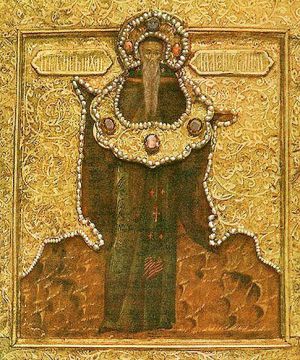
Michael is painted as a monastic elder in the schema: long, narrow, grey or white beard, often forked or tapering to a point, the head bare or hooded, the hands raised in prayer or holding a scroll of ascetic counsel. Greek practice sets him among the venerable fathers of the Menaion; Athonite practice sometimes places him beside Athanasius of Athos, the disciple holding the model of the Great Lavra and the elder his scroll. In the seventeenth-century Russian icons made for the Romanov court he is a full-length standing figure in a dark mantle upon a rocky ground, hands open before the breast, with the inscription ПРПДБНЫЙ МИХАИЛЪ МАЛЕИНЪ in cartouches flanking the head, and very often under a chased and gilded riza set with pearls and coloured stones, which leaves only the face, hands and feet of the painting visible.
The stored image is exactly of that Russian type: a seventeenth-century panel with a silver-gilt riza, the saint standing frontally with hands raised, the inscription legible in the two cartouches. The underlying icon is a pre-1900 work in the public domain and the photograph is a faithful flat reproduction of it, so it is stored under pd-old-work; the image is Russian and Romanov-era, not Byzantine, which is stated here because it shows the saint as Muscovy imagined him rather than as tenth-century Bithynia would have.
Disputed questions
- The year of his death. Theophanes' Life and the Byzantine prosopography give 12 July 961; a number of synaxaria and modern jurisdictional calendars give 962 or 963, and the OCA notice dates his life loosely by the reigns from Constantine VII to Basil II. The July 12 church date is not in dispute; only the year is, and 961 is preferred here as the reading of the earliest source.
- The name of the mountain. Kyminas (Κύμινας) is placed by most scholarship in Bithynia, in the hinterland of Prusa/Bursa; an older view located it on the Galatian border. The Bithynian identification is followed here.
- Not to be confused with the several other monastic Michaels of the calendar — Michael the Synkellos (†846), Michael of Synnada (†821), Michael of Klopsk — nor with the archangel whose synaxis is kept on November 8.