
Michael the Black-Robed
The Holy Venerable Martyr Michael the Black-Robed, monk of the Lavra of Saint Sabbas
Venerable Martyr · d. 9th century, at Jerusalem, beheaded
Commemorated 23 May — Martyrdom by beheading at Jerusalem, 29 July
Michael — called in Slavonic chernorizets, "the black-robed," the plain old word for a monk, and in Greek ho Sabbaïtēs, the Sabbaite — was a young man of Edessa in Mesopotamia who gave away his inheritance, went to Jerusalem, and became a monk of the great Lavra of St Sabbas under the direction of his kinsman St Theodore of Edessa. He supported himself, as the Sabbaite monks did, by weaving baskets of reeds and selling them in the market of Jerusalem; and it was there, in the ninth century, under the caliph al-Ma'mun, that a great lady of the caliph's household took notice of him, sent for him, and — when he refused her — accused him of blaspheming Islam. Offered adoption as the caliph's son if he would confess Muhammad a prophet, he answered that Muhammad was a deceiver and a forerunner of the antichrist, and asked to be sent back to his monastery, or to see the caliph converted, or to be killed. Poison was given him and did not harm him; he was then beheaded. His brethren carried his body back to the Lavra, and the tradition says a pillar of fire went with the relics.
_-_%D0%B8%D0%BA%D0%BE%D0%BD%D0%B0_09232_%D0%9C%D0%B8%D1%85%D0%B0%D0%B8%D0%BB_%D1%87%D0%B5%D1%80%D0%BD%D0%BE%D1%80%D0%B8%D0%B7%D0%B5%D1%86.png)
Edessa, and the road to the Lavra
He was born at Edessa in Mesopotamia — the ancient Christian city of Osrhoene, by then long under Muslim rule — in the years around 800, of a family with property. On the death of his parents he distributed his inheritance to the poor and went as a pilgrim to Jerusalem, to the churches of the Holy Places, which were open to Christian pilgrims under the Abbasids on payment of the accustomed dues.
There he did not return home but entered the Lavra of St Sabbas in the Judaean desert, the mother-house of Palestinian monasticism, at that time still one of the great intellectual centres of the Eastern Church — the house of St John of Damascus in the generation before. His elder there was his own kinsman, Theodore of Edessa, afterwards bishop of that city, and it is in the Life of Theodore of Edessa that the account of Michael's martyrdom is embedded and transmitted.
The detail the Passion is careful to give is economic: the two of them made baskets out of reeds to keep themselves, and Michael was the one who carried the baskets down to Jerusalem and sold them in the market. It is exactly the labour prescribed by the Palestinian monastic tradition, and it is what put a young monk in a public place among strangers.
The accusation
The Passion sets the scene in the market. A eunuch of the household of a great lady — the sources call her the queen Seida, who was at Jerusalem with the caliph al-Ma'mun (813–833) — admired the workmanship of Michael's baskets and brought the young monk before his mistress. She attempted to seduce him; he refused her, and would not be moved either by flattery or by threat. Humiliated, she went to her husband with the accusation that this Christian had insulted the Prophet and reviled Islam — a capital charge, and the one charge against which a Christian in that jurisdiction had no defence.
The confession and the martyrdom
Brought before the caliph, Michael was offered the way out that the Muslim authorities regularly offered to attractive and useful young converts, and in this telling offered in its most extravagant form: confess that Muhammad is a prophet and an apostle of Christ, and I will adopt you as my son. Michael refused, and answered with the polemic of the Palestinian monastic tradition — that Muhammad was a deceiver and a forerunner of the antichrist — and then, with a candour the Passion evidently admires, laid out the only three outcomes he was willing to accept: let me go back to my monastery; or be baptised yourself; or kill me.
Poison was administered, and (the account says) did him no harm; the failure of the poison is the miracle of his passion, as it is of many of the martyrdoms of the Muslim period. The caliph then ordered him beheaded, and so he was perfected, a young man, at Jerusalem.
Relics
The Christians recovered the body, and the monks of the Lavra of St Sabbas carried it home into the desert for burial among the fathers. The tradition attaches to that translation a pillar of fire descending from heaven and accompanying the relics — the sign, in this literature, of a martyrdom accepted by God.
Feast and commemoration
May 23 (church date; New Calendar civil May 23, Old Calendar civil June 5), with a second commemoration on July 29. The Slavonic calendars keep him firmly, as prepodobnomuchenik Mikhail chernorizets, and the Russian illustrated menologia give him a figure of his own on this day; the Greek tradition transmits the Passion within the Life of Theodore of Edessa. He is not among the commemorations printed in the Greek Menaion for May 23, which names Michael of Synnada, Mary of Cleopas, and the martyrs Seleucus and Salonas.
Hymns
Apolytikion — Tone 4 (common of a venerable martyr)
Having lived in the wilderness with the fathers, thou didst come to the city and wast made a martyr; for thou didst spurn the honours of the ruler as dung, and didst confess Christ before the tribunal, O venerable martyr Michael. Intercede with Christ God that our souls may be saved.
Kontakion — Tone 2
Thou didst weave the reeds of the desert with thy hands and sell them in the market, and there the enemy laid his snare; but neither the woman's flattery nor the poison of the tyrant could touch thee, and thou didst give thy head for Christ, O Michael the black-robed. Wherefore a pillar of fire went before thy relics.
Original translation from the Greek
Iconography
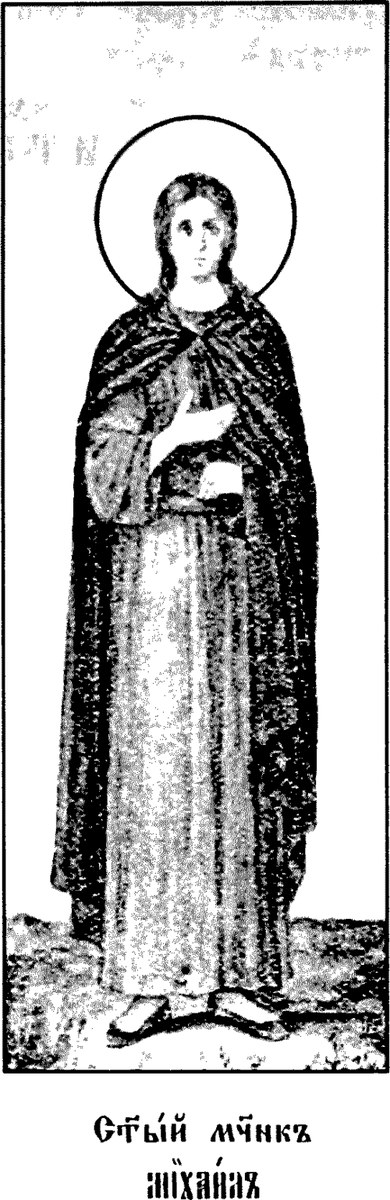
Michael is painted as a young monk-martyr: beardless or with the first down of a beard, the face lifted, the dark monastic mantle thrown over a pale undergarment, and the cross of the martyr in the right hand — the type in which the Church shows those who were both ascetics and witnesses. His distinguishing attributes, where he is given any, are the reed basket of his trade and, in narrative scenes, the cup of poison offered and refused, or the executioner's sword. He appears in the menologion tiers for May 23 and among the fathers and martyrs of the Lavra of St Sabbas.
The stored image is the Russian engraved figure of the saint published in the illustrated Жития святых (Lives of the Saints, set out after the Chet'i-Minei, St Petersburg, 1903–1911), plate 09232 — the series is numbered by the church year, so that 09 is the ninth month from September, May, 23 the day, and the trailing 2 the second commemoration of that day, which is Michael the Black-Robed's place in the Russian lists. It shows him standing full length, nimbed, a beardless youth with long hair, his eyes raised, wrapped in a dark mantle over a long pale tunic, one hand at the breast; the caption reads Стый мчнкъ Михаилъ — "the Holy Martyr Michael." The plate is anonymous and long out of copyright.
Disputed questions
The historical standing of the Passion. Michael's martyrdom is not independently attested: it is known from the Life of Theodore of Edessa, a Greek hagiographical romance ascribed to Basil of Emesa, whose historical value has long been contested. The narrative frame of that work — a Christian bishop of Edessa on intimate terms with the caliph, whom he is made to baptise — is generally judged legendary, and the chronology of Theodore's own life does not sit easily with the reign of al-Ma'mun. What the Passion of Michael preserves under that frame is nevertheless a real and repeatedly documented type of event: the execution of Christians in ninth-century Palestine on a charge of blaspheming Islam, and the martyrdom of monks of the Lavra of St Sabbas in particular. This entry gives the tradition as the Church transmits it and records that its detail cannot be verified.
The lady's name. The "queen Seida" of the Greek and Slavonic versions is almost certainly not a personal name at all but the Arabic al-Sayyida, "the Lady" — the ordinary honorific of the chief woman of the caliph's household; some retellings accordingly identify her with Zubayda, the wife of Harun al-Rashid and mother of al-Ma'mun's rival, which would push the episode a generation earlier. The identification is a guess.
Two feasts. The calendars give him May 23 and also July 29; the second is the day he shares with a group of martyrs of the Palestinian monasteries, and neither date is a recorded anniversary of his death.
Not to be confused with Michael of Synnada, the bishop and confessor commemorated on this very same day, nor with the other monk-martyrs of the Lavra of St Sabbas, nor with Michael the Soldier of Bulgaria.