
Theodore of Edessa
Our Father among the Saints Theodore the Sabbaite, Bishop of Edessa
Bishop · Venerable · b. late 8th century, at Edessa in Osrhoene — d. 848, at the Lavra of Saint Sabbas in the Judaean desert
Commemorated 9 July — Repose at the Great Lavra of Saint Sabbas, 19 July — Commemoration in the OCA and Slavonic calendars
Theodore, called the Sabbaite from the Palestinian lavra in which he spent most of his life, was a native of Edessa in Mesopotamia who was orphaned as a boy, gave away his inheritance, and went to Jerusalem, where he was tonsured at the Great Lavra of Saint Sabbas. After decades of obedience and of enclosure he was drawn out of his solitude and made bishop of Edessa — a Melkite see of the Patriarchate of Antioch, then long under Muslim rule — where he contended with the Manichaeans, the Nestorians and the Monophysites and governed his diminished Chalcedonian flock. His Life makes him travel to Baghdad to lay the grievances of the Christians before the caliph, whom he heals and baptises under the name John, and who is afterwards killed for confessing Christ. Theodore returned to Saint Sabbas and died there in 848. Chapters of ascetic teaching under his name passed into the Philokalia, and his Life, translated early into Slavonic, became one of the favourite reading-books of medieval Rus.
_-_July_-_13_-_Theodore_of_Edessa.jpg)
Edessa, and the road to the Lavra
Theodore was born at Edessa, the Syriac-speaking Christian metropolis of Osrhoene, into a prosperous family; the Life names his father Symeon and his mother Maria and gives him an elder sister. He was set to school young and distinguished himself in rhetoric and philosophy — the two disciplines that mark him ever afterwards, and that his biographer never lets the reader forget. Orphaned in boyhood (the Greek and Slavonic Lives say at ten, the Russian synaxarion notice at twelve), he divided the inheritance with his sister, gave his own half away to the poor, and went up to Jerusalem to venerate the holy places.
He did not go home. He was received into the Great Lavra of Saint Sabbas in the Judaean desert — the mother-house of Palestinian monasticism, and in the eighth and ninth centuries the intellectual centre of Chalcedonian Christianity under Arab rule, the house of John of Damascus and of a whole school of Greek and Arabic theologians. There he passed, by the received account, twelve years in the common obedience of the brotherhood and a further twenty-four in the strict enclosure of a solitary cell, in fasting, vigil and the study of the fathers. The reckoning is that of his Life, and it is meant to be read as it stands: more than half a lifetime spent learning to be silent before he was made to speak.
It was at Saint Sabbas, according to the same tradition, that he had charge of a young kinsman from his own city — the monk Michael the Black-Robed, the Sabbaite, whose martyrdom at Jerusalem is transmitted embedded in Theodore's own Life.
Bishop of Edessa
When the see of Edessa fell vacant, the choice fell upon Theodore. The Life is careful about the procedure, and the care is worth noticing: he was put forward on the initiative of the Patriarch of Jerusalem, and consecrated by the Patriarch of Antioch, in whose jurisdiction Edessa lay, with the consent of the clergy and people of the city. It is a small window onto the working of the Melkite patriarchates in the ninth century, when Jerusalem, Antioch and Alexandria all lay within the Abbasid caliphate and their affairs were transacted across it. Theodore, the Life says, was consecrated in his sixtieth year, and left his cell for the office unwillingly. At the consecration a dove white as snow is said to have circled beneath the dome of the church and settled on the new bishop's head.
The Edessa to which he came was not the Edessa of the Christian empire. The city had been Muslim-ruled since the seventh century; its Christians were divided among the Syrian Orthodox (whom the Greek Life calls Monophysites or Eutychians), the Church of the East (Nestorians), and the small Chalcedonian or Melkite community that was Theodore's own, and Manichaean teaching still had adherents in Mesopotamia. His episcopate is described almost entirely as a labour of controversy and consolidation: he preached, disputed, wrote, and held his flock together, and the Life preserves — at length, and with evident pride in its subject's rhetorical training — a long instruction delivered to the heretics of Edessa. It also records an attempt on his life by his opponents, from which he escaped. Near the city, at the monastery of the Great Martyr George, lived the clairvoyant stylite Theodosius, and the Life gives a conversation between the bishop and the pillar-dweller which is among its most attractive passages: the man of the city and the man of the column, each recognising the other's warfare.
The journey to Baghdad and the caliph John
The centrepiece of the Life is Theodore's journey to Baghdad, undertaken with the stylite's blessing, to lay before the caliph the injustices under which the Orthodox of Edessa were suffering. He found the caliph — named Mavias (Mu'awiya) in the Greek — gravely ill; the bishop put a little earth from the Sepulchre of the Lord into a vessel of water, prayed, and gave it him to drink, and the caliph was healed. Grateful, and then persuaded, the caliph heard his teaching, and at last received baptism in secret together with three of his intimates, taking the name John. Not long after, confessing Christ openly before the Muslims, he was killed with his three companions. He appeared, the Life says, on the same night and in the same words to Theodore and to Theodosius the Stylite, telling them that he had been granted to suffer for Christ, was numbered with the martyrs, and would meet them shortly in the Kingdom.
Theodore took the message as notice of his own end. He laid down his see, returned to the Lavra of Saint Sabbas, and there, in the cell where he had spent his best years, he reposed in peace in 848.
The writings
Under Theodore's name the Greek ascetic tradition transmits a century of chapters on the spiritual life (Ἑκατὸν κεφάλαια, "A Hundred Most Soul-Profiting Chapters") and a Theoretikon or "contemplative discourse," both of which were taken up by Nikodemos the Hagiorite and Makarios of Corinth into the Philokalia and so into the Slavonic Dobrotolubiye of Paisius Velichkovsky and the Russian Dobrotolyubiye of Theophan the Recluse. They are sober, closely argued texts in the line of Evagrius and the Palestinian fathers, on the passions, the guarding of the mind, and the ordering of the monastic day; their author is often cited simply as Theodore the Great Ascetic. A short catechetical discourse on the councils and a brief rule of monastic life are also ascribed to him.
The Life and its fortunes
The Life of Theodore of Edessa (Greek, ascribed to Basil of Emesa, whom the text presents as Theodore's nephew, his sister's son) is a long, elaborate and highly literary composition. It travelled remarkably well: translated into Church Slavonic at an early date, it survives in a great number of Russian manuscripts of the fourteenth to seventeenth centuries and was among the standard devotional reading of Muscovy, whence Demetrius of Rostov drew the notice in his Menaion. Its account of the martyrdom of Michael the Sabbaite gave the Slavonic tradition one of its favourite passion-narratives.
Feast and commemoration
July 9 (church date; New Calendar civil July 9, Old Calendar civil July 22), in the Russian, Ukrainian and American calendars, where he stands among a company of Eastern saints — the hieromartyrs Pancratius of Taormina and Cyril of Gortyna, and the Egyptian martyrs Patermuthius, Coprius and Alexander. He has a particular claim on the memory of the Church of Antioch, in whose patriarchate the see of Edessa lay and by whose patriarch he was consecrated; and a second claim on the Lavra of Saint Sabbas, which formed him, which he never really left, and in which he died. In the Greek books he is more often met with as an ascetic writer than as a calendar-saint, and the Philokalia has carried his name where the Life did not.
Hymns
Apolytikion — Tone 8 (common of a hierarch-ascetic)
In thee, O Father, was preserved unfailing that which is according to the image, for taking up the Cross thou didst follow after Christ, and by thy deeds thou didst teach us to overlook the flesh, which passes away, and to attend to the soul, which is a thing immortal; wherefore thy spirit, O holy Theodore, rejoices with the angels.
Kontakion — Tone 2
The bright lamp of the desert didst thou become, and afterwards a shepherd of the faithful in the land of thy fathers; forsaking the silence thou hadst loved, thou didst take up the labour of the word, O wise Theodore, and having finished thy course thou hast returned to thy cell, and to Christ, whom thou didst serve.
Original translation from the Greek
Iconography
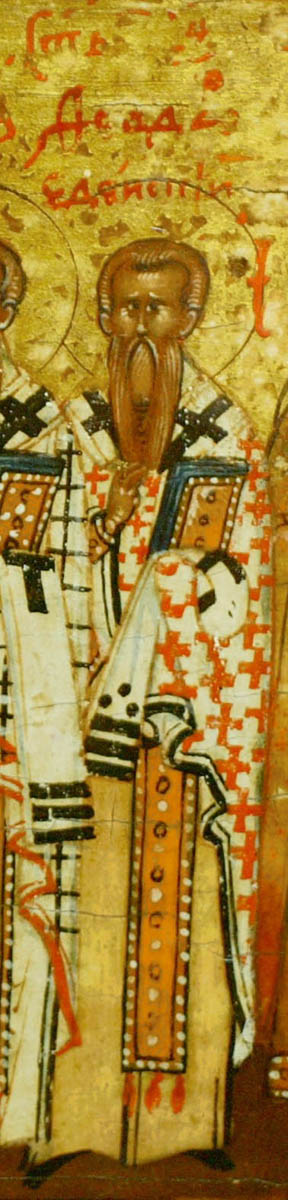
Theodore is painted as a hierarch and not as a monk: white- or grey-bearded, the beard long and tapering, vested in phelonion and crossed omophorion, blessing with the right hand and holding the Gospel-book in the left, the mark of the bishop's office. Where his Sabaite formation is remembered, the monastic koukoulion may be shown instead of the bare head, and in narrative cycles his consecration is depicted with the white dove descending on his head, which is his one unmistakable attribute. Russian menologion panels place him in the July rank with the other saints of the ninth day; the Slavonic manuscripts of his Life carry illustrated cycles of the journey to Baghdad and the baptism of the caliph.
The stored image is a figure from an early seventeenth-century Russian painted menaion panel for the month of July, now in the Church-Archaeological Cabinet of the Moscow Theological Academy: an aged hierarch with a long forked beard, in a white polystavrion worked with red and black crosses and an orange-bordered epitrachelion, holding the Gospel in a veiled hand, the Cyrillic inscription in red above him naming him of Edessa.
Disputed questions
- The historicity of the Life. Modern scholarship treats the Life of Theodore of Edessa as a work of Palestinian, probably Sabaite, hagiographical romance rather than a documentary biography, composed some generations after the events it narrates. The decisive difficulty is the caliph: the Life calls him Mavias, that is Mu'awiya, the name of the first Umayyad, who died in 680 and never ruled from Baghdad, which did not yet exist. A ninth-century Melkite bishop on intimate terms with an Abbasid caliph, who baptises him and sees him martyred, has no support in the Arabic or Syriac record, which would hardly have passed over the conversion of a commander of the faithful. That a Melkite bishop of Edessa named Theodore existed, that he was a Sabaite, and that ascetic writings under his name were current, are all perfectly credible; the Baghdad narrative is the Life's own theology of the triumph of Orthodoxy under Islam, told as story.
- The date of the feast and of the repose. The Russian and American calendars keep him on July 9 and give the year 848. The Greek tradition that knows him as Theodoros ho Sabbaïtēs places his repose — and his memory — on July 19, and dates him rather to the end of the eighth century. The disagreement follows the two branches of the transmission and is not resolved here; July 9 is the day of this entry because it is the day of the calendars that keep him as bishop of Edessa.
- Theodore of Edessa and Theodore Abu Qurrah. The genuinely documented Melkite figure of this region and generation is Theodore Abu Qurrah, bishop of Harran, the first Christian theologian to write systematically in Arabic, himself associated with the Sabaite milieu. The two Theodores are distinct men and distinct sees, and the Life knows nothing of Abu Qurrah; but the resemblance — Sabaite formation, a Mesopotamian bishopric, controversy with Muslims and with the non-Chalcedonians — has led scholars to ask whether Abu Qurrah's career supplied some of the colouring of the legend. The question is open and is recorded here so that the two are not merged.
- Not to be confused with the many other Theodores of the calendar, and in particular with Theodore the Studite, his near-contemporary, or with Theodore the Branded, the confessor of the icons.