
Milica of Serbia
Our Venerable Mother Euphrosyne, in the world Milica, Princess of Serbia
Princess · Venerable · b. c. 1335 — d. 11 November 1405, at the monastery of Ljubostinja
Commemorated 19 July — Commemoration with her son the Despot Stefan (Russian and Serbian usage), 30 August — Synaxis of the Serbian Enlighteners and Hierarchs
Milica (c. 1335 – 11 November 1405) was the wife of the great-martyr Lazar of Serbia, the mother of the despot Stefan Lazarević, and — for the sixteen years between the catastrophe of Kosovo and her death — the woman who governed what was left of the Serbian state and then, as a nun, prayed for it. Of the Nemanjić blood through her father Vratko, she held the regency after 1389, made the terrible peace with the sultan that preserved her people at the cost of her daughter, founded and built the monastery of Ljubostinja, took the veil there as the nun Eugenia and afterwards the great schema as Euphrosyne, and obtained from Bayezid the relics of Parasceva of the Balkans for Belgrade. Her relics at Ljubostinja were reported myrrh-streaming and healing.

Nemanjić blood
Milica was born about 1335, the daughter of Prince Vratko Nemanjić — the Yug Bogdan of the Kosovo epics — a great-grandson of Stefan the First-Crowned and so a descendant in a junior line of the sainted house of Nemanja. About 1353 she married Lazar Hrebeljanović, then a court officer of middling rank under Tsar Dušan; the marriage brought to Lazar's line the dynastic legitimacy that no other Serbian lord of the next generation could match, and it is the reason his sons could rule.
She bore Lazar at least eight children. Of the sons, Stefan succeeded him and Vuk rebelled against Stefan; the daughters were married into the ruling houses of Bosnia, Zeta and Bulgaria — and the youngest, Olivera, to the Ottoman sultan.
Regent
On 15 June 1389 Lazar was taken and beheaded after the battle of Kosovo. Stefan was twelve. Milica took the government, and within months faced the choice on which everything turned: Hungary was pressing from the north and the Ottomans from the south, the Serbian nobility was destroyed, and the state could not fight either. She accepted vassalage to Bayezid I — tribute, and troops on demand — and sent her daughter Olivera to the sultan's household as part of the settlement.
The Serbian tradition has never pretended this was anything but a bitter act, and it does not excuse it; it records it, and records also that it worked. Moravian Serbia survived, Stefan came of age and ruled, and the Serbian Church and its monasteries came through the years in which the Bulgarian Church did not. Milica governed until her son's majority and continued as his counsellor afterwards, twice travelling to the Ottoman court in person to plead for her people — journeys undertaken by a woman already tonsured, and remembered as such.
Ljubostinja, and the veil
About 1388–90 she founded the monastery of the Dormition of the Mother of God at Ljubostinja, near Trstenik, and built it as a house for the widows and daughters of the nobility killed at Kosovo — an institution created for a specific and immediate grief. In 1393 she was tonsured there as the nun Eugenia (Jevgenija), and later received the great schema with the name Euphrosyne (Jefrosinija), by which she is properly named in the calendars.
Around her at Ljubostinja gathered the literary circle of the Serbian court in exile from itself, and in particular the nun Jefimija, widow of the despot Uglješa, whose Praise of Prince Lazar — embroidered in gold thread on the silk shroud laid over Lazar's relics about 1402 — is among the first works of Serbian literature written by a woman. Milica had the shroud made and gave it to Ravanica.
To Milica also is owed the recovery of the relics of the great Balkan ascetic Parasceva: she obtained them from Bayezid — the sources differ on the year and on the exact circumstances — and had them carried to Belgrade, where they became the chief treasure of her son's new capital.
Repose and relics
She died on 11 November 1405 at Ljubostinja, and was buried in the monastery church. Her relics were reported to stream myrrh and to heal the sick, and Ljubostinja became a place of pilgrimage; they rest there still, and the monastery has been continuously inhabited by nuns.
Feast and commemoration
July 19 (church date; Old Calendar civil August 1), kept together with her son Stefan Lazarević, who died on that day in 1427 — so that the commemoration is his by right of the date and hers by association, mother and son honoured together. She is also numbered in the Synaxis of the Serbian Enlighteners on August 30. Her husband Lazar is kept on June 15. She is not carried by the Greek or Antiochian calendars.
Hymns
Apolytikion — Tone 8
Widowed on the day of Kosovo, thou didst not lay down the burden of thy people, but didst govern them in wisdom and then lay down thy rank for the angelic habit, O venerable mother Euphrosyne; wherefore, having built a refuge for the widows of the slain, thou dost pour out healing from thy relics upon all who come to thee.
Kontakion — Tone 2
Thou didst give thy daughter to the enemy that thy people might live, and thy own life to Christ that they might be saved; and the myrrh of thy relics answers for thee, O mother Euphrosyne. Cease not to intercede for the land thou didst not abandon.
Original translation from the Slavonic
Iconography
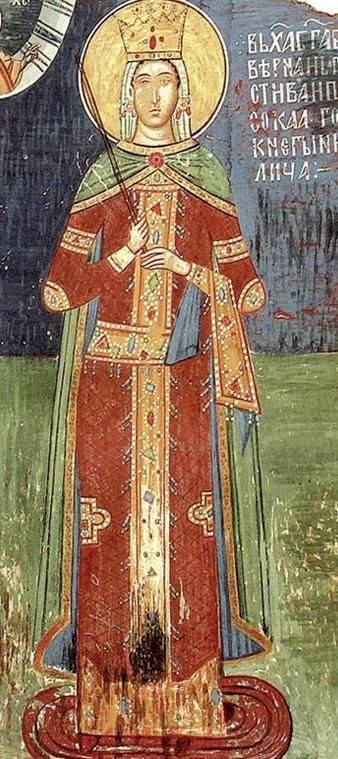
Milica is written in the monastic habit as the nun Euphrosyne: dark mantia and veil, the schema visible at the breast, the face of an elderly woman, holding a scroll or a cross, and — where the painter identifies her as ktetorissa — a model of the church of Ljubostinja offered in her hands. The ktetor composition in the narthex of Ljubostinja itself, of her own time, shows her with her sons Stefan and Vuk, and is the earliest and most authoritative image of her. In the older princely portraits, made before her tonsure, she appears crowned, in the gold-worked robe and jewelled loros of a Serbian princess, beside Lazar; both types are in use, and the monastic one has prevailed in modern icons.
No pre-1900 portable icon of her has been located and confirmed for this collection; the surviving early images are the monumental donor portraits at Ljubostinja and Ravanica.
The stored image is her ktetor fresco at Ljubostinja (1402–1405), the foundress crowned in the jewelled robe of a princess, named in the Slavonic inscription beside her.
Disputed questions
- What did she write? Milica is credited in Serbian tradition with prayers and with a lament for her husband, and the received English lives say she "composed prayers and mourning poetry." The attribution is not secure. The great lament of the period, the Praise of Prince Lazar, is certainly Jefimija's, not hers; what is safely Milica's is the charter material and the correspondence issued in her name, and her patronage of the writing done around her. This entry credits her with the patronage and leaves the poetry an open question.
- Her monastic names. Both Eugenia and Euphrosyne are hers: the first at her tonsure in 1393, the second at her reception of the great schema. English lists sometimes give only one, or reverse them.
- Her feast day. The Russian calendars and the OCA keep her on July 19, with her son Stefan. The Serbian Church commemorates her on July 19 as well, and she is included in the synaxis of Serbian saints kept on August 30; some English notices give August 30 as her principal day. The disagreement is recorded and not resolved here.
- The relics of Parasceva. The year in which Milica obtained them from the sultan is given variously (1398 is common; c. 1396 and other dates are found), and one branch of the tradition attributes the embassy to her son rather than to her. The existing entry on Parasceva records the same divergence.