
Lazar of Serbia
The Holy Great-Martyr Lazar, Prince of Serbia
Great Martyr · Prince · b. c. 1329, at Prilepac near Novo Brdo — d. 15 June 1389, on the field of Kosovo
Commemorated 15 June — Beheading after the Battle of Kosovo (1389) — Vidovdan
Lazar Hrebeljanović (c. 1329–1389) was the ruler who held the Serbian lands together in the generation after the collapse of the empire of Stefan Dušan, and who died on the field of Kosovo on 15 June 1389 — Vidovdan — fighting the army of Sultan Murad I. Raised at Dušan's court and married to Milica of the Nemanjić house, he governed Moravian Serbia from Kruševac, reconciled the Serbian Patriarchate with Constantinople after nearly thirty years of schism, and endowed churches and monasteries from Ravanica to the Russian house of St Panteleimon on Athos. Wounded and taken prisoner in the battle, he was beheaded on the orders of Murad's son Bayezid, the Sultan himself having been killed in the field. His body was laid at Priština and translated to Ravanica in 1391; his cult was established at once, and Serbian literature has never since been able to speak of the nation without speaking of him. He is honoured as Great-Martyr.
.jpg)
Prilepac and the court of Dušan
Lazar was born about 1329 at Prilepac, a fortified place near the silver-mining town of Novo Brdo in the Serbian heartland, to a family of the middle nobility; his father Pribac Hrebeljanović was a logothete — a chancery official — at the court of Stefan Dušan, and Lazar was brought up there. He held the court office of stavilac, a rank of middling honour with duties at the ruler's table, and about 1353 married Milica, a descendant of the Nemanjić line through Vratko, a great-grandson of Stefan the First-Crowned — the marriage that later gave his sons a claim to legitimacy that no other Serbian lord could match. He and Milica had at least eight children, among them Stefan Lazarević, the future despot, and daughters married into the ruling houses of Bosnia, Zeta and Bulgaria, and to the Ottoman Sultan.
Dušan died in 1355 and the empire he had built came apart within a decade among a dozen regional lords. The catastrophe was completed at the Maritsa in 1371, where the Mrnjavčević brothers Vukašin and Uglješa were destroyed by the Turks and the whole of Serbian Macedonia passed into vassalage. Lazar, who had held only a modest province in the north, was by then the strongest of the survivors. Through the 1370s he took Rudnik, Užice, Novo Brdo and the Morava valley, subdued or made allies of his rivals, and ruled from Kruševac a principality — "Moravian Serbia" — that was the last self-standing Serbian state. His charters call him knez, prince, and in the fuller style autocrat of all the Serbs; the imperial title he never took.
The reconciliation with Constantinople, and the endowments
His single greatest service to the Church was the healing of the schism with Constantinople. When Dušan had raised the Serbian archbishopric of Peć to a patriarchate in 1346 and had himself crowned emperor, the Ecumenical Patriarch had answered with an anathema, and Serbian and Greek clergy had been out of communion ever since. In 1375 Lazar and Patriarch Sava sent to Constantinople an embassy headed by the Athonite elder Isaiah the Serb, whose negotiation obtained the lifting of the anathema and the recognition of the Serbian patriarchate; the reconciliation was completed at Peć in the same year, and it is on the strength of it that Lazar is remembered in the Serbian tradition as the prince who brought his people back into the communion of the Church. The Patriarch elected that year, when Sava died, was Ephraim — the Bulgarian hesychast who shares his feast on June 15.
He built and endowed on a great scale. The chief foundation is Ravanica, raised in the later 1370s in a wooded valley east of the Morava and fortified with seven towers, the first and finest of the "Morava school" churches; the OCA notice dates its establishment to 1380. At Kruševac he built the court church of the Ascension, known as Lazarica. He was a benefactor of Hilandar on Athos, and he rebuilt the ruined Russian monastery of St Panteleimon there, for which the Russian Church has always kept his memory with particular warmth. Gornjak, Drenča, Jošanica, Naupara and Ljubostinja — the last built by his widow — belong to the same movement, which drew in the monks driven north out of Macedonia by the Turkish advance and made Moravian Serbia for a generation the centre of Slavic hesychast letters.
Kosovo, 15 June 1389
By the later 1380s Ottoman raiding had become annual, and in 1389 Murad I brought a full army north. Lazar met him with a coalition — his own forces, the contingent of his son-in-law Vuk Branković, and a Bosnian force under Vlatko Vuković sent by King Tvrtko — on the field of Kosovo near Priština, on 15 June (Old Style), the feast of the prophet Amos, since kept in Serbia as Vidovdan.
The battle was fought to mutual destruction. Murad was killed — by the Serbian knight whom the tradition names Miloš Obilić, who came into the Sultan's tent as a deserter and struck him — and his son Bayezid took command, killed his own brother Yakub, and held the field. Lazar, wounded and taken prisoner, was brought before Bayezid and beheaded by the sword on the same day, together with a great number of the Serbian nobility. Contemporary sources make the outcome a draw with both armies wrecked; the strategic result, given the disparity of reserves, was that Serbia became a tributary within a few years and a province within seventy.
Around this the Serbian people built what is probably the most elaborate national epic tradition in Europe: the Kosovo cycle of songs, with the prince's last supper, the choosing of the heavenly kingdom over the earthly, the curse on the traitor, and the maiden of Kosovo going over the field with bread and wine. The theological core of the cycle — that Lazar was offered the choice between an earthly kingdom that would perish and a heavenly one that would not, and chose the heavenly — is not a chronicle statement but a reading of his death, and it is the reading the Church has canonised in calling him martyr.
Relics and cultus
He was buried first in the church of the Ascension at Priština. In 1391 — some reckonings say 1392 — his relics were translated to Ravanica, and the cult was already fully formed: within two or three years of the battle, four separate Serbian offices and encomia had been written for him, by the Patriarch Danilo III, by an anonymous writer of Ravanica, and by others, and about 1402 his widow Milica, by then the nun Eugenia, embroidered in gold on the silk shroud that covered his relics the Praise to Prince Lazar of the nun Jefimija — a lament of great beauty which is among the first works of Serbian literature by a woman, and which asks the martyr to intercede for her sons Stefan and Vuk and for the ruin of the land.
The relics have travelled with the nation. When Ravanica was destroyed by the Turks in 1683, the monks carried the body north with them in the Great Migration — to Szentendre in Hungary, and thence in 1697 to the monastery of Vrdnik on the Fruška Gora in Srem, thereafter called New Ravanica (the "Mount Thruzh" of the OCA notice). In 1942, before the Ustaša advance, they were brought to the Cathedral of St Michael in Belgrade. In 1988–89, for the six-hundredth anniversary, the relics were carried in procession through every diocese of the Serbian Church and returned to Ravanica, where they remain.
Feast and commemoration
June 15 (church date; New Calendar civil June 15, Old Calendar civil June 28) — in Serbia Vidovdan, the day of the martyr-prince and of the Kosovo dead, and the most heavily freighted day in the Serbian year: a church feast which is also a national commemoration, with all the ambiguity that entails, and which secular history has repeatedly borrowed. The Serbian Church keeps with him on this day the Holy Martyrs of Kosovo — the nobility and soldiery who fell with him — and the day is a slava of many Serbian families and parishes.
He is not a universal Byzantine commemoration: the Greek and Antiochian books do not carry him. The Russian Church does, on the same day, and always has — the debt of the Athonite Rossikon being remembered — and the OCA notice files him as "Right-believing Prince Lazarus the Great Martyr of Serbia." The day is shared with the Prophet Amos, whose service it is, and with Ephraim of Serbia, the patriarch who returned to his throne after Kosovo.
Hymns
Apolytikion — Tone 4
Thou didst desire the kingdom that passeth not away, O holy prince Lazar, and having weighed the two kingdoms thou didst choose the better part; wherefore, receiving the crown of martyrdom upon the field of Kosovo, thou wast numbered with the company that suffered with thee. Entreat Christ God to grant peace to thy people and great mercy to our souls.
Kontakion — Tone 8
The new luminary of the Serbian land, the prince who gave his head for his people, let us honour with hymns; for having built temples in his life and having offered his own blood at the last, he standeth now before the throne of Christ, and prayeth for the flock he could not save with the sword.
Original translation from the Slavonic
Iconography
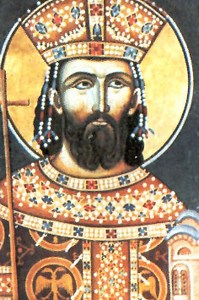
Lazar's iconographic type was fixed in his own lifetime and has scarcely changed. He is shown as a crowned ruler in early middle age, with a full dark beard, wearing the closed Byzantine crown with pendilia hanging beside the cheeks, the jewelled loros or a brocaded divitision stiff with pearls, and holding either a cross, a scroll, or — in the founder's portraits — a model of the church he built, which he offers to Christ or to the Theotokos. Where he appears as martyr he holds the martyr's cross and the palm; after the seventeenth century he is sometimes shown holding his own head, and in the Serbian baroque engravings he acquires a fur-lined mantle and a Western-looking crown. Modern Serbian work often pairs him with Milica/Eugenia, or sets him in the Kosovo scene among the martyred nobles.
The stored image is the founder's portrait from Ravanica, the monastery he built — a fresco of the 1380s, painted in his lifetime and therefore very probably a likeness: the prince half-length, haloed, in the pearled crown with pendilia and a heavily jewelled collar, the dark beard squared, the eyes forward. The available reproduction is small and the crop preserves no legible inscription; the identification rests on the Commons file description and on the fact that this is one of the most reproduced images in Serbian art. A better reproduction of the same fresco would be an upgrade, and is noted in the list of icons still being sought.
A candidate rejected in the course of this work should be recorded: a Commons file titled "Holy Martyr Tsar Lazar, icon detail," tagged CC BY-SA 3.0. The licence there is granted not by any iconographer but by an organisation which republished the photograph on its website, over an icon by an unknown, undated and probably modern hand. A licence granted by a photographer or a republisher does not touch the painter's rights in the underlying painting, and the file is therefore not storable.
Disputed questions
- Prince or Tsar? The songs and the popular tradition call him Car Lazar, and later icons often inscribe him so; his own charters and the contemporary encomia call him knez, prince, and samodržac (autocrat) of the Serbs. He was never crowned emperor, and the imperial title in the epic reflects the memory of Dušan's empire attaching itself to its last defender. The types here are great-martyr, prince.
- The year of the translation to Ravanica. 1391 is the usual date; the OCA notice gives 1391 and some Serbian sources 1392.
- Great-martyr, or passion-bearer? Serbian usage is settled: свети великомученик кнез Лазар, holy Great-Martyr. He fell in battle against a non-Christian power and was executed after it for what he was; the Serbian office treats the death as a martyrdom for the faith and not merely as an unjust killing, and the classification here follows that usage rather than the passion-bearer category under which the Russian tradition files rulers like Boris and Gleb.
- Miloš Obilić and Vuk Branković. The killing of Murad by a Serbian knight is attested in contemporary and near-contemporary sources, Ottoman and Western alike, though the assassin's name in them varies and Obilić is a late form. The epic tradition's charge of treachery against Vuk Branković is not supported by any contemporary source and is now generally regarded as a later polemic; it is recorded here as epic, not as history.
- Not to be confused with the several other Lazaruses of the calendar — Lazarus of the Four Days, the friend of Christ; Lazarus of Mount Galesius (November 7); Lazarus the Iconographer (November 17); and Lazarus of Murom (March 8).