
Stefan Lazarević
The Holy Right-believing Stefan the Tall, Despot of Serbia
Prince · Righteous · b. c. 1377, at Kruševac — d. 19 July 1427, at Glava near Kragujevac
Commemorated 19 July — Repose of the Despot Stefan (1427)
Stefan Lazarević (c. 1377 – 19 July 1427), called the Tall, was the son of the great-martyr Lazar of Serbia and of Milica, and the ruler who held what was left of Serbia together for a generation after Kosovo. A Turkish vassal in his youth and a fighter in the sultan's wars, he received from Constantinople in 1402 the title of despot, moved his capital to Belgrade and rebuilt it, legislated for the mines at Novo Brdo, endowed the monastery of Manasija (Resava) with its school of scribes, and was himself a writer — the Discourse on Love is his. He reposed suddenly while hunting on 19 July 1427 and was buried at Manasija. The Church honours him as a right-believing ruler: not a martyr, but a Christian prince who governed a subject people justly in an age that gave him no good choices.

Son of Kosovo
Stefan was born about 1377 at Kruševac, the second son of Prince Lazar Hrebeljanović and of Milica, of the Nemanjić line. He was a boy of twelve when his father was killed on the field of Kosovo on 15 June 1389 and the Serbian nobility destroyed with him. The state that survived was ruled in his name by his mother as regent, and its survival was bought at the price of vassalage to the Ottoman sultan Bayezid I — tribute, troops on demand, and the marriage of Stefan's sister Olivera into the sultan's household.
Coming of age, Stefan discharged that vassalage with a soldier's fidelity that has embarrassed his admirers ever since. He fought for Bayezid at Rovine (1395), at Nicopolis (1396) against the crusade, and at Ankara in 1402, where he and his Serbian heavy horse cut their way out of the collapse of the Ottoman army and where the Turks themselves recorded that the only troops on the field who behaved well were his. The Serbian tradition has never treated this as a stain: a vassal's oath was an oath, and the alternative was the extinction of what remained of the Serbian people.
Despot
Returning from Ankara through Constantinople in 1402, Stefan received from the Byzantine emperor the dignity of despot — the highest title the empire conferred outside the imperial house, and one that placed him, in Byzantine eyes, at the head of a recognised Christian state rather than a Turkish dependency. From that moment his policy was a slow disengagement from the Ottomans and an accommodation with Hungary: in 1403–04 he became the vassal of King Sigismund, and received Belgrade.
Belgrade he made his capital, and effectively made it a city: he rebuilt the fortress on the ridge above the confluence of Sava and Danube, walled the town, brought in merchants and craftsmen, granted privileges to settlers, built and repaired churches, and left behind him the Slovo — the famous encomium of Belgrade in the biography written of him — which is the first literary description of the city. He legislated: the Law on Mines of 1412, issued for Novo Brdo, is the most important piece of Serbian economic law of the period and regulates in detail the working of the silver mines on which the state lived, along with the government of the mining town itself.
The reign was not peaceful. He fought a long civil war with his brother Vuk and his nephews Đurađ and Grgur Branković, who took the Ottoman side; he was on both sides of the Ottoman succession struggle after Ankara; and at the end of his life he was manoeuvring between Hungary and the restored Ottoman power under Murad II, arranging the succession to his nephew Đurađ Branković so that the state should not fall apart at his death.
Church and letters
Stefan's endowments were substantial and deliberate. His great foundation is the monastery of the Holy Trinity at Resava, called Manasija, built between about 1407 and 1418 — a fortified monastery with eleven towers, containing one of the finest fresco cycles in Serbian painting and housing the Resava school, the scriptorium whose corrected orthography and careful translations set the standard for Slavonic manuscript production for two centuries and whose influence reached Wallachia, Moldavia and Russia. Round it he gathered scholars driven north by the Ottoman conquests, among them Constantine of Kostenets, the Bulgarian grammarian.
He also transferred to Belgrade, from Vidin, the relics of the Empress Theophano, and brought other relics into his capital, so making it a place of pilgrimage as well as of trade; and it was in his reign, and largely at his mother's doing, that the relics of Parasceva of the Balkans came to rest at Belgrade.
He was himself an author. The Slovo ljubve, the "Discourse on Love" — a short lyric epistle in eight stanzas, arranged as an acrostic, written to a friend (by the usual reading, to his estranged brother Vuk, or to Đurađ) — is one of the finest things in medieval Serbian literature and one of the very few pieces of it that is neither liturgical nor annalistic. He is also credited with an inscription on the Kosovo battlefield column raised to his father's memory.
Repose and cultus
On 19 July 1427, riding out to hunt near Glava, not far from Kragujevac, Stefan fell from his horse and died on the spot — the sources describe what reads as a stroke. He was about fifty. He was buried in his own foundation at Manasija, where his tomb remains.
His biography — the Life of the Despot Stefan Lazarević — was written within a few years by Constantine of Kostenets, and is the first work of Serbian historical biography written on a humanist rather than a purely hagiographic plan: it is a life of a ruler, with geography, politics and criticism in it, and it is the principal source for everything above. Veneration followed the burial without a formal act; he is kept as Despot Stefan the Tall in the Serbian calendar and, as "Blessed Stephen, king of Serbia," in the Russian and OCA calendars, on the day of his death.
Feast and commemoration
July 19 (church date; Old Calendar civil August 1), the day of his death. He is kept by the Serbian Church on this day, and by the Russian Church and the Orthodox Church in America, which style him "Blessed Stephen, king of Serbia." He is not in the Greek or Antiochian calendars. On the same day the Russian and Serbian calendars keep his mother Milica, so that mother and son are commemorated together; his father Lazar is kept on June 15, Vidovdan. In Serbia his memory is bound to Belgrade, whose founder-in-effect he is reckoned, and to Manasija, where he lies.
Hymns
Apolytikion — Tone 4
Left fatherless upon the field of Kosovo, thou didst take up a broken inheritance and shepherd it in the fear of God, O right-believing Stefan; thou didst build cities and churches, gather the wise, and give just laws to thy people in the day of their servitude. Entreat Christ God that our souls may be saved.
Kontakion — Tone 3
Thou wast a wall to the Serbian land when its walls were thrown down, and a father to those who had none; therefore the city thou didst raise up keeps thy memory, and we who honour thee cry: Rejoice, O Stefan, faithful steward of a people in bondage.
Original translation from the Slavonic
Iconography
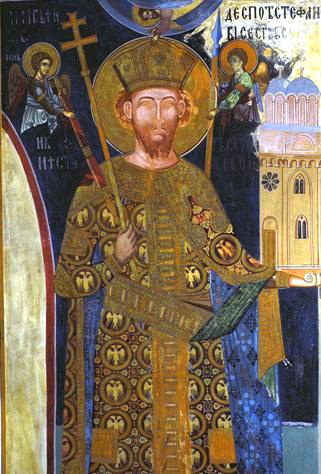
Stefan is written as a right-believing ruler: a tall figure — the epithet Visoki, "the Tall," is honoured in the painting — in the despot's dress, the long gold-worked sakkos-like robe and jewelled loros of Byzantine court costume, wearing the despot's crown, and holding in his right hand a cross and in his left a scroll or a model of the monastery of Manasija. The model is his proper attribute: he is the ktetor, the founder, and appears in that role in the ktetor composition of Manasija itself, offering the church to Christ. Where he is shown with his family, he stands beside his father Lazar, crowned as martyr, and his mother Milica in the monastic habit of the nun Eugenia.
The founder's portrait in the narthex of Manasija (Resava), of his own lifetime or within a few years of it, is his earliest and most authoritative likeness — and it is the stored image: the despot crowned and haloed in the imperial dalmatic sown with double eagles, holding the model of his Resava church, the fresco inscribed ДЕСПОТ СТЕФАН beside the halo (c. 1418).
Disputed questions
- "King of Serbia." The Russian and English calendars style him king. He never was one. His title from 1402 was despot, conferred by the Byzantine emperor; before that he was knez, prince, as his father had been. The types here are prince, righteous, and the royal style should be read as a translator's convenience.
- Was he a martyr? He is sometimes listed among the Serbian martyr-rulers by association with his father. He was not: he died in an accident in his own country, at peace, and is venerated as a right-believing ruler for the manner of his government, not for the manner of his death.
- His Ottoman service. Stefan's fighting for Bayezid at Nicopolis, against a Christian crusade, is a genuine difficulty and is not disguised in the sources; the Serbian tradition answers it by pointing to the oath, to the hostages, and to the fact that he broke with the Ottomans as soon as Ankara made it possible.
- The date of his birth is not recorded; c. 1377 is inferred from his age at his father's death and from Constantine's account.