
Anthony of Optina
Our Venerable Father Anthony (Putilov), Schema-Abbot, Elder of the Skete of Optina
Venerable · b. 9 March 1795, at Romanov on the Volga — d. 7 August 1865, at Optina
Commemorated 7 August — Repose at the Optina hermitage, 11 October — Synaxis of the Elders of Optina
Anthony (in the world Alexander Ivanovich Putilov) was born at Romanov on the Volga in 1795, the younger brother of Moses of Optina, and followed him into the Roslavl forests as a novice in 1816. In 1821 the two brothers came at the bishop's invitation to Optina and cut out of the pine wood the skete of Saint John the Forerunner, the cell-and-garden hermitage that would become the seedbed of the whole Optina eldership. Anthony was its superior for fourteen years (1825–1839), then for fourteen more the abbot of the monastery of Saint Nicholas at Maloyaroslavets; and through all of it he bore an ulcerated affliction of the legs so severe that he stood through services in agony and told almost no one. He was released from the abbacy in 1853, returned to Optina, took the great schema in March 1865, and died on 7 August of that year. He was glorified locally with the Optina elders in 1996 and for general veneration in 2000.

The Putilov brothers
The Putilovs were a merchant family of Serpukhov stock settled at Romanov in the province of Yaroslavl, and of ten children three sons became monastics of note. Alexander, born 9 March 1795, was the youngest of the three. He worked as a merchant's agent in Moscow and Rostov before the family's plans for him were overtaken by the events of 1812; the burning of Moscow, which he lived through, is one of the few things of his youth he ever spoke of.
In 1816 he went to his elder brother Timothy — the future Moses — in the Roslavl forests of Smolensk province, where a handful of hermits were living the old Athonite way in cabins in the woods under the direction of the disciples of Paisius Velichkovsky. He was received as a novice, and was tonsured with the name Anthony on 2 February 1820.
The founding of the Optina skete
In 1821 Bishop Philaret (Amfiteatrov) of Kaluga invited the Roslavl hermits to establish a skete beside the ancient but decayed Optina hermitage. Moses came on 6 June 1821 with Anthony and two companions, and the four of them felled the pine forest with their own hands on a spot a few hundred yards behind the monastery, dug the garden, and built the church of Saint John the Baptist and the first cells. The skete they made is the physical setting of the entire nineteenth-century Optina tradition — of Leonid, Macarius and Ambrose, and of the visitors who came to them.
Anthony was ordained hierodeacon in 1823, appointed superior of the skete in 1825, and ordained hieromonk in 1827. He governed the skete for fourteen years, in an obedience that was also a fraternal subordination: his own brother was abbot of the monastery, and Anthony's letters are unusually candid about the difficulty of being at once a superior and a younger brother.
Maloyaroslavets and the illness
In 1839 he was appointed abbot of the monastery of Saint Nicholas at Maloyaroslavets, and held that office until 1853. He set the house in order, established a stricter rule of services, and was — by every account — an unwilling administrator who wanted the skete back.
Throughout these years he suffered from a chronic ulceration of the legs, painful to the point of disability. He concealed it as far as he could, stood through the long services, travelled when he had to, and referred to it, when he referred to it at all, as the gift by which God kept him. It is the trait his letters of spiritual counsel are built on: he directs the sick and the discouraged out of a condition he was living in himself, and refuses them the consolation of self-pity because he refused it to himself.
Return, the schema, and repose
Released from the abbacy in 1853, he returned to Optina and lived there in retirement for twelve years as an elder to those who came to him, in correspondence with a wide circle of monastics and laypeople. On 9 March 1865 — his seventieth birthday — he was clothed in the great schema. He died on 7 August 1865 and was buried beside his brother Moses.
When Moses' grave was opened some years afterwards to receive Anthony, the workmen found the elder brother's body incorrupt; the two lie together at Optina, and their relics were recovered in the reopening of the monastery after 1988.
Glorification
Anthony was glorified as a locally venerated saint of the Optina hermitage in 1996, together with the other elders, and canonised for general veneration by the Russian Orthodox Church in 2000. His memory is kept on the day of his repose and with the Synaxis of the Optina Elders on October 11.
Feast and commemoration
August 7 (church date; New Calendar civil August 7, Old Calendar civil August 20), within the afterfeast of the Transfiguration and within the Dormition fast (August 1–14). He is kept a second time on October 11, with the Synaxis of the Elders of Optina, and on the Sunday of All the Saints of Russia. The veneration is Russian and is carried by the OCA calendar; the Greek and Antiochian books do not keep him.
Hymns
Troparion — Tone 8 (common of a venerable father)
From the forests of Roslavl thou camest with thy brother to plant a garden of stillness in the pine wood of Optina, and there, bearing thy sickness in silence for fifty years, thou didst become a physician of souls. O venerable father Anthony, entreat Christ God that our souls may be saved.
Original translation from the Slavonic
Iconography
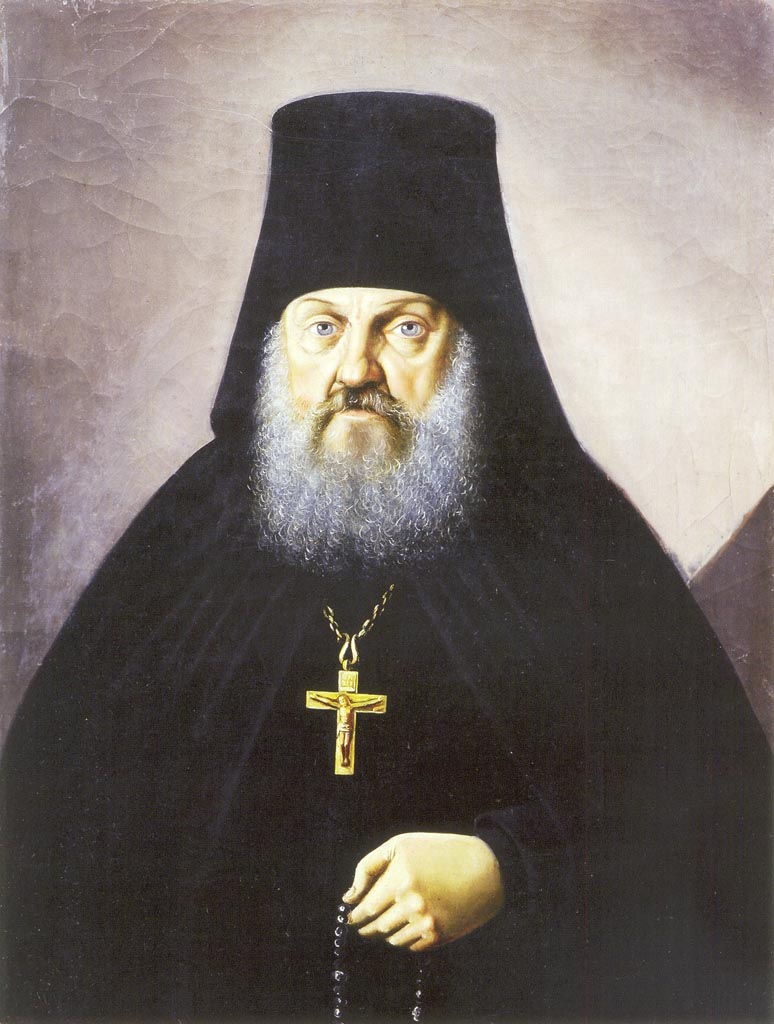
Anthony is painted in the modern Optina manner: an elder in the great schema, the analavos with its cross and instruments of the Passion over the mantle, koukoulion on the head, holding a scroll or the schema-cross; in the great composition of the Synaxis of the Optina Elders he stands with his brother Moses among the founders, usually with the skete of Saint John the Forerunner behind them. The features are drawn from life, because likenesses of him were made in his lifetime.
The stored image is one of those likenesses: a lifetime oil portrait, dated 1854, by Hieromonk Gabriel (Spassky) of the Optina skete, whose autograph inscription on the reverse of the canvas identifies both sitter and painter ("Portrait of the most honourable Elder, Abbot Anthony, painted in the year 1854 ... by the sinful skete hieromonk Gabriel"). It shows him half-length in the black klobuk and mantle, with the pectoral cross of an abbot and a prayer-rope in the right hand. This is a portrait and not an icon, and it is stored as such: it is the documentary basis of his iconography rather than a liturgical image, and the icons proper to him are all modern work made after the glorification of 1996 and are in copyright.
Disputed questions
- Two brothers, two saints. He is easily confused with Moses of Optina (†1862, kept June 16), his own elder brother, co-founder of the same skete: Moses was abbot of the monastery, Anthony superior of the skete; both are Putilovs and both are Optina saints. A third brother, Isaiah, was abbot of Sarov.
- Not to be confused with the other Optina elders of the calendar — Ambrose (†1891), Nikon (†1931) — nor with the numerous other Russian Anthonies, above all Antony of the Kiev Caves.
- Birthplace. The sources give Romanov in Yaroslavl province (Romanov-Borisoglebsk, the modern Tutayev); a few English lives give Serpukhov, which is the family's town of origin rather than his own.