
Joseph of Optina
Our Venerable Father Joseph, Elder of Optina
Venerable · b. 1837, at Gorodishche in Kharkov province — d. May 9, 1911 (O.S.), at the Optina skete
Commemorated 9 May — Repose at the skete of St John the Forerunner, Optina, 1911
Joseph of Optina (1837–1911), in the world Ivan Litovkin, was the closest disciple of Ambrose of Optina and his successor in the eldership. An orphan from a peasant family of the Kharkov province who came to Optina at twenty-three and never left it, he spent thirty years as Saint Ambrose's cell-attendant — the whole of the great elder's public ministry — sitting silently in the corner of the reception room, and by that obedience was formed into an elder of extraordinary discernment himself. After Ambrose's death in 1891 the burden of the Optina eldership and of the spiritual care of the Shamordino convent fell on him, and he bore it for twenty years, becoming superior of the skete in 1894. Notably reticent and few-worded, he was known for the unceasing Prayer of Jesus and for a stillness that visitors found more consoling than speech. He reposed on May 9, 1911, and was glorified with the company of the Optina elders by the Russian Orthodox Church in the year 2000.

Origins and early life
He was born Ivan Efimovich Litovkin on November 2, 1837, in the village of Gorodishche in the Starobelsk district of Kharkov province, the youngest of a large family of pious peasants — a household, the accounts say, in which the children were brought up "in piety, in obedience and in the fear of God," and in which spiritual things counted for more than the family's modest property. Two of his sisters became nuns.
The account of his childhood preserves an episode that the Optina tradition has always treated as the seed of his whole life. At about six years old, playing outside with other children, he suddenly cried out and pointed to the sky, and when the others asked what he saw he said that he beheld the Queen of Heaven in the air. The vision was gone in a moment; the boy spoke of it very rarely thereafter, and he was reticent about it to the end of his life, but the tradition sets it beside the second vision of his old age, and it belongs to the record.
His father died when he was four and his mother when he was eleven, and the orphan was passed among relatives and employers. He worked as a shop-boy and household servant in several towns, was cheated of his wages, went hungry, was thrown out of one place after another and was even, on one journey, robbed of everything he had. Later, as an elder, he would use these years to speak with authority to the poor and the ill-used who came to him, and the biographers note that the hardness of them left in him no bitterness at all.
The road to Optina
He had wanted the monastic life from boyhood, and had thought to reach the great monasteries of Kiev. His sister — a nun of the Borisov convent — urged him on the way to look in at the Optina hermitage and its famous elder. He came, and asked Ambrose whether he should go on to Kiev; and Ambrose, in the manner in which the Optina elders settled such matters, told him simply to stay. He entered the skete of St John the Forerunner at Optina on March 1, 1861, at twenty-three, and he remained in that skete for the remaining fifty years of his life.
He was given at once to Ambrose as cell-attendant, and the assignment lasted thirty years, until the elder's death. It is the whole of his outward biography for those decades: to keep the door, to bring in and send out the endless stream of visitors, to serve the sick elder day and night, to be interrupted at every moment, and to be silent. Ambrose tried and tested him hard, in the way of the Optina tradition, sometimes rebuking him sharply and publicly for nothing; the disciple's answer was always the same silence. He was present, unnoticed in his corner, at the conversations in which Ambrose directed the consciences of half of educated Russia, and he learned the eldership by watching it done.
Tonsured a monk in 1872 — receiving the name Joseph after Joseph the Hymnographer — he was ordained deacon in 1877 and priest in 1884, and was afterwards raised to the great schema. Ambrose gradually began to send visitors on to him, and in the last years would say of him, "Go to Father Joseph — he knows everything as I do."
The illness of 1888, and the eldership
In 1888 Joseph fell gravely ill and was thought to be dying; he was given the Holy Mysteries and anointed, and the brotherhood expected the end. In the course of that illness, the tradition relates, the Mother of God appeared to him a second time, and he recovered. From then on his reputation stood on its own, and the flow of visitors to his cell increased against his will.
Ambrose died on October 10, 1891, at Shamordino, and Joseph — by then the obvious successor in everything but self-estimation — took up the eldership. He became confessor and spiritual director of the Shamordino convent which Ambrose had founded, whose several hundred sisters had lost their father, and in 1894 was appointed superior (dean) of the Optina skete, an office he held for a further eleven years before ill health obliged him to lay it down while continuing the eldership itself.
His manner was quite unlike Ambrose's. Where Ambrose was quick, warm and voluble, Joseph was grave and spare; those who came expecting a torrent of counsel received two or three sentences, and again and again the memoirists record that the few words went precisely to the thing they had not said aloud. Visitors describe a peculiar stillness in his cell and a peace that they could not account for, and they attribute it, as he himself did when pressed, to the unceasing prayer of the heart — the Jesus Prayer, which he had carried since his years at the door of Ambrose's cell, and which he taught in the sober Optina manner, as obedience and repentance before it is anything else. He had the gift of discernment, and instances of foreknowledge are recorded of him, as are healings; but he was severe about such things and would not have them talked of.
Repose and glorification
The last years were years of weakness. He continued to receive people and to write letters of direction to the sisters of Shamordino to the end. He reposed on May 9, 1911 (Old Style; May 22 by the civil New Calendar reckoning), in his seventy-fourth year, having received the Holy Mysteries, and was buried at Optina beside his teacher.
The Optina eldership continued after him in Barsanuphius, Anatolius the Younger and Nectarius, the last of the line, until the monastery was closed by the Soviet power in 1923. Optina was returned to the Church in 1987 and the elders' relics were recovered; the Jubilee Council of the Russian Orthodox Church in the year 2000 glorified the whole company of the Optina elders for universal veneration, Joseph among them, and his relics rest in the monastery he never left.
Feast and commemoration
Joseph is commemorated on May 9 (church date; New Calendar civil May 9, Old Calendar civil May 22), the day of his repose, by the Russian Orthodox Church and in the calendar of the OCA; he is also commemorated with the whole company on the collective feast of the Optina Elders (October 11 in the Russian calendar). The Greek and Antiochian calendars do not carry his day, the glorification being of 2000 and Russian in scope; the universal commemorations of May 9 are the Prophet Isaiah, Christopher of Lycia with his companions, and the translation of the relics of Nicholas the Wonderworker to Bari — the last a feast to which the Russian Church has always given great solemnity, so that in Russian parishes the elder's memory falls on a festal day.
Hymns
Troparion — Tone 8 (common of a venerable father)
In thee, O Father, the image of God was preserved unimpaired, for taking up the Cross thou didst follow Christ; and by thy deeds thou hast taught us to despise the flesh, for it passeth away, but to care for the soul, which is a thing immortal. Wherefore, O venerable Joseph, thy spirit rejoiceth with the angels.
Original translation from the Slavonic
Iconography
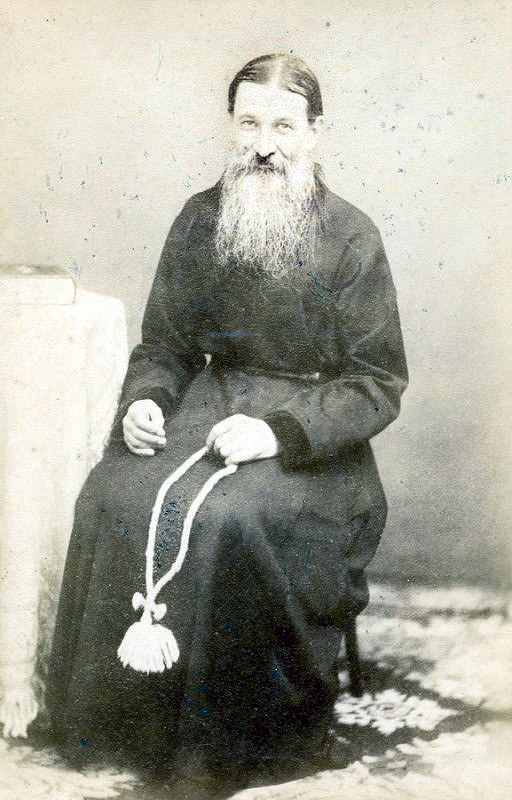
Joseph is painted from photographic likenesses taken in his lifetime: a thin, ascetic face, a high bald forehead, a long grey beard narrowing to a point, and eyes that the memoirists called mild and searching at once; he is shown in the monastic mantle and koukoulion or in the epitrachelion of a hieromonk, blessing with the right hand and holding a scroll or the Gospel in the left. In the collective icon of the Optina Elders, now widespread, he stands in the second rank beside Ambrose, the monastery and its skete painted below; in single icons the skete church of St John the Forerunner or the Shamordino convent may appear in the background, and the scroll sometimes carries a sentence of his counsel or the words of the Jesus Prayer. Because he reposed in 1911 and was glorified only in 2000, every painted icon of him is a modern work and none is free-licensed; the lifetime photograph stored below (per §50) supplies what the icons cannot, having been verified licence-clean this collection.
The stored image is a lifetime photograph of the elder (before 1911), stored per the §50 ruling as a labelled portrait. A free-licensed painted icon remains the eventual want and is listed among the upgrade-wanted icons.
Disputed questions
- The name in religion. He is Schema-hieromonk Joseph (Litovkin), styled in Russian simply Iosif Optinskiy. The baptismal name was Ivan (John); some English accounts give it as "John Litovkin," which is correct, and some give "Joseph Litovkin" as though it were his birth name, which it is not.
- Not to be confused with the other elders of Optina — Ambrose (October 10), Leonid, Macarius, Anatolius the Elder, Barsanuphius, Anatolius the Younger, and Nectarius — nor with the several other Russian saints named Joseph, nor with Joseph the Hymnographer (April 4), his patron.
- Reckoning of years at Optina. The accounts variously say that he spent thirty years as Ambrose's cell-attendant (1861–1891) and fifty years at Optina altogether (1861–1911); both figures are correct and describe different things, and they are sometimes conflated in English summaries.