
Dionysius of Radonezh
Our Venerable Father Dionysius, Archimandrite of the Trinity–Saint Sergius Lavra
Venerable · b. c. 1570, at Rzhev (in the world David Zobninovsky) — d. May 12, 1633, at the Trinity–Saint Sergius Lavra
Commemorated 12 May — Repose at the Trinity–Saint Sergius Lavra
Dionysius (c. 1570 – 1633), in the world David Zobninovsky, was archimandrite of the Trinity–Saint Sergius Lavra from 1611 and, with Patriarch Hermogenes of Moscow, one of the two churchmen who did most to save Russia in the Time of Troubles. From the Lavra — itself only just delivered from a sixteen-month Polish siege — he turned the monastery into a hospital and refuge for the maimed and homeless of the war, and with the cellarer Abraham Palitsyn sent out the circular letters to Nizhny Novgorod and the Russian towns that helped raise the militia of Minin and Pozharsky and free Moscow. Set in 1616 to correct the printed service-books against the Greek, he was accused of heresy by ignorant opponents, condemned at a council in 1618, imprisoned and put under penance; he was exonerated in 1619 when the Patriarchs Philaret of Moscow and Theophanes of Jerusalem examined the case. He bore it, the accounts insist, without bitterness. He died on May 12, 1633, and is buried at the Lavra.

Rzhev, Staritsa, and the monastic beginning
He was born about 1570 at Rzhev on the upper Volga, and baptised David; his family name is given as Zobninovsky. He was married and a parish priest — the ordinary path of a Russian cleric — and when his wife and children died he took the monastic habit with the name Dionysius at the Dormition monastery of Staritsa, where he rose to be archimandrite.
Staritsa was the place of confinement of the deposed Patriarch Job, and it was there, in the first years of the Troubles, that Dionysius came into the great affairs of the Russian Church. Called to Moscow, he attached himself to Patriarch Hermogenes and became one of his most resolute supporters in the struggle against the pretenders and against the Polish party — standing by him in the cathedral, the accounts say, when the crowd was against them.
Archimandrite of the Lavra in the Time of Troubles
In 1611 he was made archimandrite of the Trinity–Saint Sergius Lavra, the greatest house in Russia, which had just endured the sixteen-month siege by the Poles and Lithuanians (1608–1610). The country around was devastated and full of fugitives, wounded men, and the mutilated survivors of the war.
Dionysius's response was practical and immense. He established shelters and hospitals in the settlements around the monastery for the homeless and the wounded; he sent the monastery's servants out to find the injured lying in the fields and the roads, to bury the dead, and to bring in orphans; he opened the granaries. In the famine he set the brotherhood on the poorest fare and reserved the better food for the sick — the classic monastic test, and he passed it in the classic way.
At the same time he became, with the cellarer Abraham Palitsyn, the voice of the national resistance. Through 1611 and 1612 the two sent out from the Lavra a stream of letters (gramoty) to Nizhny Novgorod and the other Russian cities, and directly to Prince Dmitri Pozharsky and the commanders, calling for men and money for the liberation of Moscow from the Polish garrison, and calling in the name of Saint Sergius. Those letters, following on the letters of Hermogenes, are among the documents by which the second militia was raised — the militia of Kuzma Minin and Pozharsky which retook the Kremlin in October 1612. When the army marched, the Lavra supplied it, and Dionysius blessed it from the monastery gates.
The correction of the books, and the trial
With the country at peace under the first Romanov, Dionysius was given in 1616 a task of learning: the correction of the printed liturgical books, beginning with the Trebnik (Book of Needs), against the Greek originals and the older Slavonic manuscripts. He worked with the monk Arsenius Glukhoy and the priest Ivan Nasedka, comparing texts and removing accumulated scribal errors.
Among the corrections was the deletion, at the Great Blessing of the Waters, of an addition to the prayer — the words "and by fire" in the petition for the sanctification of the water — which the correctors found in no Greek text and in no old Slavonic manuscript. To the ignorant and the suspicious this looked like an attack on the Holy Spirit's fire; the charge was raised that Dionysius was "removing the fire" from the mysteries, and it was pressed by influential men at court while the patriarchal throne was vacant and Metropolitan Jonah of Krutitsa was administering the Church.
At a council in 1618 Dionysius was condemned as a heretic. He was deprived of his archimandrite's rank in effect, imprisoned in the Novospassky monastery, put under excommunication and heavy penance — a thousand prostrations a day — fined, and publicly humiliated, exposed on feast days at the Archangel Cathedral to the abuse of the crowd. He made, the accounts say, no defence beyond the texts, and no complaint at all.
In 1619 the Patriarch Theophanes of Jerusalem came to Moscow for the enthronement of Philaret as Patriarch of Moscow. The two patriarchs re-examined the case, found the corrections right and the accusation groundless, cleared Dionysius entirely, and restored him. He returned to the Lavra and governed it until his death.
Repose and veneration
He died at the Lavra on May 12, 1633, and was buried there; his grave is in the monastery he had served for twenty-two years. His disciple Simon Azaryin, treasurer and then cellarer of the Lavra, wrote his Life — a work of unusual candour and one of the better pieces of seventeenth-century Russian hagiography, and the source of most of what is known of him, including the sayings preserved from his own mouth. Among them is his refusal to discuss the interior life with laypeople: do not ask a monk about the things of his monastic life, since to make them public does harm — a saying which tells why the Life says little about his prayer, and hints that there was much to say.
He is commemorated on May 12 in the Russian Church and by the OCA, and is honoured among the saints of Radonezh — the company of Saint Sergius's monastery — with whom his general commemoration is kept on July 6.
Feast and commemoration
May 12 (church date; New Calendar civil May 12, Old Calendar civil May 25), the day of his repose in 1633. The feast is kept by the Russian Orthodox Church and the OCA, which lists him among the May 12 commemorations as "Venerable Dionysius, Archimandrite of Saint Sergius' Monastery"; it does not appear on the Antiochian or Greek calendars. He is also commemorated with the Saints of Radonezh (July 6) and at the Lavra with its own company of saints. It is a fitting accident of the calendar that his day falls on the same date as the glorification of Patriarch Hermogenes, whose partner he was in the deliverance of 1612: the two men of the Troubles are commemorated together on May 12.
Hymns
Troparion — Tone 8 (common of a venerable monastic)
By a flood of tears you made the barren desert bear fruit, and by your sighs from the depths you made your labours bring forth a hundredfold; you became a beacon, shining over the world by your wonders, O Dionysius our father. Intercede with Christ God that our souls may be saved.
Original translation from the Slavonic
Iconography
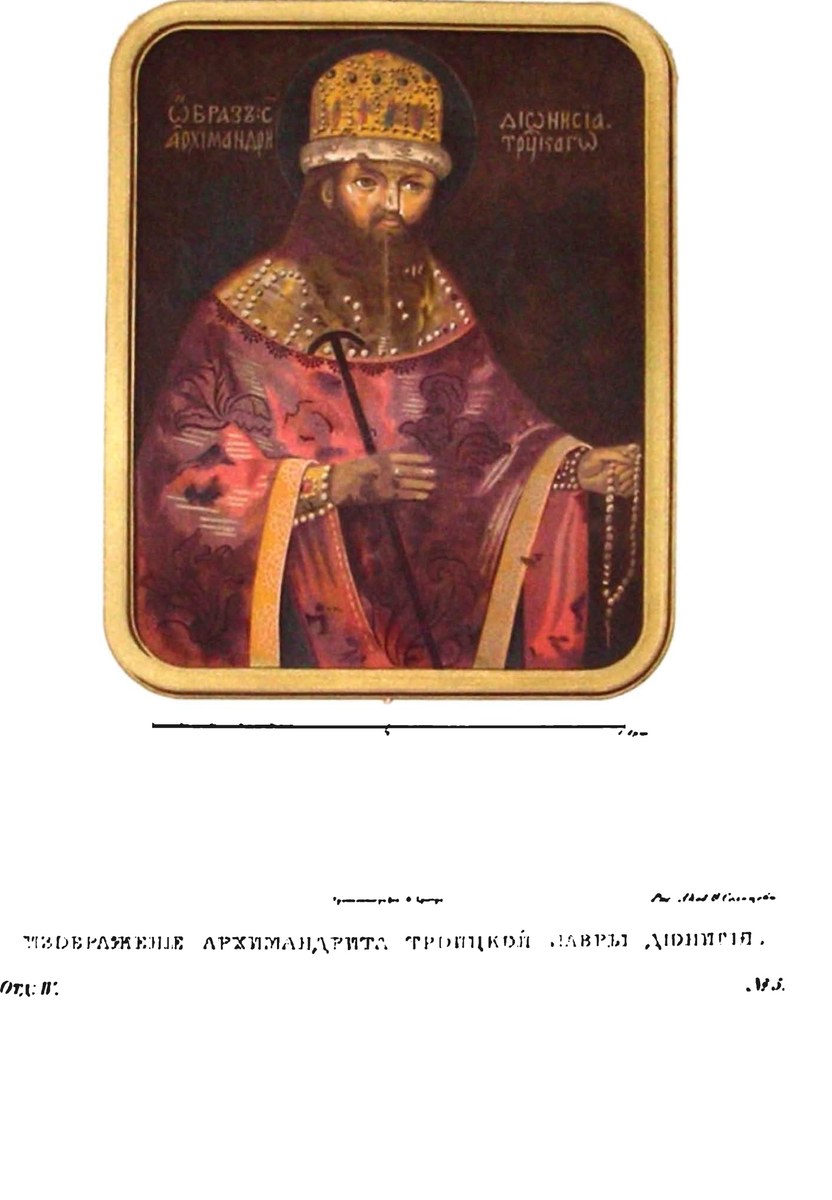
Dionysius is painted as a venerable Russian monastic: in the mantiya and the klobuk of an archimandrite, or in the analavos of the great schema, with a long greying beard, the right hand raised in blessing or crossed on the breast, and in the left a scroll — very often unrolled with a word of monastic counsel, since he is remembered as a corrector of books and a writer of letters. Two attributes are peculiar to him: the letters (gramoty) of 1611–1612, shown as a sealed scroll or a sheaf of documents, and the Trinity–Saint Sergius Lavra itself, its white walls and towers set behind him or held in his hands as its abbot. In the great compositions of the Saints of Radonezh he stands in the ranks about Sergius, and in scenes of the Time of Troubles he is shown blessing the militia from the monastery gates, or beside Patriarch Hermogenes. His veneration having grown after 1633 and been formalised later, no pre-1900 icon of him alone has been identified for this repository; nothing is stored.
The stored image is the presumed 17th-century portrait of the archimandrite, as reproduced in Drevnosti Rossiyskogo Gosudarstva.
Disputed questions
- His baptismal surname. "Zobninovsky" is the form in Simon Azaryin's Life; some Russian sources give Zobninovsky as a place-name epithet rather than a family name.
- The 1618 council. Both the identity of the driving accusers and the exact canonical form of the sentence are debated by historians of the Russian Church; that he was imprisoned, penanced and publicly disgraced, and afterwards fully cleared by Philaret and Theophanes in 1619, is not in doubt. The episode is important as a rehearsal of the later and far larger book-correction crisis under Patriarch Nikon.
- His glorification. He was venerated locally at the Lavra from soon after his death; the formal entry into the general Russian calendar is later, and the modern service is modern.
- Not to be confused with Dionysius of Olympus, Dionysius of Zakynthos, or Dionysius the Areopagite; nor with Dionysius, Archbishop of Suzdal (†1385), the contemporary of Saint Sergius, with whom Russian sources sometimes confuse him because both are named with the Radonezh circle; nor with Dionysius of Glushitsa (†1437), the icon-painting founder of monasteries in the Vologda north, commemorated June 1.