
Olga of Kiev
The Holy Equal-to-the-Apostles Olga, Grand Princess of Kiev, in holy baptism Helen
Equal to the Apostles · Princess · b. c. 890–925 (disputed; the chronicle date of her marriage is 903) — d. 11 July 969, at Kiev
Commemorated 11 July — Repose at Kiev in 969
Olga (†11 July 969), Grand Princess of Kiev and in holy baptism Helen, is the first ruler of the Rus to be baptised and the first saint of the Russian land. Widow of Prince Igor, murdered by the Drevlians in 945, she avenged him with a ferocity the chronicle records without apology, then governed the realm for her infant son Svyatoslav with a statecraft that gave the Rus their first fixed administration. About 955–957 she went to Constantinople and was baptised there, the emperor Constantine VII standing as her godfather. She could not bring her son or her people with her to the faith, and died still, in the chronicler's phrase, "the forerunner of the Christian land, as the dawn before the sun." Her grandson Vladimir baptised the Rus twenty years later. She is styled Equal-to-the-Apostles, and is commemorated on July 11.
.jpg)
Origins and early life
Almost nothing about Olga's beginnings is fixed. Her name is Norse — Helga, the feminine of Helgi, "holy" or "hallowed" — and marks her as belonging to the Varangian ruling stratum of the Rus rather than to the Slavic tribes over which it ruled. The Tale of Bygone Years says only that in the year 903 Oleg "brought Igor a wife from Pskov, by name Olga," and this bare notice is all the earliest source gives. Later Russian tradition enlarged it into the well-loved story of the ferryman's daughter of Vybuty, a village on the river Velikaya above Pskov: the young Igor, hunting, called for someone to carry him across the water, was rowed over by a girl in a boy's dress, took her for a boy, and was answered with such gravity when he spoke to her improperly that he was ashamed and remembered her; when it came time for him to marry, he sent for her. Another line of tradition, preserved in the Book of Degrees and in Pskov local writing, makes her a descendant of the princely house of Izborsk; a late and improbable Bulgarian tradition makes her a princess of Pliska.
The chronology is the first of the difficulties that attend her. If Olga married in 903 she must have been born about 890, which would make her a woman of some fifty-five years at Igor's death, a war-leader in her late fifties, and the mother of an infant son. The chronicle's own narrative — Svyatoslav a child of three or four in 945, a suitor in Constantinople impressed by her beauty about 955 — reads against those numbers, and most modern historians take the 903 entry to be an editorial construction and place her birth somewhere between about 910 and 925. The Church's calendar makes no ruling; the entry here records the problem and asserts nothing.
The murder of Igor and the vengeance on the Drevlians
Igor, son of Rurik and Prince of Kiev after Oleg, ruled a loose hegemony over the East Slavic tribes held together by the annual poliudie, the winter circuit on which the prince and his retinue went out among the subject peoples and collected tribute in kind. In 945, having already taken his tribute from the Drevlians — the forest people west of Kiev, about the town of Iskorosten on the river Uzh — Igor sent his main force home and turned back with a small following to take more. The Drevlians, in the chronicler's report of their council, said: "If a wolf comes among the sheep, he carries off the whole flock one by one, unless he be killed"; and under their prince Mal they came out from the town, cut Igor's small party to pieces, and killed him. Byzantine memory of the deed, preserved by Leo the Deacon, says he was torn in two between the bent trunks of two trees. Olga was left a widow in Kiev with Svyatoslav a small child, and the realm, by every expectation of the age, was open to whoever could take it.
The chronicle then tells, in four movements, what she did. It is one of the most famous passages in the whole of East Slavic literature, and it is not a Christian story; the Church honours a woman baptised long after these events, and the Tale of Bygone Years, composed by monks, relates them without a word of censure and with evident relish. Honesty to the record requires that they be given.
First, the Drevlians sent twenty of their best men by boat to Kiev, proposing that Olga marry their prince Mal. She received them courteously, told them to return to their boat and to consent to nothing but to be carried into her presence in it, and had a deep pit dug in the night in the courtyard of her hall. In the morning her men lifted the boat with the envoys sitting in it, carried it in, and tipped it into the pit; Olga leaned over the edge and asked whether the honour was to their taste, and they were buried alive.
Second, she sent word to Iskorosten that she consented, but that the Drevlians must send their most distinguished men to fetch her with fitting ceremony. When these came, she offered them the bath-house first, as hospitality required. They were shut in and it was burned over them.
Third, she went to the Drevlian country herself with a small escort, saying she would hold the funeral feast — the trizna — over her husband's grave-mound before she married. The Drevlians came in numbers to the mound; her servants poured for them until they were drunk, and at her word her retinue fell on them. The chronicle puts the dead at five thousand.
Fourth, in 946 she came back with the army and besieged Iskorosten for a summer. When the town would not fall she offered peace on a token tribute — three pigeons and three sparrows from each household — and the relieved Drevlians paid it gladly. She had sulphur and tinder bound with thread to every bird and released them at dusk; they flew home to the eaves and dovecotes they had been taken from, and Iskorosten burned in a hundred places at once. Those who ran out were killed or enslaved, the elders were taken, and the country was laid under a heavy tribute, two parts of it to Kiev and one to Vyshgorod, Olga's own town.
Historians have long observed that this is a folk-tale in the shape of a saga: four riddling revenges in ascending order, the burial-boat and the bath-house and the funeral feast each turning a rite of honour into a means of death, and the burning birds a motif found in Scandinavian and in Central Asian narrative alike. Whether every episode happened as told, the substance behind it is not in doubt — the Drevlians were crushed in 945–946 and their separate princely house ended — and the Church has never pretended otherwise about the woman who did it. It is precisely the distance travelled between Iskorosten and the font at Constantinople that her hymnography celebrates.
The ordering of the land
What followed the vengeance is the more durable achievement, and the reason Olga is remembered by secular historians as one of the ablest rulers of early Rus. The poliudie that had killed Igor was an arrangement without limit or fixed place: the prince took what he could where he found it. Olga replaced it. In 946 she went through the Drevlian land "setting tributes and dues"; in 947 she travelled north to Novgorod and along the rivers Msta and Luga, and there, the chronicle says, she established pogosty and dani — fixed collection points with fixed obligations, at fixed seasons. The pogost began as an administrative and fiscal station where tribute was rendered and princely justice done; in the centuries that followed, the churches of the north were built at exactly these points, and the word came to mean a country churchyard, which is what it still means in Russian. Her hunting-grounds, trapping-places and boundary marks are said to have been remembered along the Dnieper and the Desna for generations. To this reorganisation is also owed the beginning of a real frontier in the west, and the fortification in stone and oak of Vyshgorod above Kiev, which she kept for her own.
Constantinople and the baptism
Olga was not the first Christian in Kiev. Igor's treaty with the Greeks in 944 was sworn by part of his retinue in the church of St Elias on the Podol, and there was a Christian community in the city long before her. But she was the first of the dynasty to be baptised, and she went to the imperial city to do it.
The Tale of Bygone Years enters her journey under the year 6463 (955) and tells it as another contest of wits. The emperor, seeing her beauty and understanding, proposed to marry her; she answered that she was a pagan, and that if he wished it he must baptise her himself. He baptised her, with the patriarch, and gave her the name Helen, after the mother of Constantine; the patriarch blessed her and instructed her in the faith, and the chronicler says she bent her head and stood taking in his teaching as a sponge takes water. Then the emperor renewed his proposal, and she answered: "How can you take me, when you have baptised me yourself and called me your daughter? Among Christians that is not lawful — and you know it." He said, "Olga, you have outwitted me," and sent her home with gifts, calling her his daughter. The story is a chronicler's set-piece; the emperor of 955 had a living wife, and the marriage motif belongs to the same narrative family as the pigeons of Iskorosten. It carries, all the same, the point the chronicler wanted made: the princess who took the faith of the Greeks did not take their tutelage with it.
Against the chronicle stands a document of the first order. Constantine VII Porphyrogennetos himself, in the Book of Ceremonies, describes two imperial receptions of "Elga, archontissa of Rhosia", on a Wednesday 9 September and a Sunday 18 October — dates which fall together in the year 957 (some scholars argue 946). She was received in the Magnaura with its mechanical singing birds and roaring lions, dined with the empress and the porphyrogenite children, and was given gold in a jewelled dish; her retinue is enumerated — kinswomen, envoys, merchants, her nephew, her interpreters, and a priest Gregory. That last name has weighed heavily with historians: a priest already in her train may mean she was a Christian before she sailed, in which case the ceremony at Constantinople was her public reception into the Church rather than her first baptism. The emperor's account says nothing whatever about a baptism, which is strange if one occurred in his presence; the chronicle's patriarch, Theophylact, died in 956, so a baptism in 957 would have been at the hands of his successor Polyeuctus. The Orthodox tradition and the Slavic calendars follow the chronicle; the Byzantine document is recorded here beside it and neither is suppressed.
What is clear is that she came away with less than she wanted. She had asked for a hierarchy of her own and, the sources suggest, for a Byzantine bride for Svyatoslav; she got neither, and on her return a Greek embassy that came to Kiev asking for the troops and the wax and furs promised was kept waiting at the river, as she said she had been kept waiting in the Golden Horn.
The embassy to Otto
Rebuffed at Constantinople, Olga looked west. The Continuator of Regino of Prüm — a contemporary, later archbishop of Magdeburg, and therefore an unusually good witness — records under the year 959 that "envoys of Helena, queen of the Rugi, who had been baptised at Constantinople under Romanus, emperor of Constantinople," came to King Otto at Frankfurt asking for a bishop and priests for their people. A monk of St Alban's named Libutius was ordained for the mission in 960 and died before he could set out; Adalbert of Trier, later the first archbishop of Magdeburg, was consecrated in his place, went to Kiev in 961, and came back in 962 having accomplished nothing, some of his companions killed on the road. The Latin annalist blames the Rus for frivolity; the truth is more likely that by 961 the pagan party around the grown Svyatoslav was in control, and that a Latin bishop sent by a Saxon king was no more welcome than a Greek one. The episode is important nonetheless: it shows Olga determined to have a Church for her people, and willing to seek it from whichever of the two Christian empires would give it.
Last years and repose
Her son would not follow her. The chronicle preserves the exchange: Olga urged him, and he answered that his retinue would laugh at him; she said that if he were baptised all would do the same; and "he did not listen to his mother, but lived after the pagan manner." He allowed her freedom of religion at Kiev and was angry when others took it. Churches she had built were pulled down in the pagan reaction, and the Russian tradition says her nephew Gleb was killed for the faith. In her last years, the chronicle notes, she kept a priest secretly.
She built, all the same, and the Russian sources ascribe to her the wooden church of Holy Wisdom at Kiev, a church of St Nicholas over the grave of Askold on the hill above the Dnieper, the church of the Annunciation at Vitebsk, and — in the Pskov tradition — the foundation of the Trinity church at the confluence of the Velikaya and the Pskova, and with it of the city of Pskov itself, marked out for her, the tale says, by three rays of light falling on the headland. She brought back from Constantinople a cross made from the wood of the Life-giving Cross, inscribed as given for the regeneration of the Russian land.
In the spring of 968 the Pechenegs came up and besieged Kiev while Svyatoslav was campaigning on the Danube. The old princess held the city with her three grandsons — Yaropolk, Oleg and Vladimir — until a stratagem got word to the prince and he came back and drove the nomads off. When he spoke again of moving his seat to Pereyaslavets on the Danube, she said to him: "You see that I am sick; where would you go from me? When you have buried me, go where you will." Three days later, on 11 July 969, she died. She had forbidden the funeral feast of the pagans, and the priest Gregory buried her by the Christian rite in the ground. "And her son and her grandsons and all the people wept for her with a great lamentation."
Relics and translations
About 1007 her grandson Vladimir, by then the baptiser of the Rus, translated her body into the Church of the Tithes, the Desyatinnaya, which he had built at Kiev, and laid it in a stone sarcophagus. Jacob the Monk, writing in the eleventh century in his Memory and Encomium of Prince Vladimir, and the Tale of Bygone Years after him, report that the body was found incorrupt, and describe a small window cut in the side of the tomb: those who came in faith saw the body lying whole and shining through it, while to the faithless the window showed nothing but stone. The Desyatinnaya was brought down over the heads of the last defenders of Kiev when Batu's Mongols stormed the city in 1240, and the relics were lost in the ruin. Peter Mogila claimed to have identified her sarcophagus in the excavated foundations in 1635 and enshrined what was found; the identification is not secure, and the relics disappeared again after the eighteenth century. What survives of her at Kiev is the place.
Veneration and later cultus
Veneration began early. Jacob the Monk already calls her blessed and writes of miracles; by the twelfth century she is in the calendars; her memory was carried by the Pskov land as its own from the beginning. The formal enrolment among the saints of the Russian Church belongs to the councils held under Metropolitan Macarius in 1547, which regularised the veneration of the Russian saints; the title Equal-to-the-Apostles (ravnoapostolnaya) is the Russian Church's, and places her with Constantine and Helen, with Nina of Georgia and with her own grandson Vladimir. She is one of a very small number of women so styled.
The judgement the tradition passes on her is Nestor's, and it is exact: she was "the forerunner of the Christian land, as the day-star before the sun and as the dawn before the light." She converted neither her son nor her people. What she did was make the thing thinkable — a ruler of the Rus who was a Christian, an embassy that asked for bishops, a church on the hill at Kiev, and a boy in her household who remembered her. That boy was Vladimir, and the baptism of the Rus in 988 is unimaginable without her.
Feast and commemoration
July 11 (church date; Old Calendar civil July 24), the day of her repose in 969. In the Russian, Ukrainian, Belarusian and OCA calendars the day belongs to her jointly with the commemoration of the miracle of the great-martyr Euphemia at Chalcedon, and her service is a full one, with polyeleos. In Greek usage the classical synaxarion notice for July 11 is Euphemia's and does not carry Olga; modern Greek calendars and parish practice do keep her, and the name Ὄλγα is a common one. She is also commemorated in the synaxes of All Saints of Russia (movable, second Sunday after Pentecost), of the saints of Pskov, of Kiev, and of Volhynia. Antiochian usage for the day has not been verified from a primary source for this collection.
Hymns
Troparion — Tone 1
Having winged thy mind with the wings of the knowledge of God, thou didst soar above all things visible, seeking God the Maker of all; and having found Him, thou didst receive second birth through baptism. Delighting now in the Tree of Life, thou abidest incorrupt for ever, O ever-glorious Olga.
Original translation from the Slavonic
Kontakion — Tone 4
Let us sing today of God the Benefactor of all, who hath glorified in the land of Rus the God-wise Olga, that by her prayers He may grant remission of sins unto our souls.
Original translation from the Slavonic
Iconography
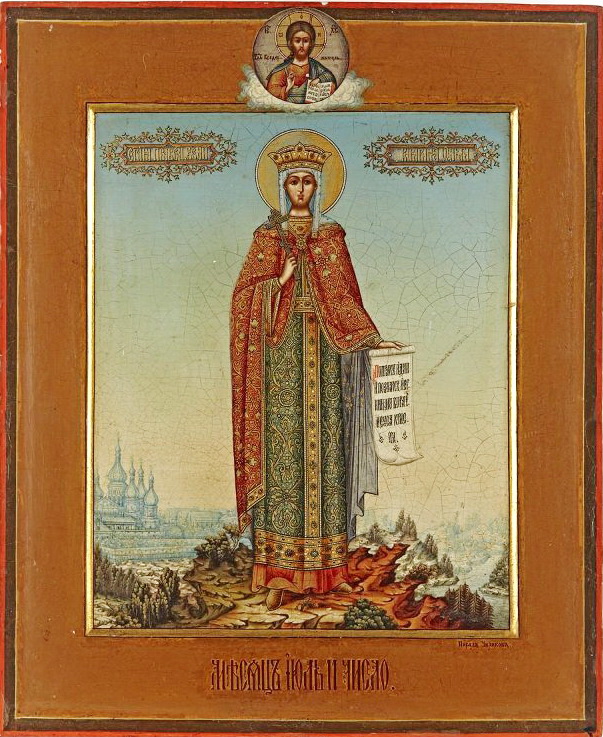
Olga is painted as a crowned princess of mature years, standing full-length in the rich brocaded robes and jewelled crown of a ruler, with a red or crimson mantle over a gold-worked gown, and almost always with two attributes: a cross held upright in the right hand, the sign of the faith she was the first of her house to receive, and a scroll in the left, sometimes inscribed with her prophecy over the Kievan hills or with a prayer for her people. In the standard Russian composition a church or a walled city stands in the landscape behind her, for the churches she founded and the city she is said to have marked out at Pskov; she is frequently painted in pair with her grandson Vladimir, the two of them flanking a cross, as the founders of Russian Christianity, and she appears in the great assemblies of All Saints of Russia in the front rank. Blessed by Christ from a segment of heaven above, she is shown in the type of the intercessor rather than of the martyr; her face is that of an old woman in the fuller Russian recensions and of a young one in the academic paintings of the nineteenth century. Narrative cycles of her life — the meeting at the ferry, the baptism at Constantinople, the burning of Iskorosten — belong to the illuminated chronicles rather than to the icon.
The stored image is a painted menaion icon for the month of July, 1893–94, by Osip Semyonovich Chirikov of Moscow, one of the last and most accomplished of the Russian academic icon-painters, now in the State Museum of the History of Religion: the princess crowned and haloed in a crimson cloak over a green and gold gown, an unrolled scroll in her left hand, a city of churches in the middle distance to her left, Christ blessing in a cloud-medallion above, and the date of the commemoration lettered along the bottom margin. An earlier, inscribed panel of Muscovite or Novgorodian work would be a better witness and is wanted in its place.
Disputed questions
- Her birth and age. The chronicle's marriage date of 903 cannot be reconciled with a child born about 942 or with the Constantinopolitan narrative; birth dates from c. 890 to c. 925 are defended. No resolution is possible on the present evidence.
- Where and when she was baptised. Three positions are held: at Constantinople in 955 (the chronicle, followed by the Slavic calendars and the OCA); at Constantinople in 957 (the reception dates of the Book of Ceremonies); or at Kiev before her voyage, the Constantinopolitan ceremonies being a state visit by a Christian ruler — argued from the presence of the priest Gregory in her suite and the silence of Constantine VII about any baptism. The patriarch named by the chronicle, Theophylact, was dead by 957.
- The marriage-suit of the emperor. Constantine VII was married to Helena Lekapene throughout; the episode is a literary construction of the chronicler and is not treated as history by any modern account.
- The Drevlian revenges. Their fourfold, riddling form and the burning-birds motif mark them as saga rather than record; the destruction of Iskorosten and the ending of the Drevlian principality are historical.
- The relics. Whether anything recovered by Peter Mogila in 1635 was Olga's is undetermined; nothing is enshrined today.
- Not to be confused with the Grand Duchess Olga Nikolaevna (†1918), eldest daughter of the last emperor, commemorated with the Royal Martyrs of Russia on July 4.