
Onesimus the Apostle
The Holy Apostle Onesimus of the Seventy
Apostle · Apostle of the Seventy · Hieromartyr · Martyr · Bishop · b. 1st century — d. c. 109, at Rome
Commemorated 15 February — The apostle's martyrdom at Rome, 22 November — With the Colossian company — Philemon, Archippus and Apphia
Onesimus (Greek Ὀνήσιμος, "useful, profitable") is the runaway slave of the Epistle to Philemon: a servant of Philemon of Colossae who fled his master, reached the imprisoned Apostle Paul at Rome, was there converted and baptized, and was sent back to Colossae bearing Paul's tender letter of intercession — the New Testament's shortest and most personal epistle, in which the Apostle plays on the slave's name and begs that he be received "not now as a servant, but above a servant, a brother beloved" (Philemon 16). Freed and returned to Paul's service, Onesimus became in time a preacher of the Gospel and a bishop — by the received tradition the successor of Timothy at Ephesus — and is numbered among the Seventy Apostles. Under the emperor Trajan he was seized, brought to Rome, and tried before the eparch Tertyllus; there, about the year 109, his legs were crushed with clubs and he received the crown of martyrdom. He is kept on February 15, and with the Colossian household on November 22.
.jpg)
The slave of Philemon
Onesimus enters history as a slave in the house of Philemon, a Christian of substance in Colossae, a city of the Lycus valley in Phrygia whose house-church the Apostle Paul had gathered through his preaching (Colossians; Philemon 1–2). The tradition, following the plain sense of Paul's letter, holds that Onesimus wronged his master and fled — that he had "been unprofitable" (Philemon 11) and, most readers add, had taken something of Philemon's with him, for Paul offers to make good any debt: "if he hath wronged thee, or oweth thee ought, put that on mine account… I will repay it" (Philemon 18–19). A fugitive slave under Roman law faced branding, the mines, or death; and Onesimus, like so many runaways, made for the anonymity of the capital.
Conversion at Rome and the Epistle to Philemon
At Rome — whether arrested and imprisoned, as one strand of the tradition holds, or seeking out the Apostle he had known in his master's house — Onesimus came to Paul in his bonds, and there the runaway was born again. Paul converted and baptized him, and the slave who had been "unprofitable" became, in the Apostle's own play on his name, "profitable" indeed: "which in time past was to thee unprofitable, but now profitable (εὔχρηστον) to thee and to me… whom I have begotten in my bonds" (Philemon 10–11). The Apostle would gladly have kept him — "whom I would have retained with me, that in thy stead he might have ministered unto me in the bonds of the gospel" (Philemon 13) — but chose instead to send him back to his master carrying the letter that bears Philemon's name, so that Philemon's forgiveness might be freely given and not compelled.
That letter is the New Testament's most sustained meditation on the transformation of a worldly bond into a bond in Christ. Paul does not command, though as an apostle he might; he entreats, "for love's sake" (Philemon 9), asking Philemon to receive the fugitive "not now as a servant, but above a servant, a brother beloved" (Philemon 16), and pledging himself surety for the debt. The runaway is returned not to punishment but to brotherhood; the master is asked to see in his slave a son of the same Father. In sending Onesimus home Paul also sent him into the Church's memory, for the letter was kept, copied, and canonised, and with it the name of the slave who became a brother.
From Colossae to the episcopate
The tradition does not leave Onesimus at Colossae. The Epistle to the Colossians, written from the same Roman captivity and carried by the same hands, names him already as one of Paul's trusted messengers: Tychicus is sent to the Colossians "with Onesimus, a faithful and beloved brother, who is one of you" (Colossians 4:9) — the fugitive of the letter now an honoured fellow-worker of the Apostle. From this the synaxaria conclude that Philemon, receiving him as Paul had asked, set him free and sent him back to serve the Apostle, and that Onesimus spent the rest of Paul's life in his company and in the Gospel's work.
After the martyrdom of Peter and Paul at Rome, Onesimus — like the other disciples of the great Apostle — carried the preaching abroad, and the received tradition makes him at length a bishop, ordained for the shepherding of the Church. The most widespread strand, kept by the Greek and Slavic synaxaria and by the OCA, names him bishop of Ephesus, the successor of Timothy in that great Asian see — an office that binds the Colossian slave to the very heart of the Pauline mission. A support for the tradition is found in the letters of Ignatius of Antioch: writing to the Ephesians on his own road to martyrdom (about 107–110), Ignatius opens by praising their bishop Onesimus, "a man of inexpressible love," and rejoices that the church of Ephesus is "worthy of God" in such a pastor (Ephesians 1). Whether the bishop Ignatius greets is this same apostle of the Seventy — then very aged — or a later Ephesian of the same name is debated among scholars; the Church's tradition reads the two as one, and honours Onesimus as the God-bearer's own contemporary in the Ephesian chair.
Martyrdom at Rome
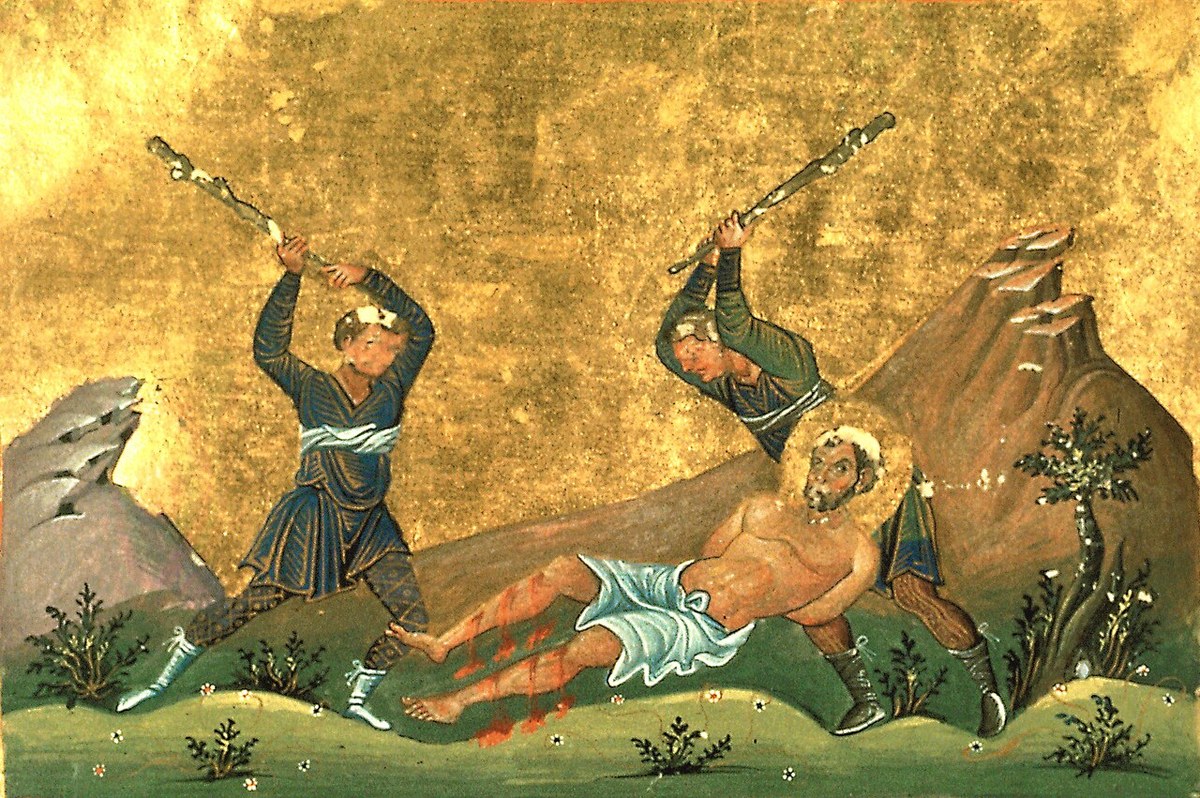
The end of Onesimus is set in the reign of the emperor Trajan (98–117), under whom Ignatius of Antioch also suffered. The synaxarion account relates that the aged bishop was seized for his preaching and brought to Rome, where he was tried before the city's eparch, Tertyllus (Τέρτυλλος). Interrogated and refusing to renounce Christ, he was cast into prison — the tradition specifies eighteen days — and then sent under guard to Puteoli (Pozzuoli, on the Bay of Naples), where he continued to preach and to gather souls to the faith. Recalled at last before the eparch, and found unshaken and still confessing, he was condemned to death: his legs were crushed — broken with clubs or heavy blows, the manner the synaxarion verses fix upon — and under this torment he gave up his soul, about the year 109. The tradition adds that a distinguished woman of the city took up the martyr's body and buried it with honour, and that his relics became a treasure of the faithful.
The day's synaxarion turns his death into an epigram on the whole of his life: "Onesimus stretched forth his legs to be crushed — the legs that had run the noble courses of Paul." The slave who had once fled his master on those same feet had come, in the end, to run the Apostle's own race, and to be broken for the Name.
Feast and commemoration
Onesimus is kept universally on February 15 (church date; Old Calendar civil February 28), the day of his martyrdom at Rome — his principal feast, on which the Menaion appoints his proper apolytikion and kontakion. He is commemorated again on November 22 with the Colossian company of Philemon, Archippus and Apphia, whose kontakion of that day gathers the whole apostolic household of Colossae; and he is honoured, with all the wider apostolate, in the Synaxis of the Seventy Apostles on January 4, among whose number he is reckoned (the nineteenth in the received roll). The Antiochian, Greek and Slavic calendars agree on the February date. In 2026 February 15 falls on the Sunday of the Last Judgment (Meatfare), whose movable office takes precedence, the apostle being kept in synaxarion notice and his hymns transferred as the typikon directs.
Hymns
Troparion — Tone 3
O holy Apostle Onesimus, intercede with the merciful God, that he may grant to our souls the forgiveness of transgressions.
Original translation from the Greek
Kontakion — Tone 4
As a ray of light thou didst shine forth upon the world, O blessed one, made bright by the beams of the all-radiant sun — of Paul, who gave light to the world; wherefore we all honour thee, O Onesimus.
Original translation from the Greek
Synaxarion
Onesimus stretched forth his legs to be crushed — the legs that had run the noble courses of Paul. On the fifteenth they broke the legs of Onesimus.
Iconography
Onesimus is depicted as an apostle-bishop of the first generation: an elder in the phelonion and omophorion, holding the Gospel-book or a scroll, in the settled hierarch's type; sometimes he is shown as a younger man, in memory of the slave made a brother. His narrative image is the martyrdom — the aged bishop brought low, his legs broken, at the eparch's sentence.
The stored image is the miniature for February 15 from the Menologion of Basil II (Constantinople, c. 985; Vatican Library, Vat. gr. 1613): Onesimus, haloed and vested, at his martyrdom — the classic Byzantine witness to his commemoration, catalogued on Wikimedia Commons (under the by-name "Onesimus of Byzantium") as the "Apostle Onesimus of the Seventy" for this day (source, public domain, pd-old-work).
Disputed questions
- Bishop of Ephesus, or of Byzantium? The dominant tradition makes Onesimus bishop of Ephesus, successor of Timothy, and identifies him with the bishop Onesimus greeted by Ignatius (Ephesians 1). A secondary strand — reflected in some episcopal lists and in the by-name "Onesimus of Byzantium" under which the Menologion miniature is catalogued — numbers an Onesimus among the earliest bishops of Byzantium. The confusion is old and is best explained as a doubling of one apostolic figure across two traditions of see-lists; this entry follows the Ephesian tradition, which the synaxaria and the Ignatian evidence support, and notes the Byzantine variant without adopting it.
- The Ignatian Onesimus. Whether the "bishop Onesimus" of Ignatius's Letter to the Ephesians is this apostle of the Seventy or a later Ephesian of the same name is not certain; the name was common. The Church's tradition reads them as one and dates the apostle's martyrdom accordingly late in Trajan's reign; the identification is received rather than demonstrated.
- Onesimus commemorated with the Colossian company. Onesimus of the Epistle is the same saint kept on February 15; he is also named among the Colossian household of Philemon on November 22, where he appears as one greeted in Paul's letter and named in the day's kontakion, not as a second person. His own full life and principal feast are kept here.
- Not to be confused with Onesimus of Magnesia (July 14), the fourth-century monastic founder and wonderworker of Asia, whom the Greek Menaion styles "our venerable father and wonderworker Onesimus." Apostle and ascetic are three centuries apart; the name was common among slaves and freedmen and recurs throughout the calendar. Neither is Onesimus the Recluse of the Kiev Caves (July 21), the enclosed monk of the Near Caves.