
Philip of Moscow
The Holy Hieromartyr Philip (Kolychev), Metropolitan of Moscow and All Russia, the Wonderworker
Hieromartyr · Bishop · Wonderworker · b. February 11, 1507, at Moscow — as Theodore (Fyodor) Stepanovich Kolychev — d. December 23, 1569, at the Otroch Monastery in Tver — strangled
Commemorated 9 January — Principal commemoration of the hieromartyr, 3 July — Translation of his relics from Solovki to the Dormition Cathedral in Moscow (1652), 5 October — Synaxis of the Hierarchs of Moscow (Philip added 1875)
Philip (1507–1569), born Theodore Kolychev of a great Moscow boyar family, was the hierarch-martyr who rebuked Ivan the Terrible to his face and paid for it with his life. Forsaking the court in his thirtieth year, he became a monk and then the renowned builder-abbot of the Solovetsky Monastery on the White Sea before Ivan drew him, against his will, to be Metropolitan of Moscow and All Russia (1566). From the cathedral pulpit he denounced the murders of the Oprichnina and refused to bless the Tsar in his blood-guilt; for this he was deposed in the midst of the Liturgy, stripped of his vestments, and exiled to a monastery in Tver, where in December 1569 the oprichnik Malyuta Skuratov strangled him in his cell. His relics were carried to Solovki in 1591 and, in 1652, translated in triumph to the Dormition Cathedral of the Kremlin, the Tsar sending a letter of repentance for his forebear's crime. He is venerated as a hieromartyr and wonderworker, the very type of the pastor who lays down his life against tyranny, and is kept on January 9.
.jpg)
Origins and early life
He was born Theodore Stepanovich Kolychev at Moscow on February 11, 1507, into the Kolychevs, one of the illustrious old boyar houses of Muscovy, long prominent in the councils of the grand princes. Raised in piety and in the learning proper to his rank, he was formed for a life at court and for a time served in the household of the young Ivan IV, who was still a boy; the two knew one another from Ivan's childhood, a fact that gives the later tragedy its peculiar edge. But the world's honours did not hold him. In his thirtieth year, in 1537, standing in church, he heard read the Gospel words "No man can serve two masters" (Matthew 6:24), and took them as spoken to himself. Telling no one, he left Moscow secretly, laid aside his rank, and travelled north in the dress of a poor man.
Solovki: monk and abbot
After labouring for a season as a shepherd by Lake Onega in the far north, he came at last to the Solovetsky Monastery, the great island house on the White Sea, and there entered as a novice under the abbot Alexis, given the humblest and heaviest tasks — hewing wood, digging, carrying stone, working in the bakery and the smithy — which he bore in silence and obedience. After about a year and a half he was tonsured a monk with the name Philip. Withdrawing for a time to the solitude of the forest, he was recalled by the brethren and, in 1548, chosen hegumen (abbot) of Solovki.
His eighteen years as abbot made Solovki one of the wonders of the Russian north. A man of practical genius as well as prayer, Philip connected the island's many lakes by canals, drained the marshes and turned them into hay-meadows and pasture, drove roads through the trackless waste, established herds of cattle, developed the monastery's salt-works and fisheries, and built two great stone churches — the Cathedral of the Dormition and the Cathedral of the Transfiguration — together with a hospital and hostelries for pilgrims. Under his hand the monastery flourished in body and soul alike; and he himself, for all his authority, kept the life of the poorest brother, sharing the manual labour by day and spending the nights in prayer. It was from this settled and fruitful sanctity that he was torn to be set over the whole Russian Church.
Metropolitan of Moscow
By the 1560s the reign of Ivan IV "the Terrible" had darkened into terror. In 1565 the Tsar had established the Oprichnina — a state within the state, a personal domain guarded by the black-robed oprichniki, a corps of enforcers who under cover of the Tsar's suspicion carried out confiscations, torture, and mass killings across the land, striking at boyars, clergy, and whole cities. When the see of Moscow fell vacant, Ivan summoned Philip from Solovki and pressed the metropolitanate upon him. Philip resisted, and made a condition: that the Oprichnina be abolished, or at the least that he retain the ancient right of the metropolitan to intercede with the Tsar and to counsel him for the good of the realm. A compromise was reached — Philip would not "interfere" in the internal affairs of the Oprichnina, but kept his right of intercession — and on July 25, 1566 he was consecrated and enthroned Metropolitan of Moscow and All Russia.
The rebuke of the Tsar
For a time the terror slackened, but it soon returned worse than before, and Philip could not keep silent. Privately he pleaded with Ivan again and again; then he began to reprove him openly. The breaking-point came in the Dormition Cathedral of the Kremlin in the spring of 1568. The Tsar entered with his oprichniki, all in their black monastic-seeming garb, and came forward for the metropolitan's blessing. Philip refused to give it. When pressed, he turned and rebuked the Tsar before the whole congregation: in that strange apparel, amid such deeds, he did not recognise the Orthodox Tsar, nor recognise him in the governance of the realm; the blood of the innocent cried out from the ground, and God would require it. "We are offering here the bloodless sacrifice," he is remembered to have said, "while behind the altar the blood of Christians is being shed." It was an act without calculation and without retreat — the pastor standing between the sword and the flock.
Deposition, exile, and martyrdom
Ivan's fury was implacable, but the metropolitan could not simply be killed outright. A tribunal was convened and false witnesses suborned — even, it is said, monks of Philip's own Solovki, terrorised or bribed — to bring charges of misconduct against him. On November 8, 1568, as Philip was celebrating the Divine Liturgy in the Dormition Cathedral, the oprichniki broke in, read out the sentence of deposition, tore the metropolitan's vestments from him, clothed him in a monk's tattered cassock, and dragged him from the church, driving him away on a sledge amid the jeers of the crowd. He was imprisoned in Moscow and then sent into exile at the Otroch Monastery (the Otroch Dormition Monastery) in Tver.
There he remained about a year. In December 1569, as Ivan marched north on the campaign that would culminate in the sack of Novgorod, he sent ahead his most feared oprichnik, Malyuta (Grigory) Skuratov, to the exiled hierarch's cell — ostensibly to ask his blessing upon the expedition. Philip, knowing the errand of blood on which the army rode, refused to bless it, and answered Skuratov to do the deed for which he had truly come. Malyuta fell upon him and smothered and strangled him. The date was December 23, 1569. He was buried behind the altar of the monastery church, and the tradition holds that the very earth and the brethren bore witness to his sanctity.
Relics and translations
In 1591, at the petition of the monks of Solovki, the relics of Philip were lifted from Tver and carried to his own Solovetsky Monastery, where they were enshrined near the Cathedral of the Transfiguration he had built. There they rested for sixty years, drawing pilgrims and working healings.
The great translation came in 1652. Nikon, then Metropolitan of Novgorod and soon to be Patriarch, obtained the leave of Tsar Alexis Mikhailovich to bring the relics of the martyred metropolitan to the capital. Nikon himself journeyed to Solovki and led the relics back in solemn procession, and on their arrival they were enshrined in the Dormition Cathedral of the Kremlin, in the very church where Philip had been deposed. The Tsar sent to the tomb a remarkable letter of repentance, begging in the name of his forebear Ivan the Terrible the forgiveness of the wronged saint and asking him to return to his cathedral — an act of public penance by the Russian crown for the crime of a former Tsar. The translation of 1652, kept on July 3, both crowned the veneration of Philip and served Nikon's own teaching on the dignity of the priesthood beside the throne.
Veneration and later cultus
Philip was venerated as a saint from soon after his death, and his general glorification followed the translations of his relics. His memory became one of the touchstones of the Russian conscience — the hierarch who told the truth to absolute power and died for it — and his cult was fostered by the Church and the crown alike. He was numbered among the great First Hierarchs of Moscow: to the joint feast of Peter, Alexis, and Jonah, established by Patriarch Job in 1596, Philip was added in 1875 (on the proposal of Metropolitan Innocent), so that he is commemorated also in the Synaxis of the Hierarchs of Moscow on October 5 (with Hermogenes, added in 1913). His principal feast is kept on January 9.
Feast and commemoration
Philip is commemorated principally on January 9 (church date; Old Calendar civil January 22), within the afterfeast of the Theophany — the day on which the Russian Church keeps his memory as hieromartyr and wonderworker. Two further feasts belong to him: the translation of his relics from Solovki to the Dormition Cathedral of Moscow in 1652, kept on July 3 (Old Calendar civil July 16); and his commemoration in the Synaxis of the Hierarchs of Moscow on October 5 (Old Calendar civil October 18), the joint feast of the First Hierarchs of Moscow to which he was added in 1875. His day of repose was December 23, but the Church's principal celebration of him is the January feast. He is kept by the Russian Church and the Churches in her tradition (Moscow Patriarchate, ROCOR, OCA).
Hymns
Troparion — Tone 8
O successor of the first-enthroned hierarchs, pillar of Orthodoxy and champion of the truth, new confessor, O holy hierarch Philip, who didst lay down thy life for thy flock: therefore, having boldness before Christ, intercede for our fatherland, and for the city and the people that worthily honour thy holy memory.
Original translation from the Slavonic
Kontakion — Tone 3
Let us praise the teacher of Orthodoxy and herald of the truth, the emulator of Chrysostom, the lamp of Russia, Philip the all-wise, who wisely nourished his children with the food of his words; for with his tongue he sang praise and with his lips he uttered hymns, as an initiate of the grace of God.
Original translation from the Slavonic
Iconography
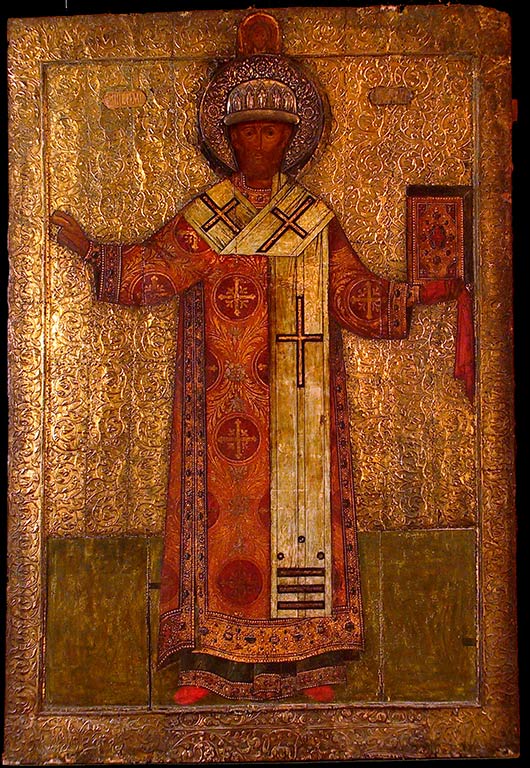
Philip is depicted as a metropolitan and hierarch-martyr: an aged bishop, long grey beard, vested in the sakkos and the white klobuk of a Russian metropolitan or in the omophorion, holding the Gospel-book and blessing, often with a scroll bearing words of his witness. Later vita-icons surround the central figure with scenes of his life — the departure from Moscow, the abbacy of Solovki, the rebuke of Ivan in the cathedral, the deposition, the strangling by Malyuta Skuratov, and the translation of his relics. Because the crosses and iron chains found on his body became a token of his sanctity, he is sometimes shown with them.
The stored image is the icon of Metropolitan Philip painted by Simon Ushakov in 1653 — the year after the translation of the relics to Moscow — the saint vested as a hierarch with the Gospel, by the greatest Russian iconographer of the age (source, public domain, pd-old-work).
Disputed questions
- The date of the cathedral rebuke. The sources place the great confrontation in the Dormition Cathedral variously on March 2 and March 21, 1568 (and some narratives conflate more than one clash between Tsar and metropolitan over that Lent); the substance — the refusal of the blessing and the open reproof — is constant.
- "Philip II." He is often styled Philip II in Russian usage, to distinguish him from an earlier Metropolitan Philip I of Moscow (†1473); the numeral is not part of his liturgical name.
- Not to be confused with the two New-Testament saints of the same English name — Philip the Apostle, of the Twelve (kept November 14), and Philip the Deacon, one of the Seven and an evangelist (kept October 11) — nor with the earlier Metropolitan Philip I of Moscow. This Philip is the sixteenth-century hieromartyr, Metropolitan and Wonderworker.