
Jonah of Moscow
Our Father among the Saints Jonah, Metropolitan of Moscow and All Russia, the Wonderworker
Bishop · Wonderworker · b. end of the 14th century, at Galich (Galich-Mersky) in the Kostroma land — d. 31 March 1461, at Moscow
Commemorated 31 March — Repose at Moscow (1461), 27 May — Uncovering of the incorrupt relics and their placing in the Dormition Cathedral (1472), 15 June — The principal commemoration of the hierarch, established by the Council of 1547, 5 October — Synaxis of the Hierarchs of Moscow, joined to it by Patriarch Job in 1596
Jonah (†1461) was the last Metropolitan of Kiev and All Russia to be styled by the old title and the first to be consecrated in Moscow by Russian bishops alone — the hinge on which the Russian Church turned from dependence on Constantinople to self-government. Tonsured at twelve in a monastery of his native Galich, and afterwards a monk of the Simonov monastery at Moscow, where the Metropolitan Photius found him asleep in the bakery with his right hand set in the gesture of blessing and prophesied that he would be a great hierarch, he was made Bishop of Ryazan and Murom, was twice passed over for the metropolitanate, and finally received it in 1448 after the Russian Church had deposed Isidore for accepting the union of Florence. He governed thirteen years, was credited with the deliverance of Moscow from the Tatar raid of 1451, and reposed in 1461; his relics were found incorrupt in 1472 and lie in the Dormition Cathedral of the Kremlin. He was glorified by the Council of 1547.

Galich and the Simonov monastery
Jonah was born toward the end of the fourteenth century at Galich — Galich-Mersky, in the forest country of the upper Volga north-east of Kostroma — to a pious family; his father's name is remembered as Theodore. He asked for the monastic habit as a child and received the tonsure in one of the Galich monasteries at the age of twelve, and after some years moved to the Simonov monastery at Moscow, the great house founded on the Moskva by a nephew of Sergius of Radonezh, where he passed many years in the ordinary obediences of a monk.
The story by which he is best remembered in Russia belongs to that period. The Metropolitan Photius, the learned Greek who governed the Russian Church from 1408 to 1431, came to Simonov, served the moleben, and blessed the archimandrite and the brethren; wishing to bless also those at work about the house, he went through the offices and came at last to the bakery, where he found the young monk Jonah asleep, exhausted by his labour — and the fingers of his right hand set in the form of a blessing. Photius forbade them to wake him, blessed the sleeping man, and told those with him that this monk would be a great hierarch of the Russian land and would bring many to salvation.
Bishop of Ryazan; the wreck of the union of Florence
Some years later Jonah was consecrated Bishop of Ryazan and Murom, a frontier see where he worked among the still half-pagan Mordvins and Meshchera of the middle Oka. Photius died in 1431, and about 1436 a council of Russian hierarchs and clergy chose Jonah as Metropolitan and sent him to Constantinople to be confirmed by the Patriarch Joseph II.
He arrived to find that he was too late: the Greeks, needing Latin help against the Turk and wanting a metropolitan who would serve the coming union, had already appointed the learned Isidore, a Greek of Thessalonica whom the Russian sources call a Bulgarian. Jonah was sent home with a promise that he should have the see after Isidore. Isidore came to Moscow, stayed only long enough to be received, and went off to Italy, where at the Council of Florence (1438–39) he subscribed the union with Rome; he returned to Moscow in 1441 with a Latin cross carried before him, commemorated the Pope at the Liturgy, and read the union decree in the Dormition Cathedral. The Grand Prince Vasily II had him arrested and a council of Russian bishops deposed him; he escaped to Rome, where he died a cardinal in 1462 (some reckonings give 1463).
The Russian Church was now without a head and unwilling to receive one from a see it believed to have fallen into union. After seven years' hesitation, and with the blessing of the Orthodox Patriarch Gregory III of Constantinople, the Russian bishops consecrated Jonah themselves, at Moscow, on 15 December 1448 — the first time the metropolitan of the Russian Church was raised to his throne by his own hierarchs without reference to the Greeks. It is from this act that the de facto autocephaly of the Russian Church is generally dated, and Jonah is thus the last metropolitan of the old undivided title "of Kiev and All Russia" and the first of the Moscow line proper; within a decade the western dioceses had a separate metropolitan of their own at Kiev, and the division of the Russian metropolitanate became permanent.
Metropolitan: the Tatar raid of 1451
As metropolitan Jonah kept the discipline of a monk — the sources are unanimous that he neither relaxed his fasting nor took anything for himself — and gave himself to the ordinary labour of a Russian hierarch of the fifteenth century: preaching, ordaining, mediating between the princes in the last years of the dynastic war, and pressing the claims of the faith in Lithuania and Novgorod.
In July 1451 a Tatar force under Mazovsha, son of the Khan Sayid-Ahmad, appeared before Moscow without warning, burned the settlements outside the walls and prepared to storm the city; the Grand Prince was away raising troops. Jonah led a procession along the walls, weeping and entreating God for the city. Seeing among the crowd the dying monk Anthony of the Chudov monastery, a man known for holiness, the metropolitan said: My son and brother Anthony, pray to the merciful God and the all-pure Mother of God for the deliverance of the city and for all Orthodox Christians. Anthony answered that the Mother of God had heard the hierarch's prayer and interceded with her Son, that the city and the Christian people would be saved through Jonah's prayers, and that the Lord had appointed that he alone should be killed by the enemy — and as he finished speaking an arrow struck him. That was on 2 July, the feast of the Placing of the Robe of the Theotokos. Confusion broke out in the Tatar camp in the night and the army withdrew in disorder, abandoning its baggage; the Russians called it "the swift Tatar raid." In thanksgiving Jonah built in his own courtyard a church of the Placing of the Robe of the Most Holy Theotokos, and the deliverance was kept as an anniversary at Moscow.
Repose, relics and glorification
Jonah reposed on 31 March 1461 and was buried in the Dormition Cathedral of the Kremlin. Healings were reported at his tomb almost at once. In 1472, during the rebuilding of the cathedral, his relics were found incorrupt and were translated to a new place in the church — the event kept on 27 May. The Council of Moscow of 1547, the great glorification council of Metropolitan Macarius, established his general commemoration; in 1596 the Patriarch Job joined him to the Synaxis of the Hierarchs of Moscow (October 5) with Peter, Alexis and, in the later form of the feast, Philip and Hermogenes. His relics remain in the Dormition Cathedral, in a shrine on the north side, and were among the very few in the Kremlin cathedrals never disturbed in the Soviet period.
Feast and commemoration
June 15 (church date; New Calendar civil June 15, Old Calendar civil June 28), the principal commemoration, on which the Slavic Menaion gives him a full office — three proper troparia, two kontakia, a canon, and the hierarch's readings — shared with the Prophet Amos, whose day it is, and with Michael of Kiev. March 31, the repose; May 27, the uncovering of the relics in 1472; October 5, the Synaxis of the Hierarchs of Moscow. He is a Russian commemoration and not a universal one: the Greek and Antiochian books do not carry him, and the entry's jurisdictions records this.
Where the polyeleos service of the hierarch is sung on June 15, the Russian Bogosluzhebnye ukazaniya appoint the hierarch's Epistle (Hebrews 7:26–8:2) and Gospel (John 10:9–16) in place of the readings of the day.
Hymns
Troparion — Tone 3
Taking up the yoke of the Lord from thy youth, thou didst follow in His footsteps with a desire that never turned back, and didst attain the labour of the priesthood; receiving a flock as bishop, thou didst receive also from God the gift of wonders, and to those who come with faith to the shrine of thy relics thou givest unstinting healing of every sickness. O our father Jonah, hierarch of Christ, pray to Christ God to grant us great mercy.
Original translation from the Slavonic
Kontakion — Tone 8
Having accomplished the ascetic life by desire of the Spirit, and having received a flock as bishop, thou wast kept incorrupt in body also for thy bodily purity by Christ the Master, who made thee the heir of Peter the wonderworker; and thou didst follow his manner of life, and Christ gave thee as a teacher to His own flock. There where thy healing relics lie they are fragrant as with sweet incense, and grant healing to the infirm who come with faith. O hierarch Jonah, pray unceasingly to Christ God for us all.
Original translation from the Slavonic
Appointed readings
Epistle — Hebrews 7:26–8:2
26For such an high priest became us, who is holy, harmless, undefiled, separate from sinners, and made higher than the heavens; 27Who needeth not daily, as those high priests, to offer up sacrifice, first for his own sins, and then for the people’s: for this he did once, when he offered up himself. 28For the law maketh men high priests which have infirmity; but the word of the oath, which was since the law, maketh the Son, who is consecrated for evermore. 1Now of the things which we have spoken this is the sum: We have such an high priest, who is set on the right hand of the throne of the Majesty in the heavens; 2A minister of the sanctuary, and of the true tabernacle, which the Lord pitched, and not man.
Gospel — John 10:9–16
9I am the door: by me if any man enter in, he shall be saved, and shall go in and out, and find pasture. 10The thief cometh not, but for to steal, and to kill, and to destroy: I am come that they might have life, and that they might have it more abundantly. 11I am the good shepherd: the good shepherd giveth his life for the sheep. 12But he that is an hireling, and not the shepherd, whose own the sheep are not, seeth the wolf coming, and leaveth the sheep, and fleeth: and the wolf catcheth them, and scattereth the sheep. 13The hireling fleeth, because he is an hireling, and careth not for the sheep. 14I am the good shepherd, and know my sheep, and am known of mine. 15As the Father knoweth me, even so know I the Father: and I lay down my life for the sheep. 16And other sheep I have, which are not of this fold: them also I must bring, and they shall hear my voice; and there shall be one fold, and one shepherd.
Iconography
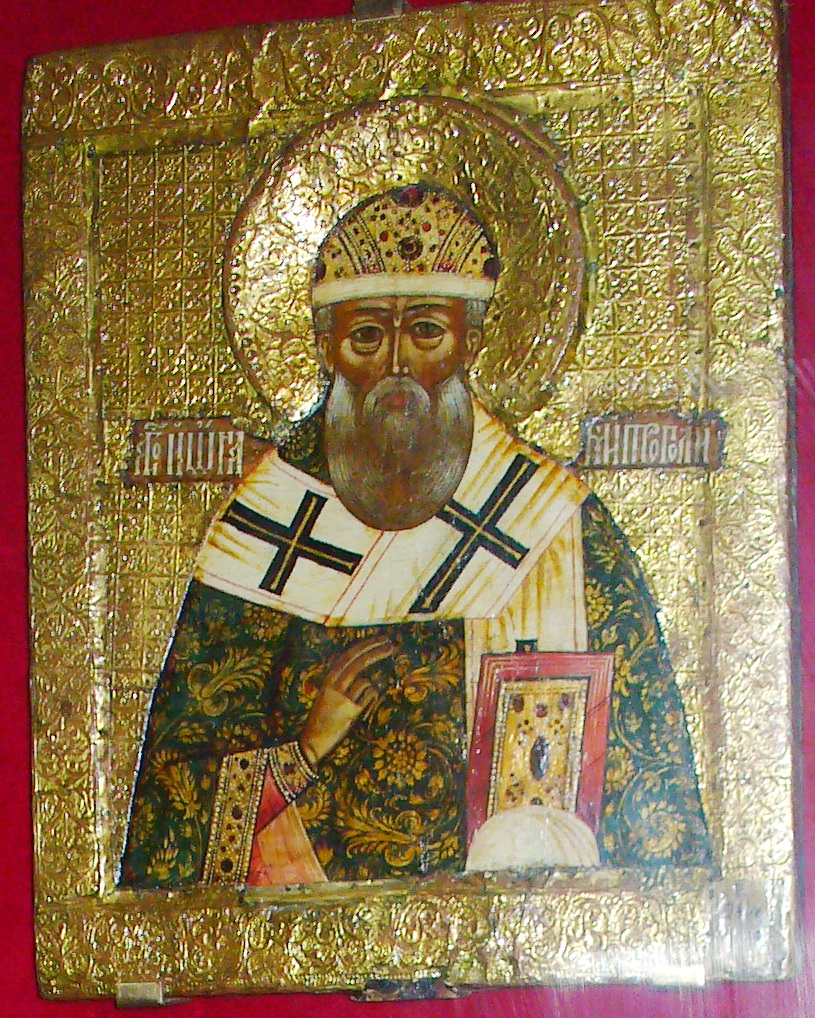
Jonah is painted as an aged hierarch of the Russian type: a broad grey or white beard, sometimes forked; the jewelled mitre of a Muscovite metropolitan, or bare-headed with the white klobuk; the sakkos or a flowered phelonion; the white omophorion with black or dark crosses; the right hand raised in blessing and the Gospel held in the left, often covered by the mantle. He belongs with the other Moscow wonderworkers — Peter, Alexis, Philip and Hermogenes — and the group icon of the four or five Moscow hierarchs standing together, common from the seventeenth century, is one of the standard subjects of Russian iconography; he appears there ordinarily third, after Peter and Alexis. Narrative scenes are rare, but the blessing of the sleeping monk in the Simonov bakery and the procession on the Kremlin walls in 1451 are both illustrated in the Illustrated Chronicle of Ivan the Terrible.
The stored image is a Russian panel icon of the mid-seventeenth century in the State Historical Museum at Moscow — wood, gesso and tempera, in a chased metal basma revetment — inscribed to either side of the nimbus С[ВЯ]Т[ЫЙ] IWНА / МИТРОПОЛИ[ТЪ], "Saint Jonah, Metropolitan": the hierarch half-length in a jewelled mitre, the white cross-omophorion over a green flowered sakkos, blessing with the right hand and holding the jewelled Gospel in the left. The inscription was read on the image itself before storing.
Disputed questions
- Which day is the principal feast? The Slavic and OCA calendars give June 15 as the day that carries his service — the day on which the Menaion has his troparia, kontakia and canon, and on which a polyeleos may be sung for him — while March 31 is the day of his repose and May 27 the uncovering of the relics. The June date is not an anniversary of either event; it is the commemoration established at his glorification, and it is entered here as primary with March 31 as secondary, which reflects liturgical practice rather than chronology. The Russian service-books are explicit that June 15 belongs to him and to Michael, first Metropolitan of Kiev, and that the hierarch's Epistle and Gospel are read on that day if a polyeleos service is sung for either of them.
- His title. He is styled indifferently "Metropolitan of Moscow" and "Metropolitan of Kiev and All Russia," and both are correct: the see was still juridically that of Kiev, and its holder had resided at Moscow since the fourteenth century. The Ukrainian and Russian historiographies read the events of 1448 very differently, and the difference is a live one; what is not disputed is the fact of a consecration performed by Russian bishops in Moscow with the concurrence of an Orthodox Patriarch of Constantinople who was himself an exile from a unionist court.
- Isidore's nationality. The Russian sources, and the OCA notice following them, call Isidore a Bulgarian; Greek and Western sources make him a Greek of the Peloponnese or of Thessalonica. The Russian designation may reflect his early monastic career in the Balkans.
- Not to be confused with the Prophet Jonah (September 21), nor with the other Russian saints of the name — Jonah of Klimetzk, Jonah the Presbyter of the Kiev Caves, Jonah of Pertominsk, or the Jonah among the hierarchs of Perm — nor with Jonah, Archbishop of Novgorod (†1470, November 5), his exact contemporary.