
Theodosius of Chernigov
Our Father among the Saints Theodosius (Uglitsky), Archbishop of Chernigov, Wonderworker
Bishop · Wonderworker · b. c. 1630s, in Podolia — d. February 5, 1696, at Chernigov
Commemorated 5 February — Repose at Chernigov, 9 September — Glorification (1896) and uncovering of the relics
Theodosius (Uglitsky) of Chernigov (c. 1630s–1696) was one of the last great hierarchs of pre-Petrine Rus' and Ukraine, Archbishop of Chernigov from 1692 and a wonderworker glorified two centuries after his repose. Born of a priestly family in Podolia and formed at the Kiev collegium, he rose through the great Ukrainian monasteries — abbot of the Krupitsky Saint Nicholas and of the Kiev Vydubitsky houses, then archimandrite of the Eletsky Dormition Monastery at Chernigov — before his consecration as archbishop. Renowned in life for gentleness, almsgiving, and care for monasticism and learning, he reposed on February 5, 1696, and was buried in the Chernigov cathedral. His relics were found incorrupt, and through the many miracles worked at his tomb — above all upon his successor John (Maximovich) — he was solemnly canonized by the Russian Church in 1896, one of the last glorifications of imperial Russia.

Origins and formation
Theodosius was born in the 1630s in the region of Podolia, in the right-bank Ukraine, into a family of the clergy: his father, Nikita Polonitsky-Uglitsky, was a priest, and his mother was named Maria. The surname Uglitsky (Углицкий) he carried from his family. He was given his first Christian formation at home, in a household of piety, and was sent for his higher education to the Kiev Collegium — the school of the Kiev Brotherhood Monastery, the great seedbed of Orthodox learning in the Ukraine of the age, in the years when the theological and cultural life of Kiev was at its height under the legacy of Peter Mogila. There he received the grounding in the Scriptures, the Fathers, and the liberal arts that marked the educated hierarchs of the Kievan school.
Monastic career
Drawn from his youth to the monastic life, Theodosius was tonsured a monk and in time ordained hierodeacon and hieromonk. He served for a period as archdeacon of the cathedral of Holy Wisdom (Saint Sophia) in Kiev and then withdrew to the stricter monastic life. His gifts of governance and his evident holiness carried him through a succession of the foremost houses of the Ukrainian Church:
- Abbot (igumen) of the Krupitsky Saint Nicholas Monastery near Baturin;
- Abbot of the Vydubitsky Saint Michael Monastery at Kiev, an ancient foundation on the Dnieper which he found impoverished and which he restored and set in good order;
- Archimandrite of the Eletsky (Yeletsky) Dormition Monastery at Chernigov, one of the chief monasteries of the city, to which he was called by the aged Archbishop Lazar Baranovich of Chernigov, the leading Ukrainian churchman of the day, as his trusted helper and eventual successor.
In each house he was remembered for the same things: the rebuilding and enrichment of the monastery, care for the divine services and for sacred singing, and a personal gentleness and generosity to the poor that made him loved.
Archbishop of Chernigov
The infirmity of the great Lazar Baranovich made a coadjutor necessary, and Theodosius was chosen. In 1692 he was consecrated Archbishop of Chernigov — the consecration performed at Moscow, by the Patriarch Adrian, a mark of the drawing of the Kievan and Chernigov church into the orbit of the Moscow Patriarchate in those decades. When Baranovich died the following year (1693), Theodosius succeeded to the full government of the see. His archiepiscopate, though brief, was marked by his continued care for the monasteries of his diocese, for the education and good order of the clergy, and for the poor; he supported the printing and learning for which Chernigov was noted, and drew to himself as archimandrite of the Eletsky house the man who would become his own successor and the chief witness to his sanctity — John (Maximovich), the future metropolitan of Tobolsk and himself a canonized saint.
Repose
Theodosius reposed on February 5, 1696, having governed Chernigov for some four years. He was buried, as he had wished, in a crypt he had prepared beneath the cathedral of Saints Boris and Gleb at Chernigov. His memory was cherished in the city from the first, and his tomb became a place of prayer.
Relics, miracles, and glorification
The veneration of Theodosius grew from the incorruption of his body and from the miracles worked at his tomb. The most celebrated concerns his own successor: John (Maximovich), gravely ill and near death, prayed at the tomb of Theodosius, was healed, and in thanksgiving ordered the reposed archbishop's body brought up and honourably enshrined — an event that fixed the public cultus. For two centuries the sick were healed and prayers answered at the relics, which were found and reported incorrupt, and the fame of the "wonderworker of Chernigov" spread through Ukraine and Russia.
In 1896 the Holy Synod of the Russian Orthodox Church, after examination of the relics and the recorded miracles, solemnly glorified Theodosius among the saints — one of the last and best-attested canonizations of the imperial period, celebrated at Chernigov before great crowds. His feasts were fixed on February 5, the day of his repose, and on September 9, the day of his glorification and the uncovering of his relics. His relics were venerated at Chernigov through the upheavals of the twentieth century — removed, displayed as a museum exhibit in the Soviet years, and at length restored to the Church — and rest again in the city he shepherded.
Feast and commemoration
Theodosius is kept on February 5 (church date; Old Calendar civil February 18), the day of his repose, and on September 9 (Old Calendar civil September 22), the day of his glorification in 1896 and the uncovering of his relics. His is a commemoration of the Russian and Ukrainian Churches — Moscow Patriarchate, the Ukrainian Church, and the Russian Church Abroad — rather than a universal feast of the whole Byzantine calendar; on February 5 his memory is kept together with the ancient virgin-martyr Agatha of Sicily and within the afterfeast of the Meeting of the Lord.
He is not to be confused with Theodosius of the Kiev Caves (Feodosy Pechersky, †1074, kept on May 3 and August 14) — the confusion most likely to occur of any in this corpus, since both are venerated as wonderworkers of the Ukrainian lands and both are styled simply "Theodosius" in Slavonic usage. That Theodosius is the eleventh-century co-founder and abbot of the Caves monastery at Kiev and the father of Russian cenobitic monasticism; this one is the seventeenth-century archbishop of Chernigov.
Iconography
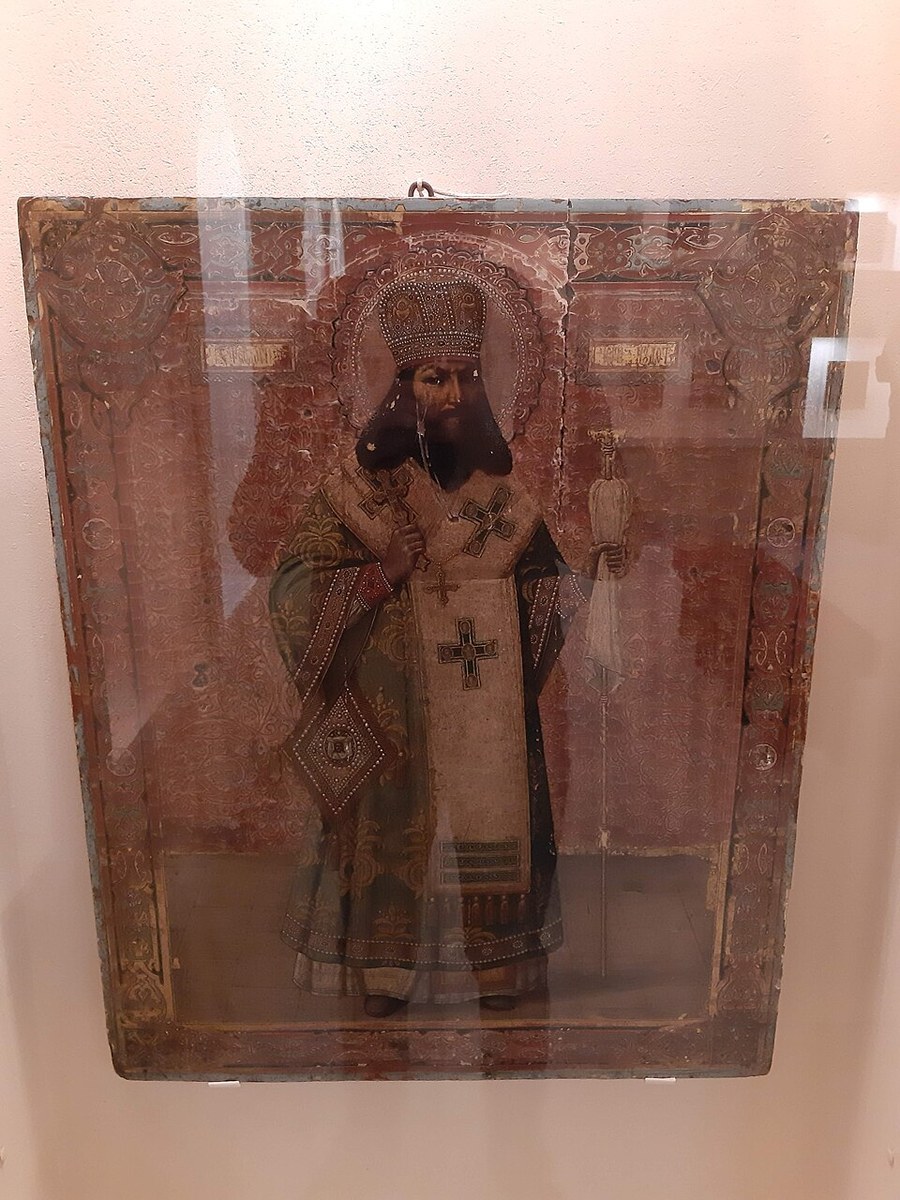
Theodosius is depicted in the settled type of a Russian-Ukrainian archbishop of the seventeenth century: vested in the sakkos and omophorion, the mitre on his head or beside him, blessing with his right hand and holding the Gospel-book or the archpastoral staff, his face lean and bearded. His iconography took shape around his glorification of 1896, and the images of that period — the festal icons written for the canonization and the portrait-icons kept at Chernigov — form the basis of his type; he is often shown against the churches of Chernigov, or with the incorrupt relics that were the ground of his veneration.
The stored image is a late-nineteenth-century portrait-icon of the saint (oil on board), preserved in the Mahiliou Regional Art Museum — a work of the years around his glorification, showing him as the vested archbishop (source; the underlying work is public domain by age, the museum photograph being a faithful reproduction of a two-dimensional work — pd-old-work per the project's constitution).