
Sampson the Hospitable
Our Venerable Father Sampson the Hospitable, Priest and Physician of Constantinople
Unmercenary · Venerable · Priest · Wonderworker · b. at Rome, of a wealthy family — d. c. 530, at Constantinople
Commemorated 27 June — Repose at Constantinople and the myrrh from his tomb
Sampson the Hospitable was a Roman-born physician who gave away a great inheritance, settled at Constantinople, and turned his own house into a free surgery for the poor of the City, treating the sick without payment and lodging those who had nowhere to go. Ordained priest by the patriarch, he cured the emperor Justinian of an illness his physicians had given up, and asked in return not gold but the founding of a xenon — a hospital and hostel — which was built beside the Great Church and bore his name for six hundred years. He reposed in peace about 530 and was buried in the church of the Martyr Mokios, where a fragrant myrrh flowed from his tomb and the sick were healed. He is numbered among the unmercenary physicians, and is one of the very few saints whose memorial is a working institution.
.jpg)
Rome, and the giving away of an inheritance
The synaxaria make Sampson a Roman by birth, of a family both wealthy and Christian, and some notices attach him by blood to the imperial house. He was given the full education of his class — grammar, rhetoric and philosophy — and to it he added medicine, which he studied not as a gentleman's accomplishment but as a trade he meant to practise.
At his parents' death he came into a large fortune, and disposed of it in the way the Church has never stopped remembering: he freed the household slaves, provided for them, and distributed the rest to the poor, keeping nothing. Then he left Rome for Constantinople, arriving with what a physician could carry.
The house that became a hospital
In the capital he took a small house near the centre of the City and did there the only thing he had kept: he practised medicine. He took no fee. He treated the destitute, and when they had nowhere to go afterwards he kept them in the house until they were well; and because the numbers grew beyond one man's hands he trained assistants. The tradition is emphatic that his cures were not merely competent but miraculous — that God added to his medicine the grace of healing, so that what his art could not reach his prayer did.
His reputation reached the patriarch, who examined his life, found it what it was said to be, and ordained him priest. It is worth pausing on the order of events: Sampson was made a priest because of the hospital, not given a hospital because he was a priest.
The healing of Justinian
The emperor Justinian fell gravely ill, and the physicians of the court could do nothing. The account — told alike in the Greek synaxaria and in the Slavonic books — has the emperor shown Sampson in a dream, or the patriarch naming him when the court had exhausted its resources; Sampson was fetched, laid his hand on the diseased place, and the emperor was well.
Justinian offered him gold and silver and lands. Sampson refused them, and said that if the emperor wished to reward him he should build a house for the sick and for strangers and endow it, and that the reward would then be the emperor's own. Justinian did it: a great xenon was raised in the very heart of the City, between the Great Church of the Holy Wisdom and the church of Saint Eirene, and made over to Sampson to govern.
The Xenon of Sampson
The institution outlived its founder by six centuries, and is one of the best-attested charitable foundations of the ancient world. Procopius names it twice. In the Wars he records that in the Nika riot of January 532 the mob's fire took "the hospice called Sampson's," and that the sick perished inside it — the notice is grim, and it is the earliest independent evidence that the house existed and was full. In the Buildings he describes how Justinian rebuilt it larger and finer than before, added a further wing, and settled on it a permanent revenue, so that the poor who came to it should be maintained in perpetuity.
The Xenon of Sampson thereafter appears again and again in the records of Byzantine Constantinople — in imperial legislation, in monastic typika, in the lists of the City's charities — as a working hospital with beds, physicians and a staff, one of the models on which the later Byzantine hospital was built. Its site by the Augustaion, in the angle between Hagia Sophia and Hagia Eirene, was among the most valuable ground in the empire, and the emperors kept giving it away to the sick.
Repose and the myrrh
Sampson himself grew old in the work. He died after a short illness, at a great age, about the year 530, and was buried in the church of the Holy Martyr Mokios in Constantinople. From his tomb, the synaxaria say, a fragrant myrrh issued, and the sick who came to it were cured — the Greek couplet appointed for his day plays on the name: the old Sampson drew drink from a jawbone; this Sampson makes myrrh gush from a grave. His memory was kept at the xenon with a yearly panegyris.
The Russian afterlife: Poltava
Sampson acquired, very late and by accident, a second and quite different fame. On 27 June 1709 — his feast — Peter I destroyed the army of Charles XII of Sweden at Poltava. The victory was ascribed to the saint of the day, and Peter built in the new capital the wooden and then the stone church of Saint Sampson the Hospitable, later the Sampsonievsky Cathedral, as the thanksgiving monument of Poltava; the great Petersburg thoroughfare takes its name from it. The Russian Church has kept June 27 with unusual solemnity ever since, and Sampson — a Roman physician of Justinian's Constantinople — is in consequence better known in Russia than in Greece.
Feast and commemoration
June 27 (church date; New Calendar civil June 27, Old Calendar civil July 10). Sampson is kept across the whole Orthodox world; the Greek books give him the day with the martyr Anectus, the Slavonic books give him first place, and Russian usage adds to the day the Poltava associations described above. He is counted among the holy unmercenaries — the physicians who took no fee — and is invoked with them at the Sacrament of Holy Unction, alongside Cosmas and Damian of Mesopotamia, Cyrus and John, Thalelaeus and Panteleimon. June 27 falls in most years within the window of the Apostles' Fast, which has no fixed beginning and ends on June 28; its position on this day is therefore not asserted here.
Hymns
Apolytikion — Tone 4
In thy patience thou didst gain thy reward, O venerable father, persevering unceasingly in prayer, loving the poor and supplying their need. Wherefore intercede with Christ our God, O blessed and godly-minded Sampson, that our souls may be saved.
Kontakion — Tone 4
Running together to thy divine coffin, O godly-minded and venerable Sampson, as to a physician most excellent and a minister well-pleasing to God, we hymn thee with psalms and songs, and we glorify Christ, who bestowed upon thee such grace of healings.
Original translation from the Greek
Synaxarion
The Sampson of old drew drink out of a jawbone; this Sampson makes myrrh well up out of a tomb. On the twenty-seventh Sampson died, and myrrh gushed forth.
Iconography
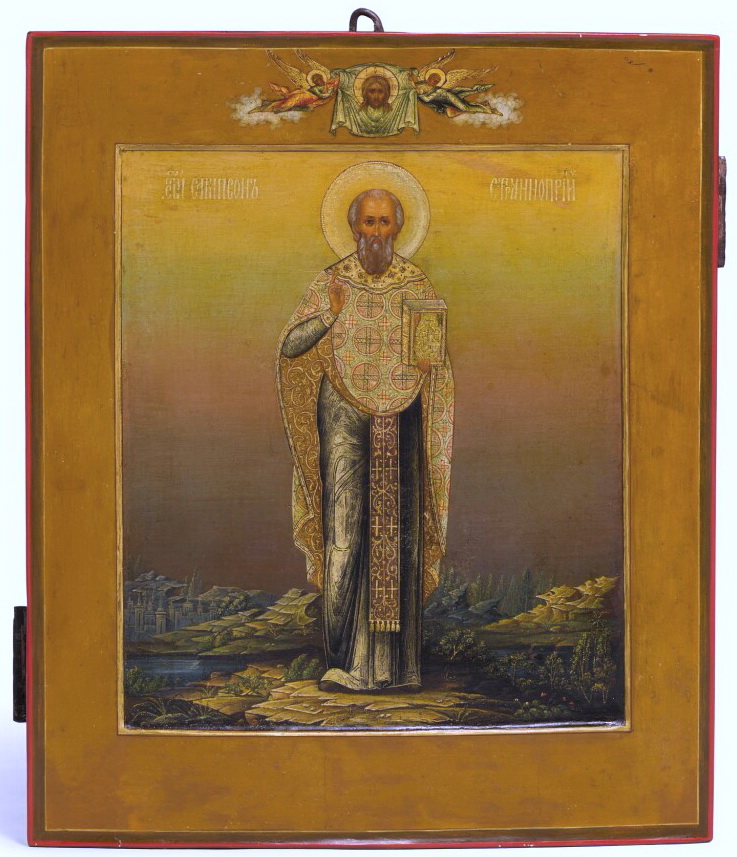
Sampson is painted as a priest, not as a monk and not as a layman-physician: grey- or white-bearded, in phelonion and epitrachelion, blessing with the right hand and holding the Gospel-book in the left, and inscribed Ὁ ΑΓΙΟΣ ΣΑΜΨΩΝ Ὁ ΞΕΝΟΔΟΧΟΣ or, in Slavonic, СВЯТЫЙ САМПСОНЪ СТРАННОПРІИМЕЦЪ. Where he is grouped with the unmercenaries he may instead take their attribute, the physician's box and spoon; and in narrative scenes the building of the xenon, or the healing of Justinian at the bedside, is shown beside him.
The stored image is a Moscow icon of about 1900 attributed to the Dikariev workshop, in the academic-revival manner then fashionable: the saint standing full-length on a rocky shore with a distant walled city — Constantinople — behind him, in a richly patterned cross-figured phelonion and a long embroidered epitrachelion, blessing and holding the Gospel, with the Mandylion borne by angels above and the Slavonic inscription СВ. САМПСОНЪ СТРАННОПРІИМЕЦЪ across the field. It is genuinely out of copyright but stands at the very edge of this collection's "pre-1900" rule, and a Byzantine or post-Byzantine panel would be a better witness if one can be found.
Disputed questions
- Which patriarch ordained him? The received notices, followed by the Orthodox Church in America, name Menas — but Menas was patriarch of Constantinople only from 536 to 552, and Sampson is said to have died about 530. The two statements cannot both stand. Either the ordination belongs to an earlier patriarch (Epiphanius, 520–535, is the natural candidate), or Sampson lived some years longer than the received date and died in the 540s. The synaxaria do not resolve it, and both the date and the name are transmitted with equal confidence.
- Roman by birth? The Greek notices say Rome. Given that the whole of his recorded activity is at Constantinople under Justinian, some have suspected that "Rome" here means the New Rome, or that a Roman origin has been supplied to dignify him. Nothing turns on it, and the tradition is unanimous.
- The kinship with the emperor. Several notices make him a relative of the reigning emperor — in some, of Constantine the Great, which is a plain chronological impossibility and appears to be a scribal drift from "of a great Roman family." It is not repeated here as fact.
- Not to be confused with the judge Samson of the Book of Judges, on whose name the liturgical verses for this day turn deliberately.