
Stephen of Makhrishche
Our Venerable Father Stephen, Abbot of Makhrishche
Venerable · b. early 14th century, Kiev — d. 14 July 1406, at the Makhrishche monastery
Commemorated 14 July — Repose at his monastery of the Holy Trinity at Makhra
Stephen was a monk of the Kiev Caves who fled the pressure put upon the Orthodox in the south-western Russian lands and came to Moscow, where Grand Prince Ivan II gave him leave to settle at Makhra, some thirty-five versts from the monastery of Sergius of Radonezh. There in 1358 he founded a house of the Holy Trinity and became its abbot. Driven out for a time by neighbouring landowners who feared for their fields, he went north into the Vologda forest and founded a second Trinity monastery on the river Avnezh with his disciple Gregory; returning to Makhra, he gave his house the coenobitic rule. He was the friend of St Sergius, whom he sheltered when Sergius left his own monastery, and to whom he gave the disciple Simon who led him to Kirzhach. Stephen died in great old age on 14 July 1406; his relics were found incorrupt in 1550 and became a source of healings.

From the Caves of Kiev to Moscow
Stephen was a native of Kiev, and took the monastic habit in the monastery of the Caves, the mother-house of Russian monasticism, where he spent several years in obedience and prayer. The fourteenth century was hard on the Orthodox of the south-western lands: the Russian sources say that the oppression of the Latins — the pressure exerted on the Orthodox population of the Lithuanian and Polish territories — made his life there impossible, and he went north.
At Moscow the Grand Prince Ivan II Ivanovich (1353–1359) received him graciously and gave him leave to settle where he chose. He picked a place in the forest called Makhra, near Gorodishche, about thirty-five versts from the monastery that Sergius of Radonezh had founded — near enough for the two to know one another, far enough for solitude. He built himself a cell and lived there alone in ascetic labour, loving silence and at first refusing those who asked to join him.
The Makhrishche monastery
He yielded in the end to their asking, and in 1358 a monastery of the Holy Trinity came into being at Makhra, with Stephen as its abbot. It stood on land whose neighbours were the brothers of a family the sources call the Yurkovs, who feared that the ground they held would pass to the monastery, and who threatened the abbot's life. He reasoned with them and could not move them; rather than contend, he left, taking a disciple with him.
Avnezh
He went far north — some sixty versts beyond Vologda, to the river Avnezh — and there, with his disciple Gregory, founded a second monastery in the name of the Holy Trinity, in the great push of Russian monks into the northern forest that filled the Vologda country with houses in that generation. The Grand Prince Dimitry Ivanovich (Donskoy) sent books and liturgical furniture to the new wilderness house; Stephen sent them on to Makhra. The Avnezh foundation outlived him: its abbot Gregory and the cellarer Cassian were killed there by a Tatar raiding party in 1392 and are venerated as venerable martyrs.
Return, and the coenobitic rule
Stephen came back to Makhrishche and set the monastery in order according to the coenobitic rule — the common life, without private property, that Sergius and Metropolitan Alexis were then restoring in the Russian houses. He was, the life says, severe with himself and indulgent to everyone else: he worked harder at the monastery's labour than any of the brethren, wore the oldest and coarsest clothing in the house, and guided the monks by quiet talk rather than by rebuke.
Stephen and Sergius of Radonezh
The most celebrated episode of his life belongs to another man's. When Sergius of Radonezh withdrew from his own monastery to escape a dispute among the brethren and to look for a place of solitude, it was to Stephen at Makhrishche that he came, and Stephen received him. To help him find a site, Stephen gave him one of his own disciples, Simon, who knew the country; and Sergius and Simon went on together to the island in the river Kirzhach, where Sergius founded the monastery of the Annunciation. Stephen is accordingly numbered among the saints of Radonezh in Russian usage, and the friendship of the two abbots is a fixed part of the tradition of both houses.
Repose and relics
He lived to extreme old age, received the great schema at the end, and died on 14 July 1406. In 1550, when a new stone church of the Holy Trinity was being built at Makhrishche, his relics were uncovered and found incorrupt; healings followed for those who called on him, and his veneration was established. The life was written about 1560 by Barlaam, abbot of Makhrishche, at the direction of the Metropolitan Macarius of Moscow, in the great campaign of canonisation and hagiographical collection of those years — the same Barlaam who wrote the life of Gregory and Cassian of Avnezh. The monastery, refounded after the Soviet period as a women's community, keeps his relics still.
Feast and commemoration
July 14 (church date; New Calendar civil July 14, Old Calendar civil July 27), the day of his repose in 1406. The commemoration is Russian, and is carried in the OCA calendar; the Greek books do not keep it. A proper canon to St Stephen of Makhrishche stands in the Russian Menaion for the day, and an akathist is in use. He is commemorated again in the regional synaxes — with the saints of Radonezh, and among the saints of Vladimir and of Vologda — and the uncovering of his relics in 1550 is kept locally.
Hymns
Troparion — Tone 8 (common of a venerable father)
By the streams of thy tears thou didst till the barren desert, and by thy sighing from the depths thou didst bear fruit an hundredfold in labours; and thou wast made a beacon to the whole world, shining with miracles, O Stephen our father: intercede with Christ God that our souls may be saved.
Original translation from the Slavonic
Iconography
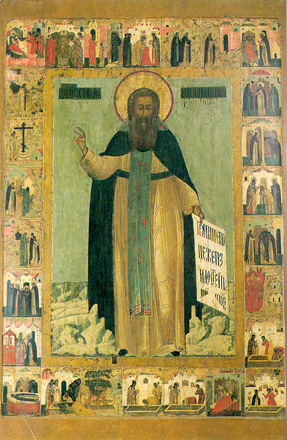
Stephen is written as a Russian abbot: an elder in the monastic mantle and analavos, long-bearded and grey, blessing with the right hand and holding in the left an unrolled scroll bearing a word of counsel to his brethren — the standard type of the northern monastic founders. Where the icon serves his own monastery he is shown holding a model of the Trinity church of Makhrishche, and in the Radonezh group icons he stands among the disciples and friends of St Sergius.
The stored image is a seventeenth-century vita icon, "Stephen of Makhrishche with his life," from the museum in the Alexandrov Kremlin — the district in which his monastery stands. The saint occupies the centre at full height, blessing, with the open scroll in his left hand and the monastery's buildings small at his feet; around him run the border scenes (kleima) of the life — the tonsure at the Caves, the coming to Moscow, the founding at Makhra and at Avnezh, the reception of St Sergius, the repose, and the uncovering of the relics — in the manner of the Muscovite hagiographical icons that followed the canonisations of the mid-sixteenth century.
Disputed questions
- "Of Vologda." The OCA and some Russian lists style him of Makhrishche, Vologda, which conflates his two foundations: he is of Makhra (in the Alexandrov district of the Vladimir land, where he lived, died and is buried) and only for a period of Avnezh in the Vologda country. Both regional synaxes claim him, and rightly.
- Not to be confused with Stephen of the Kiev Caves (April 27), abbot of the Caves and afterwards bishop of Vladimir in Volhynia, with whom he shares a name and the Caves monastery but nothing else: they are separated by three centuries.