
Synaxis of the Saints of Radonezh
The Synaxis of the Venerable and God-bearing Fathers and Saints of Radonezh
Venerable · Righteous · Wonderworker · Bishop · Prince · d. 14th–19th century
Commemorated 6 July — The common assembly of the saints of Radonezh, kept the day after the uncovering of the relics of Sergius
The Synaxis of the Saints of Radonezh is the common commemoration of the whole company of saints connected with the Trinity–Sergius Lavra and its founder, Sergius of Radonezh — his kinsmen, his disciples, the disciples of his disciples, and the hierarchs, princes, iconographers and monks who came out of that lineage across five centuries. More than a hundred names are included, from Sergius's parents Cyril and Maria in the fourteenth century to the Lavra's saints of the nineteenth. The feast was appointed for July 6, the day following the commemoration of the uncovering of the relics of St Sergius (July 5), so that the founder's feast opens directly into the feast of all who came after him.
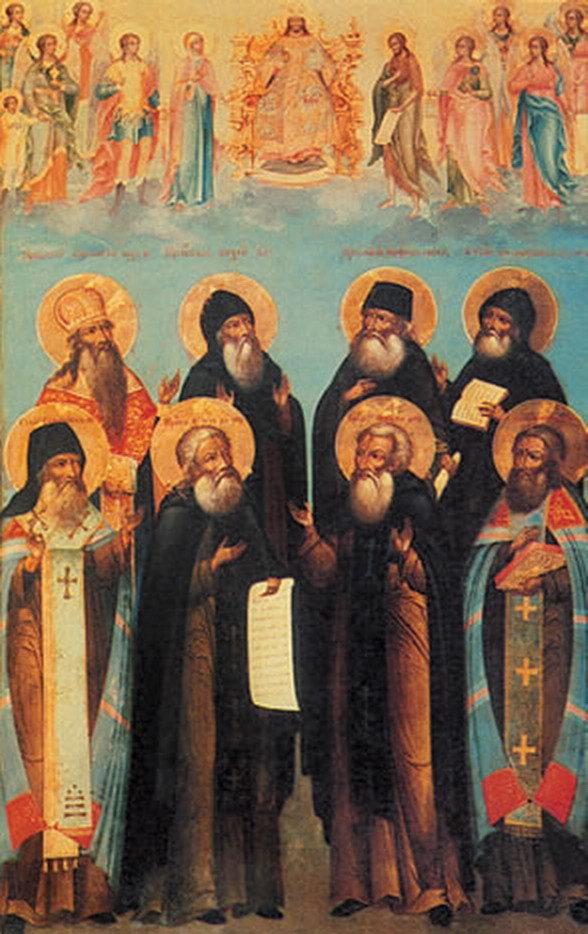

(For a synaxis the biographical section gives the history and composition of the commemoration rather than a single life.)
Radonezh and the Lavra
Radonezh was a small settlement north-east of Moscow to which the impoverished boyar family of Cyril and Maria of Rostov moved in the 1330s, and from which their son Bartholomew — in monastic profession Sergius — went out with his brother Stephen into the forest to found the hermitage that became the Trinity–Sergius Lavra. From that root grew what is, humanly speaking, the most consequential monastic movement in Russian history: Sergius's disciples went out in every direction to found houses of their own, and their disciples founded more, until by the fifteenth century a great part of northern Russian monasticism traced its descent to the Trinity.
The commemoration gathers this whole descent under one head. It is therefore not a commemoration of a place only, but of a spiritual genealogy.
Who is included
The roll is long and is not closed in exactly the same form in every printing. It includes, in broad classes:
- The founder and his family — Sergius himself (†1392); his parents the righteous Cyril and Maria of Radonezh; his brother Stephen; his nephew Theodore, Archbishop of Rostov.
- His immediate disciples — Nikon of Radonezh, his successor as abbot; Micah of Radonezh, who was present at the appearance of the Mother of God to Sergius; Isaac the Silent; Simon the Ecclesiarch; Sabbas of Storozhevsk; Athanasius of Serpukhov; Roman of Kirzhach; Methodius of Peshnosha; Andronicus and Sabbas of Moscow; Abramius of Galich; Alexander of Kushta, and many more.
- Iconographers — above all Andrei Rublev (†c. 1430), monk of the Andronikov monastery and painter of the Trinity, and his companion Daniel Chorny.
- Princes and laypeople — the Grand Prince Demetrius of the Don (†1389), whom Sergius blessed before Kulikovo, and others of the princely houses associated with the Lavra.
- Hierarchs and later fathers — Dionysius of Radonezh, archimandrite during the Time of Troubles; the Lavra's abbots and metropolitans down to the nineteenth century, including Philaret of Moscow and the elders of the Gethsemane skete.
Well over a hundred names are commemorated in all, spanning the fourteenth to the nineteenth centuries, and comprising monks, bishops, princes, soldiers, painters and laypeople.
Establishment of the feast
Regional synaxes — the common feasts of "all the saints of Rostov", "of Novgorod", "of Tver", "of Siberia" — are a characteristically Russian development, most of them established or re-established in the nineteenth and twentieth centuries as a way of honouring local saints who had no proper service of their own. The Synaxis of the Saints of Radonezh belongs to this class and is a modern institution: it was appointed by the Moscow Patriarchate in 1981, under Patriarch Pimen, together with several other regional synaxes, and was fixed to July 6 precisely because it follows July 5, the uncovering of the relics of St Sergius in 1422. A proper service was composed for it at that time.
Feast and commemoration
July 6 (church date; Old Calendar civil July 19). At the Trinity–Sergius Lavra at Sergiev Posad the two days are kept together as one celebration: the uncovering of the relics of the founder on July 5, and on July 6 the assembly of all who followed him. Elsewhere in the Russian Church the synaxis is served with the proper office of 1981 where it is available and otherwise with the common of venerable fathers. Individual members of the synaxis retain their own days; those already entered in this collection are linked above, and the rest are to be added as their own feasts are reached.
Hymns
Apolytikion — Tone 4 (common of a synaxis of venerable fathers)
As bright stars about the great luminary Sergius ye were shown forth in the land of Radonezh, O venerable fathers, and by your labours ye made the wilderness a city of God; wherefore we honour your assembly and cry: entreat Christ God that our souls may be saved.
Iconography
The synaxis-type follows the pattern of the Russian regional assemblies. In the centre stands St Sergius, either full length or enthroned, often holding a scroll or a model of the Trinity church; above him is the Old Testament Trinity in Rublev's composition, or the appearance of the Mother of God to Sergius; and about and below him the saints of Radonezh are ranged in tiers, each named in Slavonic beside his head — schemamonks in the analavos, bishops in omophorion and mitre, the princes crowned and in furred robes, Rublev with brush and panel. The Trinity Lavra itself, with its white walls and its cluster of domes, is frequently painted along the lower register as the ground on which the whole company stands. The entry once reasoned that, the feast being appointed only in 1981, every icon of the synaxis as such must be modern — but the gathering of the Radonezh saints was painted long before the feast was formalised, and the stored image proves it: an 18th-century icon of eight named saints of Radonezh ranged in two rows beneath the Deisis, from the church of the Prophet Elijah by the Lavra. The 1981 appointment gave a fixed day to a synaxis the iconographers had been gathering for two centuries.
Disputed questions
- A modern feast. The commemoration itself dates only from 1981, though every saint it names was canonised long before; it is a new liturgical arrangement of old material, not a new canonisation.
- The roll varies. Different Russian printings and different Lavra publications give somewhat different lists, and the numbers cited range from about seventy-five to over a hundred and twenty. There is no single authoritative roll; the principle of inclusion — connection with Sergius and with the Trinity Lavra — is clearer than its application at the margins.
- Century. The company spans five centuries; this entry is indexed under the fourteenth, the century of Sergius and of the greater part of the disciples, with the span stated in the frontmatter.
- Jurisdiction. The feast is kept in the Russian Church and by the Orthodox Church in America; it does not appear in the Greek or Antiochian calendars.