
Stephen of the Kiev Caves
Our Venerable Father Stephen, Abbot of the Kiev Caves and Bishop of Vladimir in Volhynia
Venerable · Bishop · b. c. 1040 — d. 27 April 1094, at Vladimir in Volhynia
Commemorated 27 April — Repose at Vladimir in Volhynia, 10 October — Synaxis of the Saints of Volhynia
Stephen was a disciple of Theodosius of the Kiev Caves, whom the dying founder named as his own successor at the request of the brotherhood, and who as abbot completed the great church of the Dormition at the Caves monastery and reorganised its life around the new church. Deposed in 1078 by a faction within the community, he answered the injury by praying for those who had driven him out, and founded a new monastery on the Klov stream near Kiev, dedicating its church to the Placing of the Robe of the Theotokos at Blachernae in thanksgiving for the Mother of God's protection of the Caves. About 1091 he was made bishop of Vladimir in Volhynia, took part that same year in the translation of the relics of Theodosius, and for three years governed his see with a reputation for meekness and mercy before his repose on 27 April 1094. He is commemorated on April 27 and among the Saints of Volhynia on October 10.

Under Theodosius
Stephen entered the Kiev Caves monastery — the mother house of Russian monasticism, founded by Antony and organised by Theodosius — as a young man, and was formed there under Theodosius's own direction. Within the community he held the office of domesticus (ustavshchik in later Russian usage), the monk responsible for the ordering of the choir and the correct execution of the singing and the rubrics: a post that presupposes both learning and a temperament for exactness, and one that put him daily at the centre of the monastery's liturgical life.
When Theodosius came to die — in 1074 — the brethren asked him to give them Stephen, and the words the Caves tradition preserves are the plainest possible testimonial: "He grew up under your instruction, and he has served you; give him to us." Theodosius consented and appointed him, laying on him three charges which are a summary of the Caves rule itself: to keep the monastic typikon strictly, to care for pilgrims and strangers, and to pray for the monastery's benefactors.
Abbot: the church of the Dormition
Stephen's abbacy is remembered for one great work. The stone church of the Dormition of the Most Holy Theotokos, begun under Theodosius, was left unfinished at his death; Stephen completed and adorned it, and it became the Great Church of the Caves Lavra, the model and mother of church building in the Rus' lands for centuries. Around it he re-ordered the community's physical life, moving the brethren's cells up to the new church, and leaving at the old caves a small deputed company charged with the burial of the dead and with the daily Liturgy for their commemoration — a division of labour that fixed the character of the Caves as at once a working monastery and a great necropolis of the Rus'.
Deposition, and the monastery at Klov
In 1078 — barely four years into his abbacy — Stephen was driven from office by discord within the community. The Caves sources are reticent about the details, naming a quarrel with a monk and a faction that formed against him; what they record with care is his response. He answered neither with self-justification nor with resentment but with prayer for those who had expelled him, in the words the Paterikon preserves: "Lord, lay not this sin to their charge."
He did not leave monastic life, but began again. Having heard from the Greek master builders who had come to build the Caves church the account of the appearance of the Mother of God at Blachernae in Constantinople, by which they said they had been sent to Kiev, Stephen founded about 1091 a new monastery on the Klov stream near the city and built there a church of the Placing of the Robe of the Theotokos — the Blachernae feast — as a thank-offering for the Mother of God's protection of the Caves. The Klov monastery, sometimes called the Blachernae monastery of Kiev, was a direct offshoot of the Caves and one of the earliest daughter houses of the Lavra.
Bishop of Vladimir in Volhynia
In 1091 Stephen was consecrated bishop of Vladimir in Volhynia (Volodymyr, the old see of the Volhynian land, in the west of the Rus' territories). In the same year he took part in the translation of the relics of St Theodosius at the Caves, coming back to the monastery he had once governed to bury his own teacher's remains in the church he had himself completed — one of those closings of a circle that the chronicles record without comment.
He held the see for three years, and the tradition's estimate of his episcopate is a character rather than a record of acts: an example, it says, of meekness and mercy, with the labour of building up the Christian faith through a region only a century converted. He reposed on 27 April 1094. His memory was kept at Vladimir and at the Caves, and in modern usage he is numbered among the Saints of Volhynia.
Sources of the life
Stephen is known from the historical writing of the Caves itself: the Kiev Caves Paterikon, the collection of lives and tales of the monastery's fathers, and the material on Theodosius's death and succession that goes back to Nestor the Chronicler and the Primary Chronicle. He is one of the best-documented figures of the first century of Russian monasticism precisely because his life is bound up with the two events the Caves writers cared most about — the death of Theodosius and the building of the Great Church.
Feast and commemoration
April 27 (church date; Old Calendar civil May 10) — the day of his repose in 1094, and his principal commemoration in the Russian and Ukrainian calendars and in the OCA, where he is listed as "Venerable Stephen, Abbot of the Kiev Far Caves, and Bishop of Vladimir in Volhynia." He shares the day with the hieromartyr Simeon of Jerusalem, whose office holds the day, and with Eulogius the Hospitable.
He is commemorated again on October 10 in the Synaxis of the Saints of Volhynia (Sobor Volynskikh svyatykh), the local synaxis of the see he governed, which on the Old Calendar falls on the civil October 23.
The Greek synaxaria also list him for April 27 — the Greek books have "Ἅγιος Στέφανος Ἐπίσκοπος Βλαντιμίρ" — which is one of the few Rus' commemorations to have passed into Greek use on a fixed April day.
Because April 27 falls in late April, its place in the year depends on the date of Pascha and may lie either in Great Lent and Holy Week or in the Pentecostarion.
Hymns
Troparion — Tone 8
Obedient to the teaching of the God-bearing Theodosius, thou wast appointed by him to be the guide of his holy flock; and having shepherded it well, thou didst complete in comeliness the church of the Theotokos, founded in wonder by her own will, O ever-memorable Stephen. Therein entreat of Christ God great mercy for us who pray.
Original translation from the Slavonic
Kontakion — Tone 6
The enemy, envying thy honourable life, thrust thee out by his craft from the headship of the flock; yet thou, being driven forth, didst raise up in another place also a church of the Theotokos, for which she herself honoured thee with the rank of the hierarchy; and having therein well shepherded the sheep entrusted to thee, thou didst pass over in gladness unto Christ, O Stephen. Pray thou unto Him for us thy servants.
Original translation from the Slavonic
Iconography
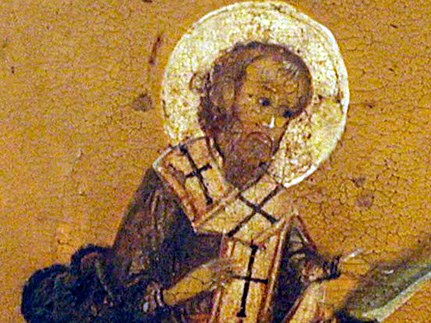
Stephen is painted in the composite type proper to a monk who became a bishop: he may appear as a hierarch, in phelonion and omophorion, blessing and holding the Gospel, with the monastic cowl or skhima showing beneath the vesture; or, in the Caves compositions, as a venerable father in the monastic habit, holding a scroll. His distinguishing attribute, where one is given, is a model of a church held in the hand — the Great Church of the Dormition which he completed, or the Klov church of the Robe which he founded — the builder's attribute that Byzantine and Russian painters give to founders and completers of churches. In the great group icons of the Fathers of the Kiev Caves, ranged in tiers about the Lavra and the Mother of God, he takes his place among the abbots.
A cropped detail from a nineteenth-century Russian icon is circulated on Wikimedia Commons as depicting him (the file used for him on several Wikipedias): it shows a bishop in a crossed omophorion, but carries no legible inscription and is a fragment of a larger composition, so that its identification rests entirely on the uploader's caption. It has been rejected for this collection under the project's constitution, and Stephen is entered instead in the list of icons still being sought. The stored image is a portrait-image of no later than the 19th century.
Disputed questions
- The Near or the Far Caves? Stephen is styled in the OCA's calendar "Abbot of the Kiev Far Caves," and in the Russian books simply "of the Caves"; since his own body rests at Vladimir in Volhynia and not in either cave complex, the epithet reflects his place in the monastery's tradition rather than the site of a burial. Whether his memory belongs with the synaxis of the fathers of the Far Caves (August 28) as well as with the Volhynian synaxis is not consistently answered by the calendars, and this entry records only the two commemorations that are securely attested for him.
- Dates. The year of birth (c. 1040) is an estimate from the shape of his career, not a transmitted date. The accession to the abbacy in 1074 and the deposition in 1078 are fixed by the Caves chronology; the founding of Klov and the consecration to Vladimir are both placed in 1091, and the received notice that he "served three years in the episcopal office" agrees with a repose in 1094.
- Not to be confused with the other Stephens of the calendar, and in particular with Stephen the Protomartyr (December 27), Stephen the New, the martyr of the icons (November 28), or Stephen of Surozh (December 15). Within the Russian calendar he is distinct from the several later Stephens of Perm and of Makhrishche.