
Stephen of Mar Sabbas
Our Venerable Father Stephen the Sabbaite, the Wonderworker
Venerable · Wonderworker · b. c. 725 — d. 794
Commemorated 13 July — Repose at the Lavra of Saint Sabbas
Stephen the Sabbaite, called the Wonderworker, was the nephew and spiritual heir of John of Damascus. Brought as a boy of about ten to the Great Lavra of Saint Sabbas in the Judaean desert, he never left it: for some sixty years he divided his life between the community and the naked wilderness beyond it, spending the working week alone in the desert and returning to the Lavra for the Saturday and Sunday services. He was given the gifts of healing, of driving out unclean spirits, and of reading the thoughts of those who came to him, and he foreknew the day of his death, which fell in 794. His life was written down by his disciple Leontius of Damascus — one of the earliest and most substantial works of Arabic-speaking Melkite hagiography — and the Church keeps his memory on July 13.
_-_July_-_18_-_Stephen_the_Sabaite.jpg)
Origins and early life
Stephen was born about 725, in the first generation of Palestinian Christians to live their whole lives under Muslim rule. The Umayyad caliphate governed from Damascus, and his family belonged to the Arabic-speaking Chalcedonian (Melkite) élite of that city — the class of Christian administrators from which his uncle John of Damascus, the great theologian and hymnographer of the Church, had come before renouncing the caliph's service for the desert. When Stephen was about ten years old he was brought to the Lavra of Saint Sabbas, the house founded two and a half centuries earlier in the Kidron gorge south-east of Jerusalem, where John was then living and writing. He entered the community as a child and remained in it, in one manner of life or another, until he died: the sources know of no journey, no office outside the Lavra, and no period of his adult life spent anywhere else.
He was formed, therefore, in the most productive workshop of Byzantine liturgical poetry of the age. Mar Saba in the eighth century held John of Damascus, whose Exact Exposition of the Orthodox Faith and whose three orations against the iconoclasts were written under its roof, and Cosmas of Maiuma, John's foster-brother and fellow canon-writer. Stephen grew up among men who were composing the canons the Church still sings, in a monastery which was, at that moment, the intellectual centre of Orthodoxy in the Levant precisely because it stood outside the reach of the iconoclast emperors in Constantinople.
The ascetic struggle
Stephen's own vocation, as Leontius describes it, was not scholarship but silence. He passed through the ordinary services of the community — the sources have him at various times as guest-master, as cellarer, and as reader — and then withdrew. His settled rule in maturity was to leave the Lavra at the beginning of the week for the deep desert, live there alone in fasting and prayer, and come back for the vigil of Saturday and the Sunday Liturgy, so that he was at once a hermit and a member of the community. The Life preserves the notice he is said to have hung at his cell when he was in the Lavra and needed to be left alone: Forgive me, fathers, for the Lord's sake, and do not disturb me except on Saturday and Sunday. It is a small thing, but it is the most characteristic sentence transmitted about him, and it fixes the shape of his whole life.
That regimen was kept, according to his biographer, for the better part of sixty years, in a desert where the practical difficulties were water, heat, and the raiding parties that had made martyrs of Sabbaite monks within living memory. Leontius does not romanticise it. The Life is unusually concrete about the economy of the Lavra, about the traffic of pilgrims and petitioners, about the sick who were carried out to Stephen's cell, and about the strains between the eremitic and the cenobitic parts of the house.
Gifts of healing and discernment
What drew people to him was the reputation of a wonderworker. He healed the sick who were brought to him and delivered those troubled by unclean spirits. More striking to his contemporaries was the gift of discernment of thoughts: those who came for counsel found that he answered the question they had not asked, and named the sin they had come meaning to conceal. Leontius, who lived with him, records these things as a witness rather than as a compiler, which gives his book a quality unusual in the genre — the miracles are dated, located, and attached to named people, and the biographer several times says frankly what he did not himself see.
Stephen also foreknew the day of his repose, and so ordered his affairs and took leave of the brethren. He died at the Lavra in 794, at about the age of sixty-nine, and was buried there.
The Life by Leontius of Damascus
The Life of Stephen the Sabbaite by his disciple Leontius of Damascus is a document of importance well beyond the cult of one desert monk. Written within a generation of Stephen's death, it survives in Arabic — the earliest witness is a manuscript of the monastery of Saint Catherine at Sinai — and in a Greek version, and it is one of the first substantial pieces of Christian literature produced in Arabic by the Melkite communities of Palestine and Syria. It shows a Church that had already begun to think and write in the language of its rulers while keeping the Greek liturgy, and it is a primary source for the ordinary life of Palestinian monasticism under the early Abbasids: what the monks ate, how they dealt with the authorities, how they moved between the Lavra and the holy places of Jerusalem. For the Antiochian tradition in particular — which is the tradition of Arabic-speaking Chalcedonian Christianity — Leontius's book is one of the foundation stones of the vernacular literature.
Feast and commemoration
July 13 (church date; New Calendar civil July 13; Old Calendar civil July 26). The day is shared with the summer Synaxis of the Archangel Gabriel, which is the dominant observance, so that Stephen's office is sung as that of a venerable father alongside the angelic commemoration. Greek, Slavonic, Antiochian and OCA calendars agree on the date and on the epithet Sabbaite; the Russian books add plemyannik, "nephew," to distinguish him from the October Stephen. He has no proper canon in the printed Menaia in general use, and the service is taken from the common of a venerable one.
Hymns
Apolytikion — Tone 8
In thee, O Father, was preserved unimpaired that which is according to the image; for thou didst take up the Cross and follow Christ, and by thy deeds thou didst teach us to despise the flesh, for it passeth away, but to care for the soul, a thing immortal. Wherefore, O venerable Stephen, thy spirit rejoiceth with the angels.
Kontakion — Tone 2
Thou didst dwell in the wilderness as in a paradise, O God-bearing Stephen, and from the stillness thou didst bring forth healings for the sick and freedom for the possessed; thou didst read the hearts of them that came to thee and didst foresee thine own end. Wherefore we cry: Rejoice, boast of the Lavra of Sabbas.
Original translation from the Greek
Iconography
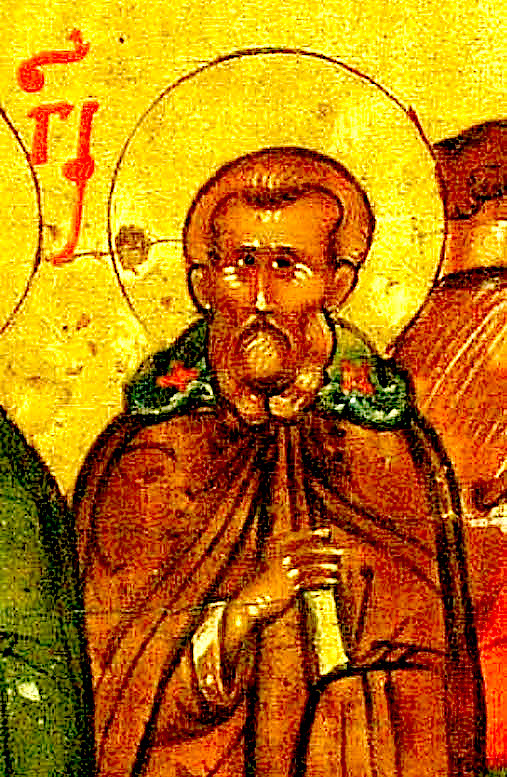
Stephen is written as a monastic elder of the Palestinian desert: bearded, in the brown or dark monastic mantle over the tunic, sometimes cowled, holding an unrolled or furled scroll — the sign of the ascetic teacher — and blessing with the free hand. He has no distinctive attribute of his own; where a scene is given him it is the desert cell, and in Russian menaion tablets he stands among the July saints between Thomas of Malea and the martyrs of Nicopolis. He is not depicted with a codex or with hymn-books, which belong to the iconography of the hymnographers of his monastery, and his uncle John of Damascus is distinguished from him by the turban that Byzantine art gives the Damascene.
The stored image is a detail from a seventeenth-century Russian menaion tablet for the month of July (c. 1650), now in the Church-Archaeological Cabinet of the Moscow Theological Academy: the saint in half-length, a spare grey-brown ascetic face, in the brown mantle with a green-lined collar, holding a scroll. The Commons file description identifies the figure expressly as "Stephen the Sabaite, nephew of St John of Damascus" — that is, this saint and not the October hymnographer — and the numbering in the file title is the sequence of the crop within the tablet, not a calendar day; the surrounding crops from the same tablet run Thomas of Malea (July 7), Theodore of Edessa (July 9), the martyrs of Nicopolis (July 10), Stephen (July 13). The underlying panel is of the seventeenth century and long out of copyright.
Disputed questions
- Two Stephens of Mar Sabbas. The Lavra gave the calendar two saints of this name: the present Stephen the Wonderworker, nephew of John of Damascus, kept on July 13; and Stephen the Hymnographer, the composer of Triodion idiomela, kept on October 28. Whether they are one man or two is an old and unresolved question. A great deal of scholarship identifies the hymnographer with the †794 nephew, on the reasoning that the Lavra is unlikely to have produced two celebrated Stephens within a century; the Orthodox Church in America, following the received calendars, states plainly that the October 28 Stephen is not the same as the saint of July 13. This entry follows the calendars in keeping them apart, since the two commemorations exist and have distinct notices, while recording that the identification is seriously argued. The two entries carry reciprocal notes. Flagged for verification.
- "Art thou weary, art thou languid." The English hymn of that name, and several others of the same group, were printed by John Mason Neale in the nineteenth century as translations from "St Stephen the Sabaite." Neale himself later admitted that the Greek originals were his own free construction rather than translation, and no Greek text corresponding to these hymns has been found. They should not be cited as compositions of this saint, in either identification.
- Not to be confused with Stephen the New (†764, November 28), the monastic martyr of Mount Auxentius killed under Constantine V; with Stephen the Wonderworker, abbot of Triglia (ninth century, March 28), whose epithet is identical; or with Stephen the Protomartyr.