
Thais of Alexandria
The Blessed Thais of Alexandria, the penitent
Venerable · d. 5th century, in the desert of Scetis
Commemorated 10 May — Memory of the blessed penitent, who died on the night of her conversion
Thais — Taisia in the Slavonic books — was a well-born Egyptian girl left an orphan with a fortune, who spent the whole of it turning her house into a hospice for the monks of Scetis; and when her money was gone and the guests no longer came, she was left destitute, fell into bad company, and became a prostitute. The fathers of the desert sent John the Dwarf (Kolobos) to her. He sat down in her house and wept, and when she asked why, said, "I see Satan playing in your face." She asked whether there was repentance for her; and at his one word she rose and walked out into the desert without even stopping to set her house in order. That night, on a bed of sand which the old man had marked with the sign of the cross, she died — and John saw a shining road let down from heaven and the angels carrying up her soul, and was told that one hour of her repentance, made with the whole heart, had been accepted above the long penance of others. Her memory is kept on May 10.
_-_%D0%B8%D0%BA%D0%BE%D0%BD%D0%B0_09103_%D0%A2%D0%B0%D0%B8%D1%81%D0%B8%D1%8F.png)
The house open to the monks
The story is one of the shortest and best-known pieces of the desert literature, and it turns entirely on a reversal. Thais was the daughter of pious and wealthy parents, and their death left her a young woman alone with a great inheritance. She used it, as the account insists, well: she made her house a xenodocheion — a lodging and hospice — for the monks of Scetis who had business in the settled country, and she kept them, fed them and sheltered them for years, at her own charge, until the money was spent.
Then the ordinary logic of poverty took hold. Having beggared herself in charity she had nothing left to live on; and — this is the point the fathers who transmitted the tale meant to be heard — the monks whose hospitality she had paid for did not maintain her. Her house emptied. Bad company gathered where the monks had been, and Thais, without means and without counsel, fell first into sin and then into the trade of it, and became a notorious harlot of the city.
John the Dwarf
Word of it came at last to Scetis, and the elders were ashamed. They sent for Abba John called Kolobos, "the Dwarf" — one of the great fathers of the desert, disciple of Ammoes and famous for the dry stick he watered for three years until it bloomed — and asked him to go down and see whether anything could be done, for the woman had been their benefactress.
He came to her house and asked to see her. She received him and sat down with him; and the old man, looking at her, wept. She asked him why he was weeping. "I see Satan playing in your face," he said, "how should I not weep?" And she said: "Abba, is there repentance?" He said, "Yes." Then she said, "Take me where you will." She asked only that he wait a moment — and he, thinking she wished to arrange her affairs, was answered: "Why should I put my house in order? Let it be as it is." And she got up and went out with him into the desert, taking nothing.
One hour of repentance
They walked until evening, and when night came Abba John heaped up a little pillow of sand for her, made the sign of the cross over it, and told her to sleep there; and he made another for himself a short way off and lay down. In the middle of the night he awoke and saw a shining road let down from heaven above the place where she lay, and the angels of God bearing up her soul. He rose and went to her and found her dead.
He fell on his face in prayer, and heard that one hour of her repentance had been received more than the repentance of many who continue long in it and never show such fervour of heart. The whole point of the story is compressed into that sentence, and it is why the Church keeps her: not for years of asceticism, of which she had none, but for the completeness of a single turning. She never reached a monastery, never wore the habit, never made a rule; she died on the first night of the road.
Feast and commemoration
May 10 (church date; New Calendar civil May 10, Old Calendar civil May 23). The commemoration is Slavic in the main: the Russian books, following Saint Dimitry of Rostov's Lives of the Saints, keep "the blessed Taisia of Egypt" on this day, and the Orthodox Church in America carries her; the Greek synaxaristes of May 10 does not list her, its day being filled by Simon the Zealot, the martyrs of Lentini, Hesychius and the venerable Laurence. She is kept immediately after Isidora of Tabenna in the Russian notice of the day, and the two engraved plates of the May volume stand side by side, which is one reason the two Egyptian women of the day are so often run together in later retellings. No proper service is transmitted for her anywhere; where her memory is kept liturgically it is served from the common of a venerable woman.
Hymns
Troparion — Tone 8 (common of a venerable woman)
In thee, O Mother, was the divine image kept secure; for taking up thy cross thou didst follow Christ, and by thy deeds thou didst teach us to despise the flesh, for it passeth away, but to care for the soul, a thing immortal. Therefore doth thy spirit, O blessed Thais, rejoice together with the angels.
Original translation from the Slavonic
Iconography
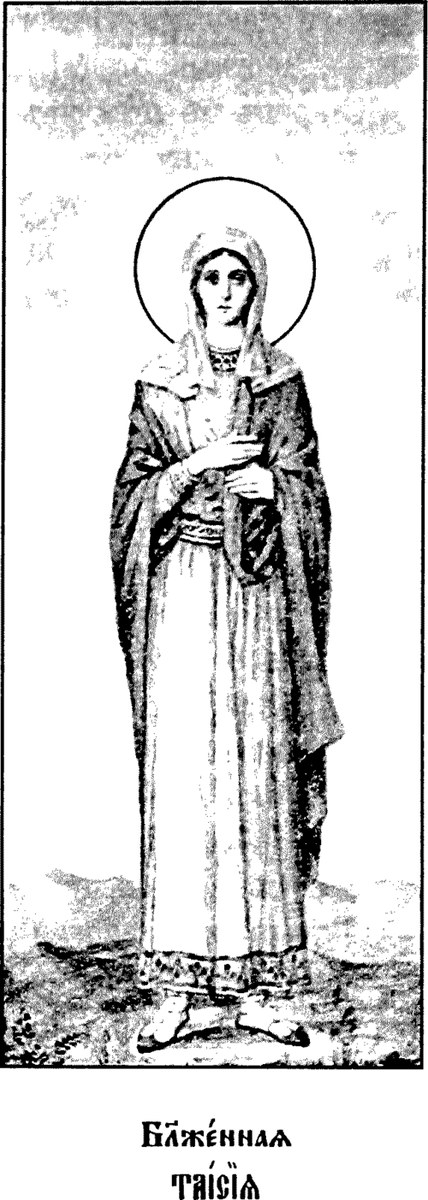
Thais is painted as a penitent of the desert rather than as a nun: she wears no habit in the story, and the engravers therefore give her the plain long tunic and dark mantle of a laywoman, the head covered, the hands crossed at the breast or held in prayer. She has no attribute of her own. The narrative subject proper to her is unusual and striking, and is occasionally attempted in Russian book illustration: the desert at night, the woman lying on the heaped sand with the cross traced over it, and the shining road let down from heaven with angels bearing up her soul while the little old man kneels beside her — the only scene in the calendar in which a saint's whole ascetic life and her repose occupy a single night.
The stored image is an engraved plate from the illustrated Moscow Lives of the Saints (Zhitiya Svyatykh after Dimitry of Rostov, 1903–1911), belonging to the May 10 notice and inscribed in Church Slavonic Блаженная Таисіа, "the Blessed Taisia": she stands full-length, veiled, in a long girded tunic with a mantle over the shoulders and the hands folded at the breast.
Disputed questions
- Which Thais? The calendar keeps two penitents of this name, and they are constantly confused. The other is Taisia of Egypt, commemorated October 8 with Pelagia: a celebrated courtesan converted by abba Paphnutius, who burned her goods in the street, was enclosed for three years and died in a monastery. This Thais is a different woman with a different plot: her fall follows her charity rather than preceding her conversion, her rescuer is John the Dwarf, and she dies within hours of repenting. The pre-revolutionary Russian collections already distinguish them explicitly — "the second Taisia, not the harlot" — and Saint Dimitry of Rostov's Lives prints this one at May 10. No source known to this collection merges them, and they are kept as two entries here.
- Alexandria. The earliest form of the story does not name her city; the Slavonic and Russian retellings place her at Alexandria, which is the natural reading of a wealthy Egyptian household in contact with Scetis, and is the ground of the epithet used in this entry. The desert is Scetis in every version.
- Her century. The Russian calendars and the Orthodox Church in America give the fifth century, which agrees with the floruit of John the Dwarf (d. c. 405–409) only if she is placed at the very beginning of it; some accounts accordingly put her in the late fourth. The date is a function of the elder's, not of any independent record.
- "Blessed" or "venerable"? Both the Greek and the Slavonic style her blessed (блаженная), and the engraved plate stored with this entry is inscribed so. This corpus has no blessed classification: she is indexed as venerable, the type used for the ascetic women of the desert, and the liturgical style is preserved in official_name.
- The witness of the sources. The account belongs to the Apophthegmata Patrum and the Latin Vitae Patrum rather than to any dated chronicle, and modern hagiography reads it as a didactic tale of the Scetiote tradition. It is given here as the tradition delivers it.