
Isidora of Tabenna
Our Venerable Mother Isidora, the Fool-for-Christ of Tabennisi
Venerable · Fool for Christ · d. c. 365
Commemorated 1 May — Memory of the venerable fool-for-Christ, 10 May — Russian usage, following Dimitry of Rostov's Lives of the Saints
Isidora is the first fool-for-Christ whose story the Church records — a nun of the great Pachomian women's monastery at Tabennisi in the Egyptian Thebaid in the middle of the fourth century, who deliberately made herself despised. She wore a rag on her head instead of the monastic cowl, never sat at table but lived on the crumbs and the scourings of the pots, served four hundred sisters who mocked, struck and drenched her, and never in all those years spoke an idle or a resentful word. Her secret was disclosed by an angel to the hermit Piteroum, who was sent to the monastery to find "one wearing a crown upon her head" and holier than himself; and when the honour of the community turned upon her, she slipped away and was never found again. Her account, written by Palladius within living memory, is the foundation-text of the whole tradition of holy folly.
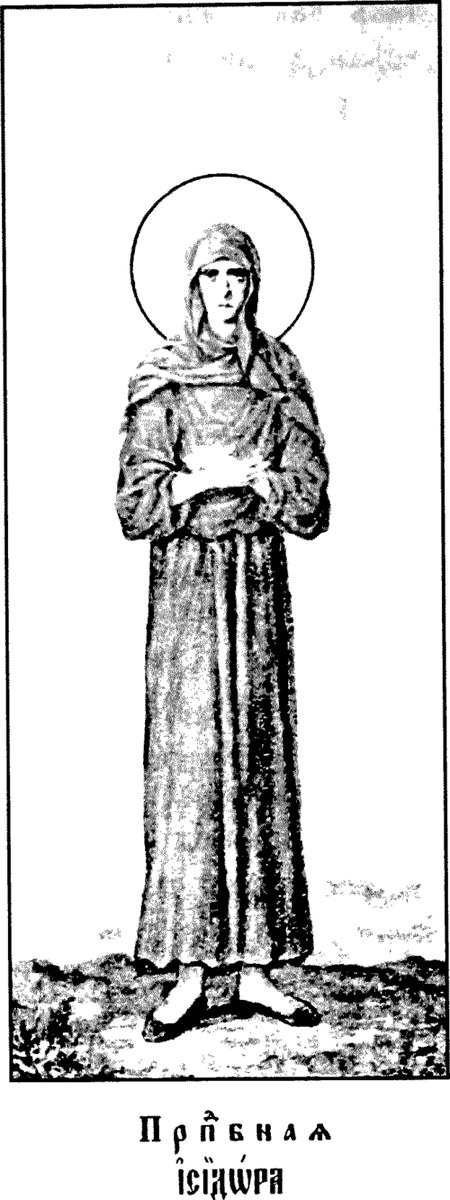
_-_%D0%B8%D0%BA%D0%BE%D0%BD%D0%B0_09102_%D0%98%D1%81%D0%B8%D0%B4%D0%BE%D1%80%D0%B0.png)
The monastery at Tabennisi
Tabennisi (Tabenna, Tabennēsis) on the Nile in the Upper Thebaid was the mother-house of the Pachomian koinonia, and beside the men's community Saint Pachomius had established, under his sister Mary, a monastery of women, which by the middle of the fourth century numbered some four hundred. It was a large, well-ordered and busy house: a common table, common work in wool and linen, appointed hours, a portress, and a priest who came from the men's monastery to serve the Liturgy and to hear confessions.
In this crowd of sisters one — the ancient account gives her no name, and later tradition calls her Isidora — chose a way of hiddenness so complete that it looked like disgrace. She adopted the appearance of a woman out of her mind: instead of the koukoulion of the habit she bound a common rag about her head; she was never seen to sit down, but stood or worked; she never sat at the common table nor tasted a piece of the bread set out, but lived on the crumbs swept from the tables and on what she could scrape from the pots and pans she scoured. She took upon herself the meanest labour of the house, the kitchen and the sponging of vessels, and — as Palladius says with careful precision — she was the servant of the whole monastery, and was "as it were the sponge of the monastery."
Reviled by four hundred
Because she seemed a fool, the sisters treated her as one. They despised her, they would not eat with her, they abused her; they beat her, cuffed her, mocked her, poured slops and dishwater over her, threw mustard on her face and blows on her body. Palladius records that in all this she was never seen to be angry, never answered back, never complained to anyone, never spoke a needless word, and never took offence. She had made her whole life a single uninterrupted act of prayer beneath a disguise of imbecility; the reviling she received was what she had asked God for, and she did nothing to lift it. This is the exact pattern that the later fools-for-Christ of Byzantium and Russia — Symeon of Emesa, Andrew of Constantinople, Basil of Moscow, Xenia of Petersburg — would follow, and Isidora precedes them all.
The angel and the hermit Piteroum
The disclosure came from outside. Piteroum, an ascetic of great reputation living at Porphyrites in the eastern desert, had begun to think well of himself. An angel of the Lord appeared to him and said: why do you pride yourself on your holiness? Go down to the women's monastery at Tabennisi, and there you will find one who wears a crown upon her head — she is better than you. For, said the angel, though she is jostled by so great a crowd and serves them all, she has never for one hour taken her heart from God; while you sit here in the desert, and your mind wanders through the cities.
Piteroum came to Tabennisi and asked, as a visitor of standing, that all the sisters be brought before him. He looked at them and did not find her. "There is one more," they said, "but she is a salē — she is out of her wits — and she is in the kitchen." (They used, says Palladius, the word for those whom the Egyptians called saloi, the demented.) He asked them to fetch her; she would not come, and they dragged her in. Piteroum saw the rag bound round her head and, before them all, fell down at her feet and asked her blessing. She fell at his in turn, and said, "Bless me, father." The sisters cried out that he was being mocked by a fool. "You are the fools," he answered, "for this woman is amma — mother — to both you and me; and I pray only to be found as worthy as she is in the day of judgment."
At that the sisters fell down weeping and confessed what each had done to her: one had poured the washing-water over her, one had struck her, one had smeared her face, one had emptied the slops on her. Piteroum prayed for them and went away.
Flight and hidden repose
The rest is short. Within a few days Isidora could not bear the reverence and the apologies of the house — "unable to endure the honour and esteem of the sisters, and burdened by their apologies," Palladius says — and she left the monastery secretly. Where she went, or where she hid herself, or how she died, no one ever learned. The tradition assigns her repose to about the year 365.
That the account ends in an unsolved disappearance is not a defect of the record but the point of the life: she had spent herself entirely to remain unknown, and she was granted it. The Church's calendars have honoured a woman whose name they are not even sure of, and whose grave no one has ever seen.
Feast and commemoration
May 1 (church date; New Calendar civil May 1, Old Calendar civil May 14) in Greek usage and on the American calendar; May 10 in the Russian books (see Disputed questions). No proper service is transmitted anywhere; where her memory is kept liturgically it is served from the common of a venerable woman. She is invoked as the patroness of those who bear contempt, and in modern Orthodox writing she stands at the head of every treatment of holy folly as an ascetic vocation.
Hymns
Troparion — Tone 8 (common of a venerable woman)
In thee, O Mother, was the divine image kept secure; for taking up thy cross thou didst follow Christ, and by thy deeds thou didst teach us to despise the flesh, for it passeth away, but to care for the soul, a thing immortal. Therefore doth thy spirit, O venerable Isidora, rejoice together with the angels.
Original translation from the Greek
Iconography
Isidora has no ancient iconographic type of her own; she is painted, when at all, as a nun of the Egyptian desert in a plain dark tunic and mantle, thin-faced and bare-footed, and her one distinguishing attribute is the rag or cloth bound about her head in place of the monastic cowl — the mark by which Piteroum knew her, and which the angel called her crown. Some modern Greek and Russian icons show her with the scouring cloth or a broken vessel, or in the scene of the elder Piteroum bowing before her while the sisters look on in astonishment; the narrative composition is rare. Because the calendars sometimes call her "the Simple," she is occasionally given the vacant, inward expression that Byzantine painters used for the saloi, though the more usual choice is the ordinary sober face of a venerable mother.
The stored image is an engraved plate from the illustrated Moscow Lives of the Saints (Zhitiya Svyatykh, 1903–1911, May volume), inscribed in Church Slavonic "Venerable Isidora": the nun stands full-length with hands folded at her breast, in a coarse mantle drawn over her head — the rag of the story rendered as a monastic veil.
Disputed questions
- Her name. Palladius, our only early witness, does not name her; she is "a certain virgin" of the Tabennisiote house. The name Isidora enters with the later Greek and Coptic synaxaria and is universal in the Byzantine and Slavic calendars, which is why the Church keeps her under it. Some Latin martyrologies keep her simply as "the holy fool of Tabenna."
- Her feast day. The Greek synaxaria and the Orthodox Church in America keep her on May 1; the Russian tradition following Saint Dimitry of Rostov's Lives of the Saints places her on May 10, and the engraved plate stored here belongs to the May 10 notice of that collection. Both dates refer to the same nun, and there is no second Isidora of Tabennisi. Some Greek sources also give May 10.
- "Martyr Isidora." The OCA calendar entry for May 1 styles her Martyr Isidora and supplies no life; this is a scribal misclassification of the venerable fool, not a distinct martyr, and no passion of any Isidora is attached to this day.
- Not to be confused with Isidore of Pelusium or the other male saints of that name — in particular Isidore of Chios, the sailor-martyr (May 14), and Isidore of Rostov, the fool-for-Christ (†1474, also May 14), with whom she shares her manner of life but not her identity — nor with the later Egyptian nun Taisia (Thais) of the same collection of lives, whose story Dimitry of Rostov prints beside hers.