
Theodore of Constantinople
Our Father among the Saints Theodore I, Archbishop of Constantinople
Patriarch · Bishop · d. c. 686/687
Commemorated 27 December — Repose; within the afterfeast of the Nativity
Theodore I (†c. 686/687) was Archbishop and Ecumenical Patriarch of Constantinople in the difficult decade after the Sixth Ecumenical Council. A native of the imperial city, he served as a priest of Hagia Sophia and keeper of its sacred vessels before being raised to the patriarchal throne about the year 676. Deposed after some two years through slander and the pressure of the court, he bore his removal in patience; vindicated, he was restored to the throne in 683 and guided the Church of Constantinople to the end of his life, dying in peace about 686. He is kept on December 27, within the afterfeast of the Nativity.
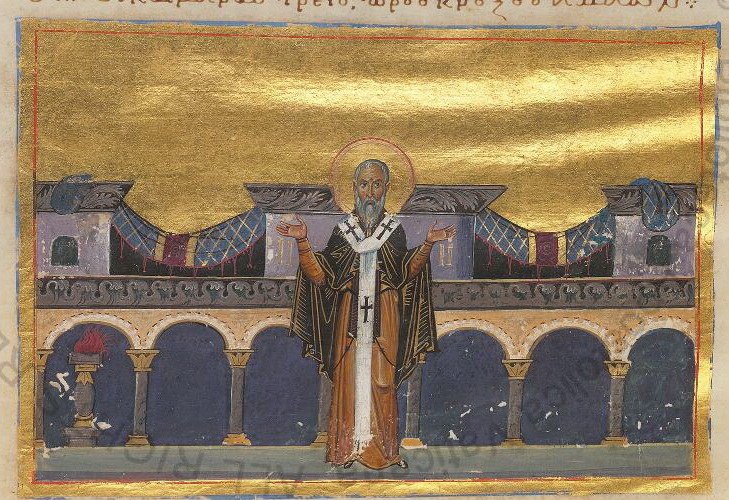

Theodore was a Constantinopolitan by birth and was formed in the clergy of the Great Church, Hagia Sophia, where he rose to be skeuophylax — the priest charged with the keeping of the sacred vessels and treasures of the cathedral, a office of trust close to the patriarch. About the year 676 he was chosen Patriarch of Constantinople. His tenure fell in the turbulent aftermath of the Monothelite controversy, in the very years framing the Sixth Ecumenical Council (Constantinople III, 680–681), which condemned the doctrine of a single will in Christ and restored communion between the imperial city and Rome — a period in which the patriarchal throne changed hands more than once amid the settling of the peace.
After about two years Theodore was deposed, the Byzantine tradition says through slander; his see was given to another, and he endured his removal without protest. In time the truth prevailed, and in 683 he was restored to the patriarchate, which he then governed, the synaxarion says, "to the very end of his life," dying in peace about 686. The Church honours him as a hierarch who kept the faith and bore injustice with meekness.
Feast and commemoration
Theodore is kept on December 27 (church date; Old Calendar civil January 9), within the afterfeast of the Nativity, his memory joined to that of the Protomartyr Stephen who leads the day and of Theodore the Branded. His is a synaxarion commemoration, without a proper service of its own in the received books; the day's office is that of the Protomartyr and the afterfeast.
Hymns
Troparion — Tone 4
O God of our fathers, who dealest ever with us according to thy gentleness, take not thy mercy from us, but by the prayers of thy hierarch Theodore direct our life in peace.
Original translation from the Greek
Iconography
Theodore is depicted, in the settled manner of a Byzantine patriarch, as an aged bishop with a full grey beard, vested in the cross-figured polystavrion and the omophorion, holding the Gospel-book and blessing — the type of the hierarchs of the Great Church. The stored image is the miniature of the Menologion of Basil II (Constantinople, 985), which gives him exactly this type: the patriarch stands orans before the porticoes of the Great Church, grey-bearded, in phelonion and omophorion, the manuscript's caption naming him above the frame.
Disputed questions
- The chronology, and the reason for the deposition. The Byzantine synaxarion and the Slavic Lives ascribe Theodore's removal simply to slander; some Western and modern accounts, disentangling the tangled patriarchal fasti of these years, connect his depositions and restoration with the ecclesiastical politics of the Monothelite settlement and communion with Rome, and give his final restoration in 686 with death about 687. The precise sequence of the Constantinopolitan patriarchs of 677–686 is variously reconstructed; the calendars keep his memory on December 27 and reckon his repose about 686.
- Not to be confused with the many other Theodores of the calendar, including the two commemorated on this same day — Theodore the Branded (Graptos, †c. 840/841), the Palestinian monk-confessor of the second iconoclasm, and Theodore the Studite (†826) — nor with the popes and later patriarchs of the same name.