
Theodore the Branded
Our Venerable Father and Confessor Theodore the Branded (Graptos), Monk of the Lavra of Saint Sabbas
Venerable · Confessor · Priest · b. c. 775 — d. c. 840/841, at Apamea in Bithynia
Commemorated 27 December — Repose in prison; within the afterfeast of the Nativity
Theodore the Branded (Graptos, c. 775 – c. 840/841) was a Palestinian monk of the Lavra of Saint Sabbas, priest, hymnographer, and confessor of the holy icons under the second iconoclasm, and the elder of the two brothers surnamed Graptoi, "the Written-upon." With his brother Theophanes he was sent by the Patriarch of Jerusalem to Constantinople to contend for the veneration of images, and under three iconoclast emperors — Leo V, Michael II, and above all Theophilus — endured interrogation, imprisonment, and exile. In 836 Theophilus had twelve mocking iambic verses cut and burned with hot irons into the brothers' faces, whence their name; to the emperor they answered, "Write what you wish; at the Last Judgment you shall read your own writing." Theodore, the elder, did not live to see the icons restored: he died of his sufferings in prison at Apamea in Bithynia about the year 840. His brother, who survived to become Metropolitan of Nicaea, gathered his relics and composed a canon in his memory. He is kept on December 27, within the afterfeast of the Nativity.

Origins and formation at the Lavra
Theodore was born about 775 in Palestine, under the caliphate, the elder of two sons of the devout presbyter Jonah the Sabbaite (commemorated September 21), who after the death of his wife ended his own days as a monk of the Great Lavra of Saint Sabbas in the Judaean desert. Both boys were given young to that Lavra, received there an excellent education — the sources single out their grounding in philosophy — and were tonsured; Theodore was in time ordained to the priesthood. Their formation was guided by Michael the Synkellos of Jerusalem, the scholar-monk with whom the whole of their confessing career would be bound up, and it was steeped in the theology of the icon that the desert school of John of Damascus and Cosmas the Melodist had bequeathed to the Church of Jerusalem.
Mission to Constantinople and the long confession
When Leo V the Armenian (813–820) renewed the iconoclast persecution in the empire, the Patriarch of Jerusalem sent Michael the Synkellos with the two brothers to Constantinople to plead the cause of the holy icons. There Theodore and Theophanes denounced the emperor's heresy to his face, and the pattern of the next quarter-century was set: under Leo V, and again under Michael II (820–829), the brothers endured interrogation, hunger, prison, and banishment, returning to the confession each time the throne changed hands. Theodore, as the elder and a priest, spoke for the two, and the hagiographic dossier — the Life of Michael the Synkellos and the Life of Theodore Graptos — preserves the disputations in which he answered the iconoclast bishops from Scripture and the Fathers.
The branding
The cruelest invention was reserved for Theophilus (829–842). In 836, after a final refusal to communicate with the iconoclasts, the emperor ordered twelve iambic verses — lines composed to deride the brothers as vagabonds and vessels of superstition — to be cut and burned into the skin of their faces with heated irons. The work took two days. The verses, which the Synaxarion preserves, turned the brothers' pilgrimage to the Holy Places into an accusation: "When all men long to run to that City where the all-pure feet of God the Word once stood for the redemption of the world, these men appeared in that venerable place as wicked vessels of superstitious error… wherefore, branded in the face as malefactors, they are condemned and driven forth again." The brothers' recorded answer to Theophilus became one of the treasured sayings of the persecution: "Write what you wish; at the Last Judgment you shall read your own writing." From this disfigurement they are called Graptoi — "the Written-upon," "the Branded" — the only saints of the calendar surnamed from the text inscribed on their bodies.
Imprisonment and repose
After the branding the brothers were separated. Theodore was held in close imprisonment at Apamea in Bithynia, where, worn out by torture, hunger, and the privations of the cell, he died of his sufferings about the year 840 — some three years before the icons he had defended were restored. The year is given variously: the Orthodox Church in America and the Slavic tradition place his death about 833, the Greek synaxaristes about 840 or 841; the calendars keep his memory on December 27. He died a confessor, not — in the strict sense — a martyr, having survived his tortures for a season; yet the Church, seeing that he perished of them in prison, honours him among those who "suffered even unto blood" for the icons.
Relics and later cultus
When Orthodoxy was restored under the empress Theodora and the Patriarch Methodius (the Triumph of Orthodoxy, 843), Theodore's brother Theophanes — recalled from exile and made Metropolitan of Nicaea — gathered his relics, which were translated to Chalcedon, where miracles were reported at them, and composed a canon in memory of his brother, so that the elder Graptos is hymned in the very craft the two had learned together at the Lavra. The brothers are venerated together throughout the East: their father Jonah the Presbyter is kept on September 21, Theophanes on October 11, and Theodore on December 27 — a whole household on the calendar, and a whole household of the confession.
Feast and commemoration
Theodore is kept universally on December 27 (church date; Old Calendar civil January 9), the third day of the Nativity, within the afterfeast — his office in the Menaion sung together with the hymns of the afterfeast and with those of the Protomartyr Stephen, who leads the day. The Greek Menaion titles him "our venerable Father and Confessor Theodore the Graptos, own brother of Theophanes the Poet." He is also named and honoured with his brother on October 11, Theophanes' own feast, where the Greek books style Theophanes "brother of Saint Theodore the Graptos"; but Theodore's proper day is December 27. The Slavic calendars keep him on the same day as "Theodore the Inscribed, Confessor."
Hymns
Troparion — Tone 8
In thee, O Father, that which is according to the image was preserved with exactness; for taking up thy cross thou didst follow Christ, and by thy deeds thou hast taught us to despise the flesh, for it passeth away, but to care for the soul, a thing immortal. Wherefore thy spirit, O venerable Theodore, rejoiceth with the Angels.
Original translation from the Greek
Synaxarion
Theodore too has something great to boast of, as he departs from the earth: how great a thing — the branding upon his face!
Iconography
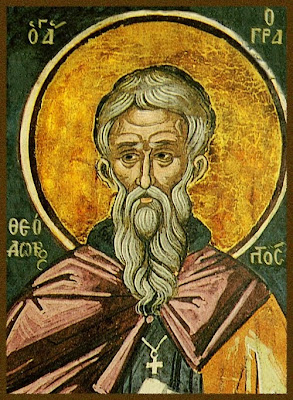
Theodore is depicted as an aged monk in the dark tunic and mantle of the great schema, with a long grey beard, holding a scroll or an icon of Christ — the badge of the iconodule confessor — and, in the more explicit images, with the marks of the branded verses shown upon his brow. The finest icons pair him with his brother, the two Graptoi standing side by side, each named by inscription and each bearing the scroll of his confession. The stored image is an Athonite fresco (14th–15th century) of Theodore alone, inscribed "the holy Theodore the Graptos" — the confessor as a grey-bearded monk against a gold ground, his face bearing the mark from which he is named.
Disputed questions
- Year of death. The OCA and Slavic calendars give c. 833; the Greek tradition c. 840/841. The later dating is the better attested and is followed above, with the range recorded.
- Confessor or martyr. Because Theodore died of the effects of his tortures while still imprisoned, some accounts style him martyr; the calendars class him a confessor (ὁμολογητής), the term used for those who suffered for the faith without a direct death sentence, and that classification is followed here.
- His brother. Theophanes the Branded, the younger Graptos, survived to become Metropolitan of Nicaea (†845, kept October 11); the two are perpetually named together, and the received Greek apolytikion for December 27 is in fact sung in Theophanes' name (see Hymnography).
- Not to be confused with Theodore the Studite (†826, kept November 11), the great abbot of the Stoudios and confessor of the same second iconoclasm — a distinct and more famous Theodore of the same age and cause; nor with the other Theodore of this very day, Theodore, Archbishop of Constantinople (†c. 686), a patriarch of an earlier century.